

Climate Disaster Deaths Are Down 97.5%. So Where Exactly Is The Climate Emergency?
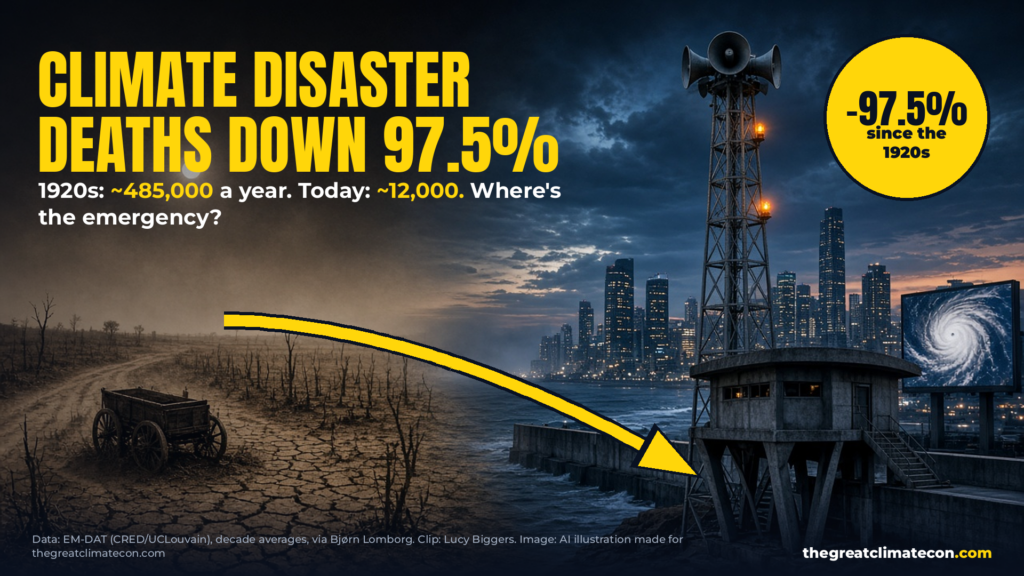
In the 1920s, floods, droughts, storms and wildfires killed around 485,000 people a year. Today it’s about 12,000, on a planet with more than four times as many people. Lucy Biggers asked the question the climate lobby can’t answer: if the climate is so deadly, why doesn’t it show up in the death toll?
Every heatwave, every flood and every storm now comes with the same line from the BBC and the activists: the climate is killing us, and it’s getting worse.
As usual, lies have been used to scare people and we need to bring some truth to the matter which also happens to be some good news.
No, it’s the the end of the world, and although we do have a lot of problems in our society we need to sort out, on the zclimate things are looking pretty good and we should be grateful for the times we are living in and pray they continue.
The data
Down 97.5% in a century
The chart in the clip is Bjørn Lomborg’s, built from EM-DAT, the International Disaster Database run by CRED at UCLouvain in Belgium. It is the standard global record of disasters, used by the UN, the World Bank and the IPCC itself.
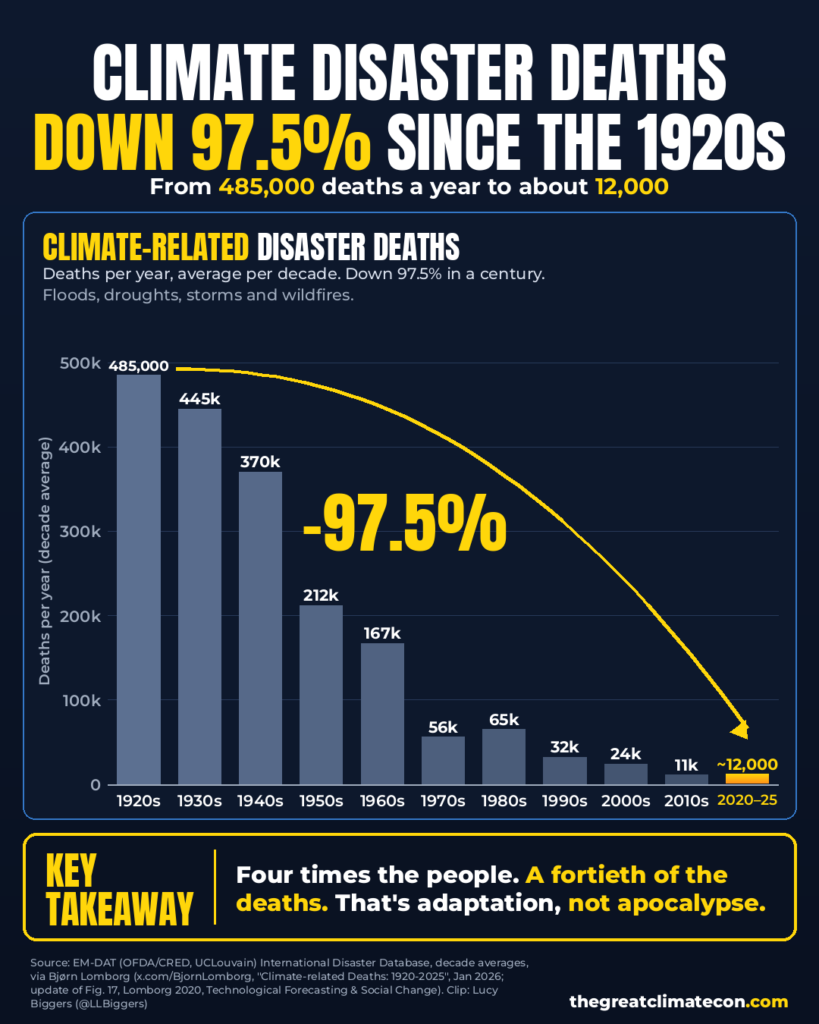
It counts deaths from climate-related disasters: droughts, floods, storms, wildfires and landslides. Averaged by decade:
- 1920s: about 485,000 deaths a year
- 1930s: about 446,000 a year
- 1960s: about 167,000 a year
- 1990s: about 32,000 a year
- 2010s: about 11,000 a year (10,973)
- 2020 to 2025: about 12,000 a year
That is a fall of 97.5% from the 1920s. Not a blip, not a cherry-picked year. A century-long collapse in the death toll from the very weather we are told is spiralling out of control.
Lomborg’s summary is blunt: “Richer, smarter, and more resilient societies reduce disaster deaths. This swamps any potential climate signal.” And as he asks: why is this not reported?
Your risk
Four times the people, a fraction of the deaths
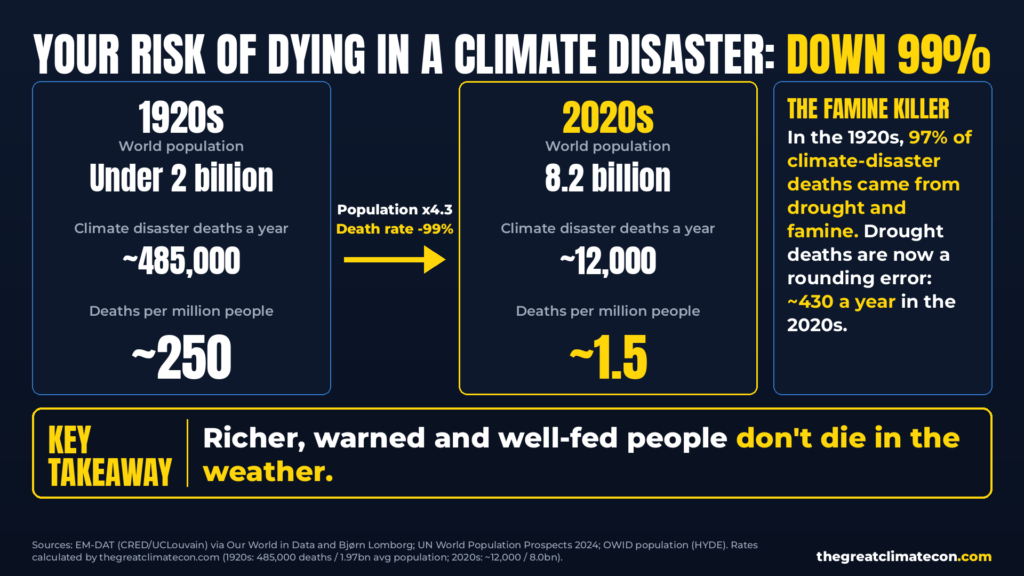
The raw totals actually undersell it. In 1920 the world had under 2 billion people. Today it has 8.2 billion, more than four times as many, and far more of them living on coasts, floodplains and in cities.
Run the rate:
- 1920s: about 485,000 deaths among roughly 2 billion people = about 250 deaths per million people a year
- 2020s: about 12,000 deaths among roughly 8 billion people = about 1.5 deaths per million people a year
Your personal risk of being killed by a climate-related disaster has fallen by more than 99% in a hundred years. If the climate were turning deadlier, this is the number where you would see it first. You don’t.
Drought and famine
The killer that disappeared: drought and famine
In the 1920s, around 97% of those climate-disaster deaths came from drought and the famines that followed. EM-DAT records roughly 472,000 drought deaths a year that decade. In the 2020s, the figure is around 430 a year.
Droughts didn’t stop happening. What changed is that people stopped starving because of them. Fertiliser, irrigation, high-yield crops, roads, trucks, global trade and money in people’s pockets mean a failed harvest in one region no longer becomes mass death. As we showed in Starvation Deaths Hit Record Low And Crop Yields Explode, the world is better fed than at any point in history. Every one of those gains runs on cheap, reliable energy.
Bangladesh
Same bay, same cyclones, almost nobody dead
If you want to see adaptation in one place, look at Bangladesh, a country the climate lobby holds up as its poster child for climate victims.
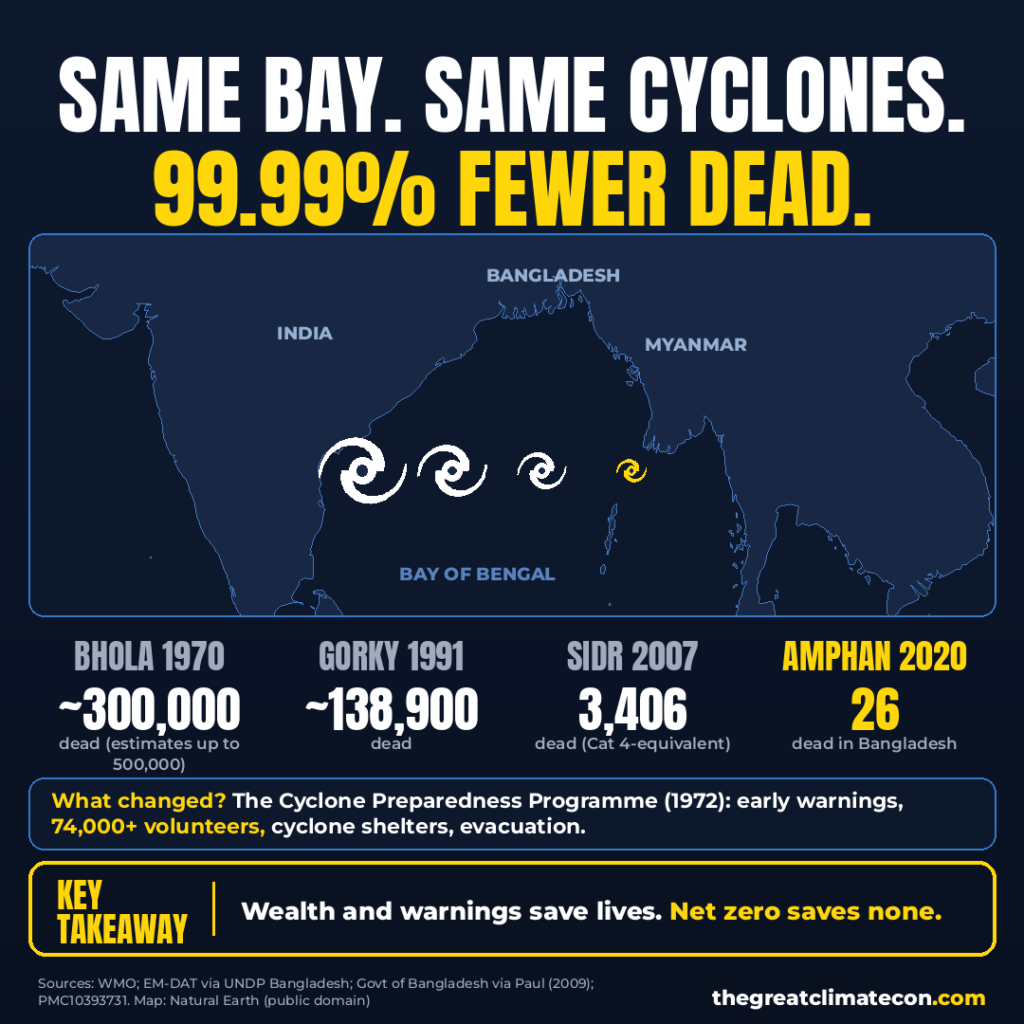
- 1970, the Bhola cyclone: around 300,000 dead, with estimates up to 500,000. The World Meteorological Organization calls it the deadliest tropical cyclone on record.
- 1991: around 138,900 dead.
- 2007, Cyclone Sidr, a top-end Category 4-equivalent storm: 3,406 dead.
- 2020, Cyclone Amphan: 26 dead in Bangladesh.
Same Bay of Bengal. Same storm surges. What changed is that after 1970 Bangladesh built the Cyclone Preparedness Programme: radio warnings, tens of thousands of trained volunteers with megaphones, concrete cyclone shelters and evacuation plans. And it got richer. Wealth and warnings did what no carbon tax ever could.
The IPCC
Even the IPCC can't find the signal
This isn’t just sceptics talking. The IPCC’s own Sixth Assessment Report (Working Group I, Chapter 12, Table 12.12) assesses whether a climate change signal has emerged in the observed record for each type of hazard. For river floods, hydrological drought, tropical cyclones and severe wind storms, it does not find one.
So the hazards haven’t shown the trend the headlines claim, and the death toll from them has collapsed. We’ve covered the weather side in detail in Is Weather Becoming More Extreme?
The objection
"But that's just better infrastructure"
That was the co-host’s objection, and it’s the one you’ll hear from every climate campaigner who sees this chart. It doesn’t rescue their argument. It destroys it.
Better infrastructure, early warnings, sea walls, air conditioning, cyclone shelters and global food supply chains are all products of wealth. Wealth is built on cheap, abundant energy, and for the last century that has overwhelmingly meant fossil fuels.
If adaptation has cut the death toll by 97.5% while the planet warmed, then adaptation works, and it works far better than anything net zero promises. The “climate emergency” is meant to justify making energy scarcer and dearer. That is the one policy guaranteed to make people poorer and less able to protect themselves when the weather turns.
As Biggers put it: we’ve out-adapted. So where’s the climate signal? It isn’t in the death toll. It’s in the press releases.
The bottom line
The bottom line
- Climate-related disaster deaths are down 97.5% since the 1920s: from about 485,000 a year to about 12,000 (EM-DAT, via Lomborg).
- The world has four times the people, so the individual risk has fallen by more than 99%.
- Drought and famine, once the great killer, have all but vanished from the toll.
- Bangladesh went from 300,000 dead in one cyclone to 26 in another.
- The IPCC's own Table 12.12 finds no emerged signal for floods, hydrological drought, tropical cyclones or severe wind storms.
The weather hasn’t become more lethal. We’ve become richer, better warned and better built. Net zero puts all of that at risk. For ten more claims that collapse on contact with the data, read Top 10 Climate Cultist Carbon Conspiracies Destroyed By Truth.
Credit: Chart and data analysis by Bjørn Lomborg, from EM-DAT, CRED / UCLouvain.
Sources
Sources
- Bjørn Lomborg, climate-related disaster deaths have declined 97.5%, January 2026 (opens in a new tab)
- Bjørn Lomborg, "Climate deaths declined 97+% over last century" (opens in a new tab)
- Our World in Data, decadal deaths from disasters by type (EM-DAT, CRED / UCLouvain, 2026) (opens in a new tab)
- Our World in Data, population growth (opens in a new tab)
- UN World Population Prospects 2024 (opens in a new tab)
- WMO, the world's deadliest tropical cyclone was 50 years ago (opens in a new tab)
- UNDP Bangladesh, Bangladesh needs to build back better (EM-DAT cyclone deaths) (opens in a new tab)
- Paul (2009), Hazard Warnings and Compliance with Evacuation Orders: Cyclone Sidr (opens in a new tab)
- ScienceDirect (2021), Bangladesh's Cyclone Preparedness Programme (opens in a new tab)
- PMC (2023), Cyclone Preparedness Programme volunteers, warnings and shelters (opens in a new tab)
- IPCC AR6 WGI, Chapter 12, Table 12.12 (opens in a new tab)
Source links open in a new tab.
Want to win the “climate emergency” argument every time? Unlock every lesson, book and course in The Climate Con Learning Centre. Join the membership or support the work.
Books, plus the free e-book Rich in Energy, Poor in Policy.
The Advanced Guide To The Climate Con
The Beginners Guide To The Climate Con
Continue Your Learning

Geoengineering On Your Taxes: Britain Is Paying To Refreeze The Arctic, To Save Ice That Was Meant To Be Gone By 2013
Geoengineering On Your Taxes: Britain Is Paying To Refreeze The Arctic, To Save Ice That Was Meant To Be Gone By 2013 https://thegreatclimatecon.com/wp-content/uploads/2026/11/ssstwitter.com_1795169072879.mp4 Real Ice
256 Labour MPs Voted Against Backing Rosebank. The Score Was 90 To 270. So We Just Import The Oil Instead?
On 18 November 2026 the House of Commons voted 90 to 270 against a motion calling on the government to commit to developing the Rosebank oil field as soon as practicable. 256 Labour MPs voted No. Rosebank is the UK’s largest known untapped oil field. Leave it in the ground and Britain still uses the oil. We just buy it from abroad.
314 Hectares Of Prime Farmland Saved As The 840MW Botley West Solar Farm Is Refused. Who Said We Can’t Win?
The government has refused the 840MW Botley West solar farm in Oxfordshire. That keeps 314 hectares of top-grade farmland growing food, protects the Green Belt around Blenheim Palace, and proves local people can push back and win.

36-Year High: They Said The Great Barrier Reef Was Dying. Then It Recorded The Most Coral Since Monitoring Began
In 2022 Australia’s official reef monitors recorded the most coral on the northern and central Great Barrier Reef in 36 years. Ten years earlier, the forecast was 5–10%.
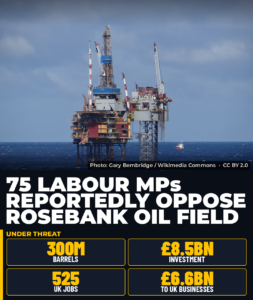
75 Labour MPs Reportedly Want 300 Million Barrels Of British Oil Left In The Ground. So We Just Import It Instead?
A reported 75 Labour MPs have signed a letter against Rosebank, around 300 million barrels of oil west of Shetland. Stop it and Britain loses £8.5bn of investment and 525 UK jobs, and still buys the oil, just from abroad.
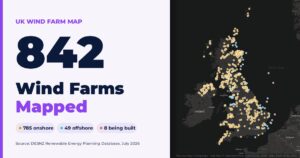
Wind Farm Map UK
Every operational UK wind farm on one map: 834 sites and 31,519 MW (31.5 GW) from the government’s DESNZ Renewable Energy Planning Database, July 2026 extract.
Track The Cost Of Net Zero
Stay ahead of the transition with real-time cost monitoring and optimization tools.
Access Cost Trackers →