
Geoengineering On Your Taxes: Britain Is Paying To Refreeze The Arctic, To Save Ice That Was Meant To Be Gone By 2013
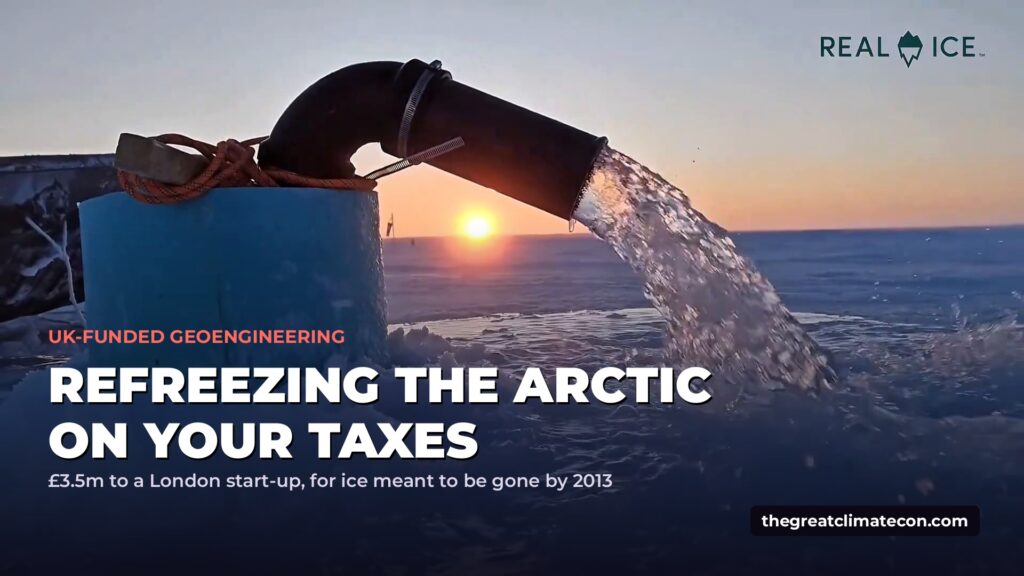
Real Ice pumping seawater onto sea ice at its test site in Cambridge Bay, Nunavut, Canada. Still from Real Ice footage, as shared by Ole Lehmann on X. Darkened and overlaid with text.
Let me start with the good news, because there is plenty of it. The Arctic sea ice is still there. It was there in 2013, when the BBC said summers would be ice-free. It was there in 2016, when one of Britain’s best-known ice professors said it would be gone. And this September, at its lowest point of the year, it still covered 4.60 million square kilometres.
A lot of you have asked me this week whether Britain has started modifying the weather. Here is the straight answer. Nobody is changing the weather over your house. But UK geoengineering is real. It is paid for with your money, it is run by an agency that answers to no voter, and its first big outdoor experiment is trying to fix a problem that the forecasts promised us years ago and that never arrived.
The viral clip
What went viral
On 19 November, Ole Lehmann posted a clip that has now passed 2.7 million views:
“a startup called Real Ice is literally trying to refreeze the Arctic … in winter, they drill through the ice and pump seawater up on top … their test patch came out about 50 cm thicker than the ice around it”
He added that “the Arctic is on track to lose almost all its summer ice as soon as the 2030s”, and that the company says thickening an area twice the size of California would cost about $5 to 6 billion a year. That cost is Real Ice’s own estimate, given to CNN in December 2024: “between $5 billion and $6 billion a year to thicken ice over 386,000 square miles”. By June 2026 the company was telling the Guardian that halting the summer shrinkage would cost “$10bn over the longer term”.
That warning should sound familiar. In 2007 the BBC told us Arctic summers would be ice-free by 2013, Al Gore said it could happen in as little as seven years, and in 2012 a Cambridge professor put the date at 2015 to 2016. Every one of those deadlines has come and gone, and this September the ice still averaged 4.81 million square kilometres, almost five times the 1 million mark scientists use for “ice-free”. We keep a running list of the best failed ice-free Arctic predictions.
The money
The British part
The pumping happens in Cambridge Bay, in Nunavut in the Canadian Arctic. The company doing it is British. Real Ice Development Company Ltd was incorporated on 27 January 2022 and is registered at 3 Coldbath Square in London.
And the money is British too. Real Ice received £3.5 million from ARIA, the Advanced Research and Invention Agency, a public body set up by Parliament in 2022 and funded by the taxpayer. The £3.5 million is part of a £9.9 million grant called Re-thickening Arctic Sea Ice, led by the Centre for Climate Repair at the University of Cambridge. A second company, Arctic Reflections, got £3.3 million to do the same thing at a second Canadian site.
The plan runs over three winters, 2026 to 2028, starting at 0.1 square kilometres and growing to as much as 1 square kilometre per site “if the communities are supportive”, ARIA says. In the first winter, the team pumped about 50,000 tonnes of seawater onto the ice, which by the start of the melt season was about 50 cm thicker, according to the Guardian.
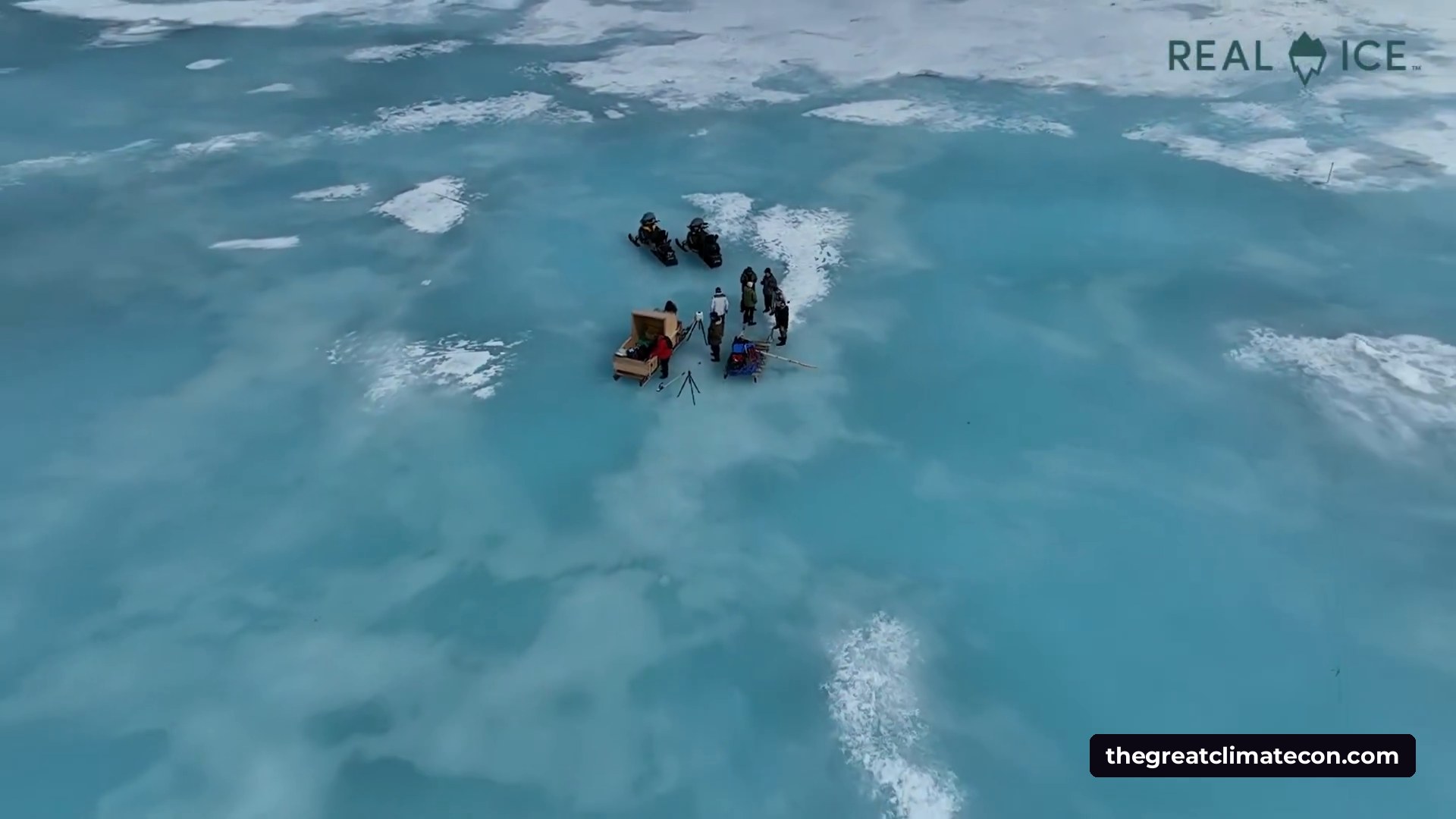
The flooded test patch from the air. Still from Real Ice footage, as shared by Ole Lehmann on X.
The programme
Yes, this is geoengineering, and Britain is funding a lot of it
Geoengineering means deliberately tinkering with the planet’s ice, weather and climate. The ice pumps are one piece of a much bigger ARIA programme called Exploring Climate Cooling: £56.8 million across 22 research teams. The government’s own summary says it covers stratospheric aerosol injection, marine cloud brightening and Arctic sea ice thickening. ARIA’s own Oversight Committee calls it “the largest disclosed public funding for climate cooling to date“.
It pays for five outdoor experiments. Up to three are planned for Britain, and ARIA says the sites have not been decided:
- Thickening Arctic ice, Canada (£9.9m). The Real Ice project. So far, the only one that has actually happened.
- Spraying seawater into the air to brighten clouds, UK (£6.1m). The REFLECT project, led by the University of Manchester. Outdoor tests “would not begin before 2028”.
- Electrically charging fog, UK (£2m). The University of Reading’s BrightSpark team has picked three possible UK sites and wants to start in winter 2027/28, charging a patch of fog “roughly the size of a tennis court”.
- Flying mineral dust into the stratosphere, UK or abroad (£5.5m). Milligrams of limestone, dolomite or corundum carried up in a sealed container and brought back down. ARIA says nothing is released.
- Brightening clouds over the Great Barrier Reef, Australia (£1m, possibly rising to £5m). A reef that, as it happens, has just recorded the most coral since monitoring began.
When we first covered this programme in April 2025, it was being reported at £50 million, with outdoor experiments said to be weeks away. The final budget is £56.8 million. Nineteen months on, none of the UK outdoor trials has started; the only experiment actually carried out is the one on the Canadian ice.
On top of that, the government lists £10.5 million from the Natural Environment Research Council for computer modelling, and a small slice of the Met Office Hadley Centre’s £21 million a year.
The sign-off
Who signed it off
Not Parliament. The Arctic experiments were approved by one man, ARIA’s then chief executive Ilan Gur, in a letter dated 18 December 2025:
“the ultimate decision on whether to release funding to support any given outdoor experiment rests with me as ARIA’s CEO … My decision is therefore to approve the release of funding for this set of experiments”
He was advised by an Oversight Committee that ARIA set up itself. That committee backed the experiment, but it was frank about where this could lead. In its recommendation of 9 December 2025 it wrote that the trial “is also potentially a first step in a larger evolution of scaling climate intervention”, and pointed out that Real Ice’s own mission is to “prove and scale new methods of restoring and preserving Arctic sea ice”.
When MPs debated a petition to ban geoengineering in June 2025, signed by more than 159,000 people, the minister, Kerry McCarthy, told them ARIA “has complete autonomy on its project choices … ARIA is responsible for its own choices.” The debate ended with the standard motion that the House “has considered” the petition. There was no vote on a ban. ARIA is also exempt from the Freedom of Information Act, an exemption Parliament agreed “to reduce the administrative burden on ARIA’s small team”. It does still answer environmental information requests, which is how some of the figures above came out.
The official line is that this is research only. The government says it “does not support the deployment of SRM and does not plan to do so. It does not undertake any form of deliberate weather modification.” The Met Office says it “does not undertake any practical or theoretical research into weather modification“. If you have read our piece on the backlash over ARIA’s sun-dimming plans, you will know why people are not simply taking that on trust.
The risks
What could go wrong
You do not have to take my word for the risks. The people who study this for a living have spelled them out.
Stopping is the danger. The Royal Society warned in November 2025 that if sun-dimming were ever used and then stopped abruptly, “global temperatures could increase by 1-2°C within a couple of decades. This phenomenon, known as the ‘termination effect’ would likely have severe impacts on ecosystems and populations unable to adapt quickly.” It also said it “could exacerbate rather than ameliorate some regional changes in climate, such as patterns of rainfall change“.
The weather does not do as it is told. The Met Office says its own computer modelling of geoengineering shows “potentially dangerous effects on regional and national climate, such as significant changes in rainfall patterns.” As the MP who opened the 2025 debate put it: “Our weather systems are immensely complex, interconnected and not well understood.”
The ice pumps do not scale. In September 2025, 42 polar scientists published an assessment in Frontiers in Science and called polar geoengineering “environmentally dangerous”. Their summary says “an estimated 10 million pumps would be needed to cover 10% of the Arctic Ocean”, at an estimated “$50 billion per year”, and that “the pumps would sink when the sea ice melts or breaks up, littering the seafloor with debris and causing widespread pollution”. Because sea ice drifts, the pumps would also cross national borders.
And the wildlife lives on top. The Guardian’s visit to the site noted that pumping seawater onto the ice “brings the salt up, as well as nutrients and microbes”, and that flooding the snow “could prevent polar bears and seals from digging dens for their cubs and pups”, though none use this particular test site. Even the project’s lead, Professor Shaun Fitzgerald, says: “Anything new has the potential for unintended consequences.”
The record
A fix for a problem that never arrived
Every one of these schemes is sold the same way: the ice is about to vanish, so we must act. We have heard that before. Many times.
- December 2007. The BBC ran the headline “Arctic summers ice-free ‘by 2013’“. Professor Wieslaw Maslowski told it “you can argue that may be our projection of 2013 is already too conservative.”
- December 2007. Accepting his Nobel Peace Prize, Al Gore said the summer ice “could be completely gone during summer in less than 22 years”, and that a new US Navy study “warns it could happen in as little as 7 years. Seven years from now.”
- December 2009. At the Copenhagen climate summit, Gore said there was “a 75 per cent chance that the entire polar ice cap during some of summer months could be completely ice free within five to seven years”. Maslowski himself replied: “It’s unclear to me how this figure was arrived at” (Telegraph).
- September 2012. Cambridge’s Professor Peter Wadhams told the Guardian: “This collapse, I predicted would occur in 2015-16 at which time the summer Arctic (August to September) would become ice-free.” In the same interview he called for “the various geoengineering ideas that have been put forward”. The failed forecast and the geoengineering pitch arrived together.
We have collected 20 of the best ice-free Arctic predictions and Al Gore’s 20 years of getting it wrong, if you want the full set. Here is how they compare with what the satellites actually measured.
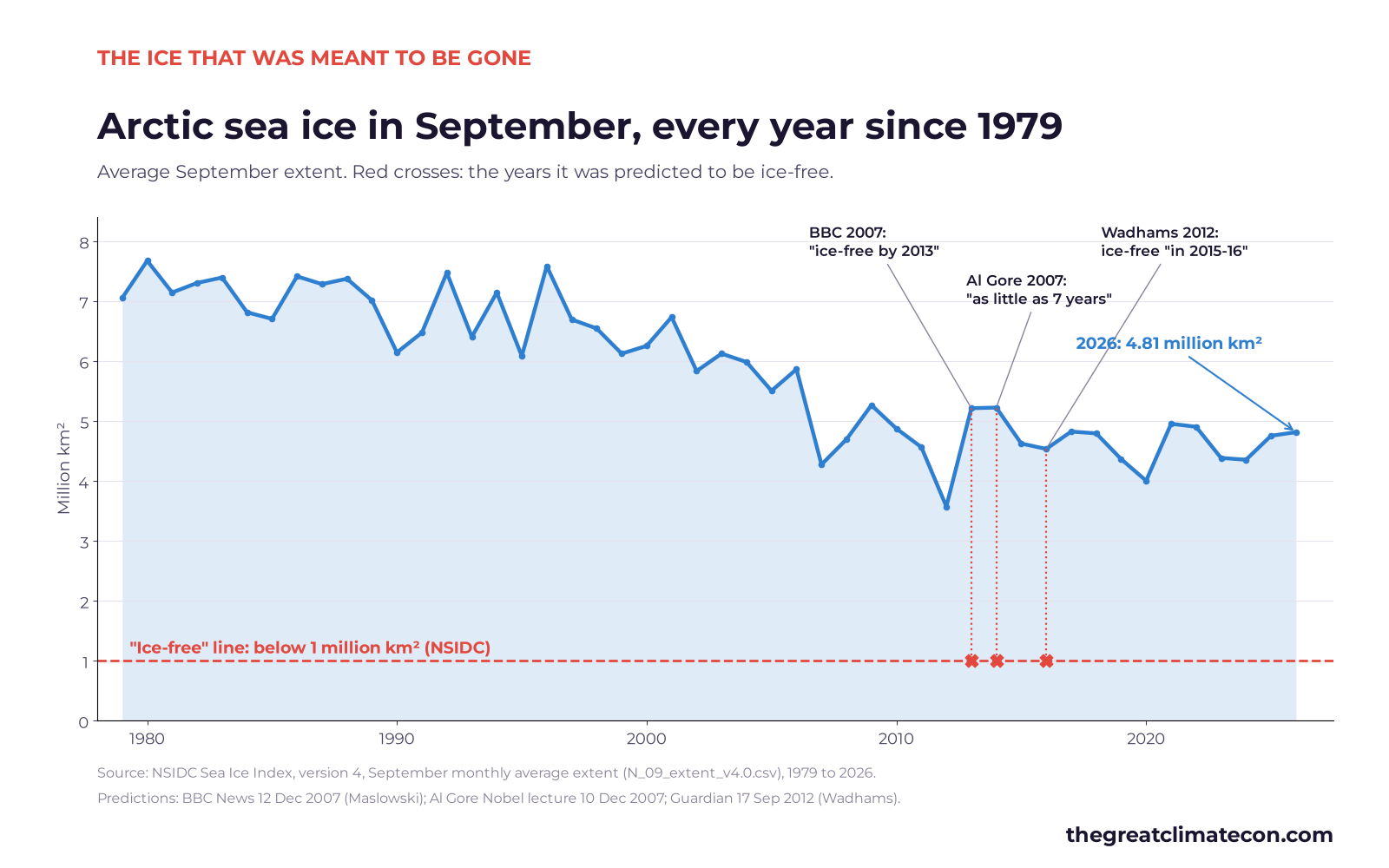
Chart: The Great Climate Con, from the NSIDC Sea Ice Index, version 4 (September average extent, 1979 to 2026).
Scientists call the Arctic “ice-free” when the ice falls below 1 million square kilometres. This September’s low of 4.60 million square kilometres was more than four and a half times that. The September average was 4.81 million, higher than in 2007, the year the “ice-free by 2013” forecasts were made, and well above the 2012 low of 3.57 million, which no year since has come near.
To be fair to the data, the NSIDC also notes that the last 20 years are the 20 lowest minimums since satellite records began in 1979. The ice is lower than it was in the 1980s. But the collapse we were promised never came. For almost two decades the summer ice has gone up and down within the same range. The polar bears, by the way, are doing very nicely too.
And remember what all of this is meant to counter. The CO₂ behind every one of these schemes is plant food, and the extra we have added has helped make the Earth measurably greener.
The bottom line
The bottom line
- Nobody is changing the weather over Britain, and the government says it does not.
- But UK geoengineering is real. ARIA is spending £56.8 million of public money on it, including £3.5 million for a London company to pump seawater onto Arctic ice in Canada.
- Up to three small outdoor geoengineering trials are planned in the UK: spraying seawater to brighten clouds, charging fog, and sending mineral samples into the stratosphere.
- The Arctic trial was approved by an agency chief, not by Parliament, and ARIA is exempt from Freedom of Information requests.
- Royal Society, Met Office and polar scientists have all warned of real risks, from the "termination effect" to pumps "littering the seafloor".
- The ice it is meant to save was forecast to be gone by 2013, 2014 and 2016. In September 2026 it still covered 4.60 million square kilometres.
So here is my message. You do not need to worry about the Arctic. It has been “about to disappear” for nearly 20 years and it is still there, doing what it has always done: shrinking each summer and growing back each winter. What deserves a closer look is the idea that unelected agencies and start-ups should start tinkering with the ice, the clouds and the sky, with your money, to fix a problem that keeps failing to turn up. The truth here is good news. We live in remarkable times, and we should be grateful for them, not frightened into experiments on the planet.
Want to win the Arctic argument every time? Unlock every lesson, book and course in The Climate Con Learning Centre. Join the membership or support the work.
Books, plus the free e-book Rich in Energy, Poor in Policy.
The Advanced Guide To The Climate Con

The Beginners Guide To The Climate Con
Continue Your Learning
- 20 Of The Best Ice Free Arctic Failed Predictions
- ARIA CEO Set To Step Down After Massive Public Backlash Over Sun Dimming
- 20 Years Of Getting It Wrong: Al Gore's Failed Predictions
- Polar Bear Levels Are At Record High Numbers
- £50m Geoengineering Experiment To Dim The Sun Set To Begin In A Few Weeks In The UK

Geoengineering On Your Taxes: Britain Is Paying To Refreeze The Arctic, To Save Ice That Was Meant To Be Gone By 2013
Geoengineering On Your Taxes: Britain Is Paying To Refreeze The Arctic, To Save Ice That Was Meant To Be Gone By 2013 https://thegreatclimatecon.com/wp-content/uploads/2026/11/ssstwitter.com_1795169072879.mp4 Real Ice
256 Labour MPs Voted Against Backing Rosebank. The Score Was 90 To 270. So We Just Import The Oil Instead?
On 18 November 2026 the House of Commons voted 90 to 270 against a motion calling on the government to commit to developing the Rosebank oil field as soon as practicable. 256 Labour MPs voted No. Rosebank is the UK’s largest known untapped oil field. Leave it in the ground and Britain still uses the oil. We just buy it from abroad.
314 Hectares Of Prime Farmland Saved As The 840MW Botley West Solar Farm Is Refused. Who Said We Can’t Win?
The government has refused the 840MW Botley West solar farm in Oxfordshire. That keeps 314 hectares of top-grade farmland growing food, protects the Green Belt around Blenheim Palace, and proves local people can push back and win.
Continue your learning at Thegreatclimatecon.com