
314 Hectares Of Prime Farmland Saved As The 840MW Botley West Solar Farm Is Refused. Who Said We Can't Win?

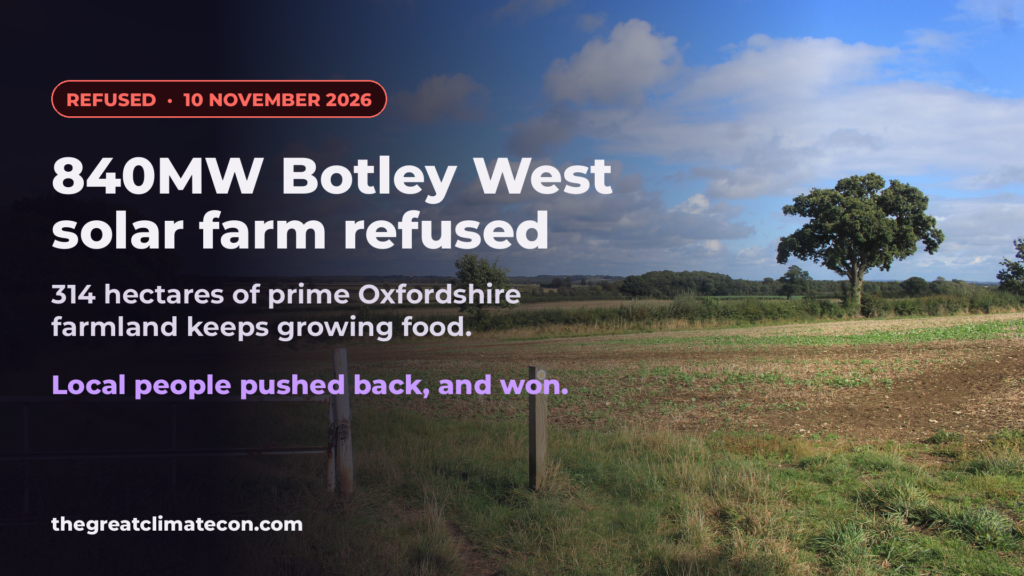
Photo: farmland at Bladon, Oxfordshire, near the Botley West site. Des Blenkinsopp, Geograph, CC BY-SA 2.0.

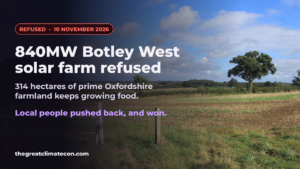
The government has refused the 840MW Botley West solar farm, which would have covered more than 3,000 acres of Oxfordshire countryside. That keeps 314 hectares of top-grade farmland growing food, and the local people who never gave up helped make it happen.

By Travis Cook, The Great Climate Con. Built on reporting by FarmingUK and the government’s decision letter.

I want to start with a thank you. To every farmer, villager, campaigner and councillor in Oxfordshire who wrote in, turned up and kept going for years: you did it.

We’re constantly told these mega projects can’t be stopped. That the targets come first, the countryside comes second, and ordinary people don’t get a say. This week proved that wrong.

On Tuesday 10 November 2026 the government refused consent for Botley West, an 840MW solar farm that would have spread across more than 3,000 acres of Oxfordshire countryside near Blenheim Palace. FarmingUK called it one of Britain’s largest renewable energy developments.

That’s good news. Really good news. And it’s proof that when people stand up for their land, their food and their communities, they can win.

The decision

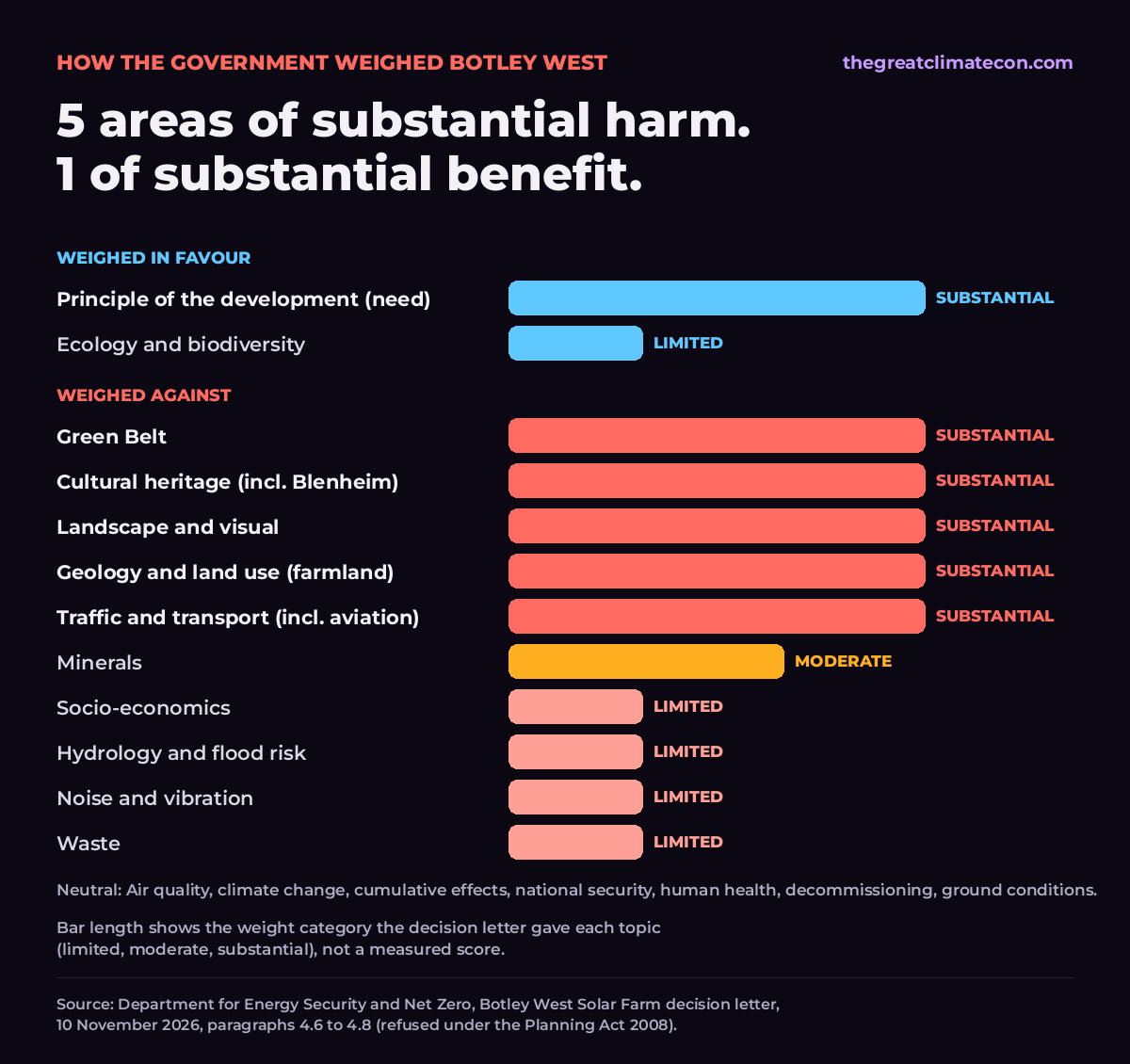
Refused, because the harm outweighed the benefits

Chart: The Great Climate Con, from the weightings in the Botley West decision letter, 10 November 2026, paragraphs 4.6 to 4.8.

The decision was made by energy minister Baroness Curran on behalf of the Secretary of State for Energy Security and Net Zero (decision letter). The independent Examining Authority that ran the examination had already recommended refusal, and the government agreed that the scheme’s harm would outweigh its benefits.

The decision letter doesn’t mince its words. It found “substantial harm to the Green Belt” and harm to heritage, “including assets of the highest significance (the Blenheim Palace World Heritage Site)”. It found “significant adverse effects” on the landscape, aviation impacts that “present an unacceptable risk to public safety”, and problems with the developer’s approach to assessing and restoring the best farmland.

One substantial benefit, the principle of building it, against five areas of substantial harm. And Botley West isn’t the only giant scheme out there. Find the solar farms near you on our Solar Farm Map.

By the numbers

Botley West, in four numbers

Here’s what was on the table, and what the people of Oxfordshire stopped.

Maximum capacity
0 MW
Hectares of top farmland
0 ha
Of the site in Green Belt
0 %
Representations made
0

Sources: Planning Inspectorate (840MW); decision letter, paragraphs 4.316, 4.103 and 4.1 (314 hectares, 69%, 1,115 Relevant Representations).

The farmland

314 hectares of food-growing land stays food-growing land

This is the part that matters most to me. According to the decision letter, the best and most versatile farmland made up 42% of the area to be covered in panels, mostly Grades 2 and 3a. That’s 314 hectares of good English farmland, 5.5 hectares of it to be lost for good under hardstanding for a National Grid substation.

The government said that land “would be sterilised for over 40 years, taking it out of arable food production”, and that the sheep grazing offered in its place “would not mitigate” that loss.

It called the developer’s explanation for choosing this site “unsatisfactory”. National policy prefers poorer quality land to be used, and FarmingUK reports the developer had not adequately shown why lower-quality land couldn’t be used instead. The developer hadn’t even clearly committed to restoring the soil to its original grade once the panels came off.

Farmland is for growing food. A country that can feed itself is a country that’s secure, and you don’t get that by covering good fields in panels for 40 years. Common sense won this one.

We’ve been making this case for a long time: Solar Farms Or Actual Farms: What’s More Important?

The people

1,115 representations, and the people were heard

None of this happened by accident. 1,115 Relevant Representations were made on the application (decision letter). The Stop Botley West campaign kept going through years of process, and when the news came through they told supporters: “Congratulations to everyone. SBW are so pleased that all the hard work has paid off.”

John Orme from Stop Botley West told the BBC the decision had “restored a bit of faith” in the planning process. Calum Miller, MP for Bicester and Woodstock, said “enormous credit belongs to the local campaigners and councils who worked tirelessly to make their case” (BBC).

The countryside charity CPRE welcomed the decision too. Its chief executive Roger Mortlock said: “The government has recognised that climate action need not mean sacrificing irreplaceable green fields” (FarmingUK).

That’s what hope looks like. Not a slogan. Ordinary people reading the documents, writing in, turning up and refusing to be steamrollered.

The same fight is going on with wind. See what’s already built across Britain on our UK Wind Farm Map, and read how about 17.2 million trees have been felled for wind farms on Scotland’s public land.

The other reasons

A World Heritage Site and England's biggest pilot-training airport

Blenheim Palace was inscribed by UNESCO on the World Heritage List in 1987 (UNESCO). The government gave great weight to its conservation and concluded that the public benefits of Botley West “would not outweigh the harm” to the heritage assets affected (decision letter).

Then there’s the airport. The decision letter records London Oxford Airport as the biggest pilot-training airport in England. FarmingUK reports the scheme raised questions about emergency landing areas and solar glare on pilots, and the government concluded the remaining aviation impacts “present an unacceptable risk to public safety”.

And about 69% of the site sat in the Oxfordshire Green Belt (FarmingUK), the very land that’s meant to stay open.

The objection

“But it would have powered 330,000 homes”

That was the developer’s headline: enough electricity for about 330,000 homes (FarmingUK). But the decision letter notes that after its own late changes, the developer put that down to about 275,000 homes. It also said it was in advanced negotiations to supply a 100MW data centre, which the letter says would cut the number further.

So the headline shrank before the decision was even made. And no homes figure changes the facts above: the best farmland, the Green Belt, the setting of a World Heritage Site and the safety of trainee pilots.

Even the campaigners were clear about where panels belong. “We really would like solar more on roofs, on brownfield sites, on industrial sites,” John Orme told the BBC. Not on the fields that feed us.

What next

Six weeks, and the campaigners are ready

The developer, Photovolt Development Partners (PVDP), says it is disappointed and will review the decision (FarmingUK). It has six weeks to seek a judicial review, and any challenge would have to show a legal or procedural error rather than simply disagree with the planning judgement (FarmingUK; Planning Act 2008, section 118). Stop Botley West has already said it will keep campaigning if that happens (BBC).

So stand with them, and stand with us. Join the newsletter at the bottom of this page to hear about wins like this as they happen. And if you’re new here, take a look around the free Learning Centre preview to see the bigger picture behind the targets.

The bottom line

The bottom line

It’s happened before, and it will happen again: Local Residents Claim Victory Over Solar Installation

Want to win the solar farm argument every time? Unlock every lesson, book and course in The Climate Con Learning Centre. Join the membership or support the work, and stand with a movement 150,000+ strong.

Books, plus the free e-book Rich in Energy, Poor in Policy.

The Advanced Guide To The Climate Con

The Beginners Guide To The Climate Con

Continue Your Learning

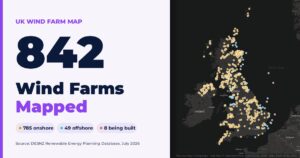
842 UK wind farms mapped

Wind Farm Map UK

Every operational UK wind farm on one map: 834 sites and 31,519 MW (31.5 GW) from the government’s DESNZ Renewable Energy Planning Database, July 2026 extract.

Read More »

Continue your learning at Thegreatclimatecon.com

Leave a Comment

The Climate Con

Sign up to our newsletter

The latest updates from The Climate Con, straight to your inbox.

No spam, unsubscribe anytime. We use Brevo as our marketing platform; by subscribing you agree your details are sent to Brevo for processing under their terms of use.

Continue your learning at Thegreatclimatecon.com