

75 Labour MPs Reportedly Want 300 Million Barrels Of British Oil Left In The Ground. So We Just Import It Instead?

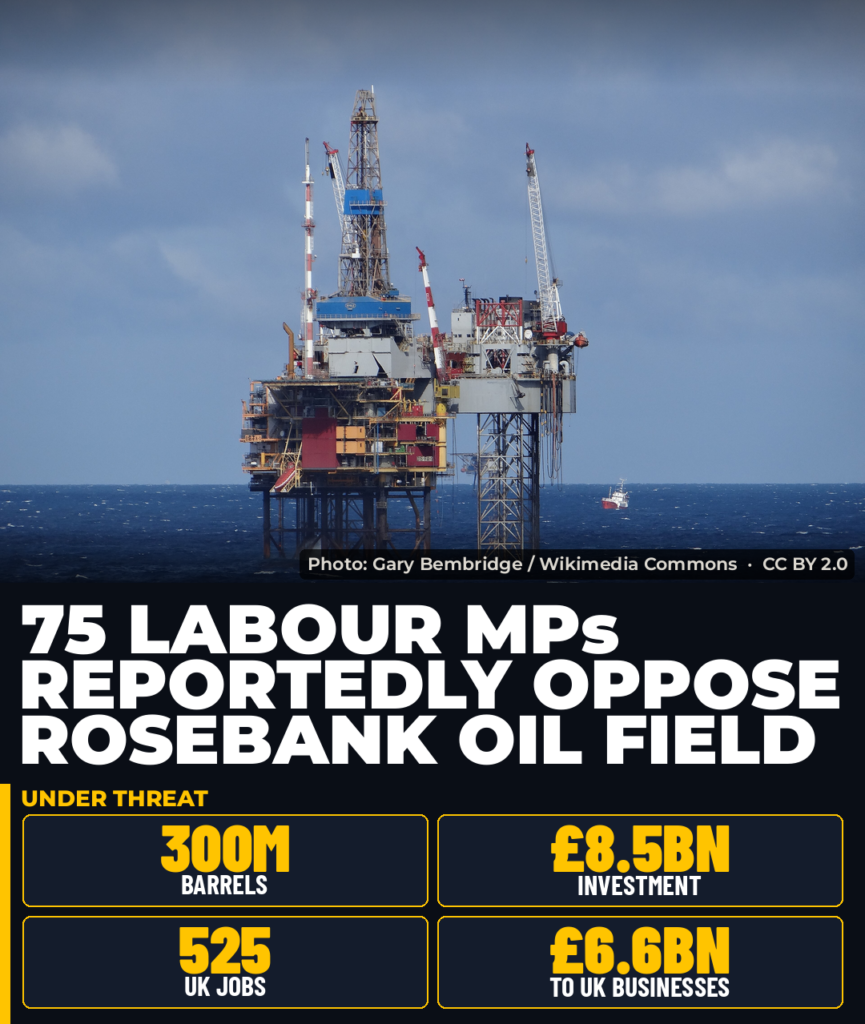
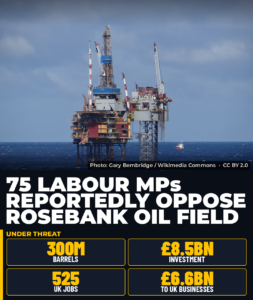
Rig photo: Gary Bembridge, Wikimedia Commons, CC BY 2.0. Pictured: a North Sea oil rig, not the Rosebank field itself.

A reported 75 Labour MPs have signed a letter against Rosebank, a field of around 300 million barrels west of Shetland. Stop it and Britain loses £8.5bn of investment and 525 UK jobs, and still uses the oil. We just buy it from abroad.

By Travis Cook, The Great Climate Con. Built on reporting by Politics UK, GB News and the BBC.

Let’s be straight with each other. Britain still runs on oil and gas. It heats our homes, moves our lorries and keeps our factories going, and that isn’t changing any time soon.

So when there are around 300 million barrels sitting in British waters, with the money lined up and the work already started, you’d think the only question would be how fast we can get it out.

Instead, a reported 75 Labour MPs have signed a letter to stop it.

Here’s what they’re asking Britain to give up, and who ends up selling us the oil instead.

The rebellion

A reported 75 Labour MPs, against one oil field

On 14 November Politics UK reported that 75 Labour MPs have now signed a letter opposing approval of Rosebank, calling it the biggest rebellion against Andy Burnham so far. It added that he has been warned of government resignations if the field is approved.

GB News reported the same 75 figure on 15 November. It said the letter warns that Britain’s credibility as a global climate leader would be destroyed if the project went ahead, and that one parliamentary private secretary to a cabinet minister told The Sunday Times they would quit their role if Rosebank is approved.

Four days earlier, the BBC put the number at more than 60 of about 400 Labour MPs, for a letter that had not yet been sent. So the count has only gone one way.

Labour MPs, reported
0
BBC count, 11 Nov
0 +
Labour MPs, about
0

Rosebank was first approved in 2023 (Equinor). The Court of Session in Edinburgh later ruled the approvals unlawful, so this government has to decide it afresh, and the same Energy Secretary approved the Jackdaw gas field in October (BBC). Rosebank is the one they’ve chosen to fight.

The field

Around 300 million barrels, 130 km off Shetland

According to Equinor, Rosebank sits around 130 kilometres north-west of Shetland in about 1,100 metres of water. Total recoverable resources are estimated at around 300 million barrels of oil, with the first phase alone targeting about 245 million.

This isn’t a someday project. Adura, which operates Rosebank, says subsea installation started in summer 2024, drilling began in the first quarter of 2026, and first oil is targeted for 2027.

Million barrels
0
Km north-west of Shetland
0
First oil target
0

Drilling has started and the production vessel is already contracted. Stopping it now doesn’t save anything. It just throws it away.

The jobs

£8.5bn of investment and 525 UK jobs, for about 25 years

Adura puts Rosebank’s direct investment at £8.5bn, of which £6.6bn is likely to go to UK-based businesses. That’s nearly four pounds in every five (our arithmetic).

It says the field will support an average of 525 UK-based full-time jobs over its lifetime, and that field life is about 25 years. That’s skilled work for a quarter of a century, in the places that have kept the lights on for generations.

Direct investment
£ 0 bn
To UK-based businesses
£ 0 bn
UK jobs, on average
0

Adura also expects Rosebank to boost the wider UK economy by about £25bn. That’s what a reported 75 Labour MPs are asking the country to walk away from.

The imports

We already import 43.3% of the energy we use

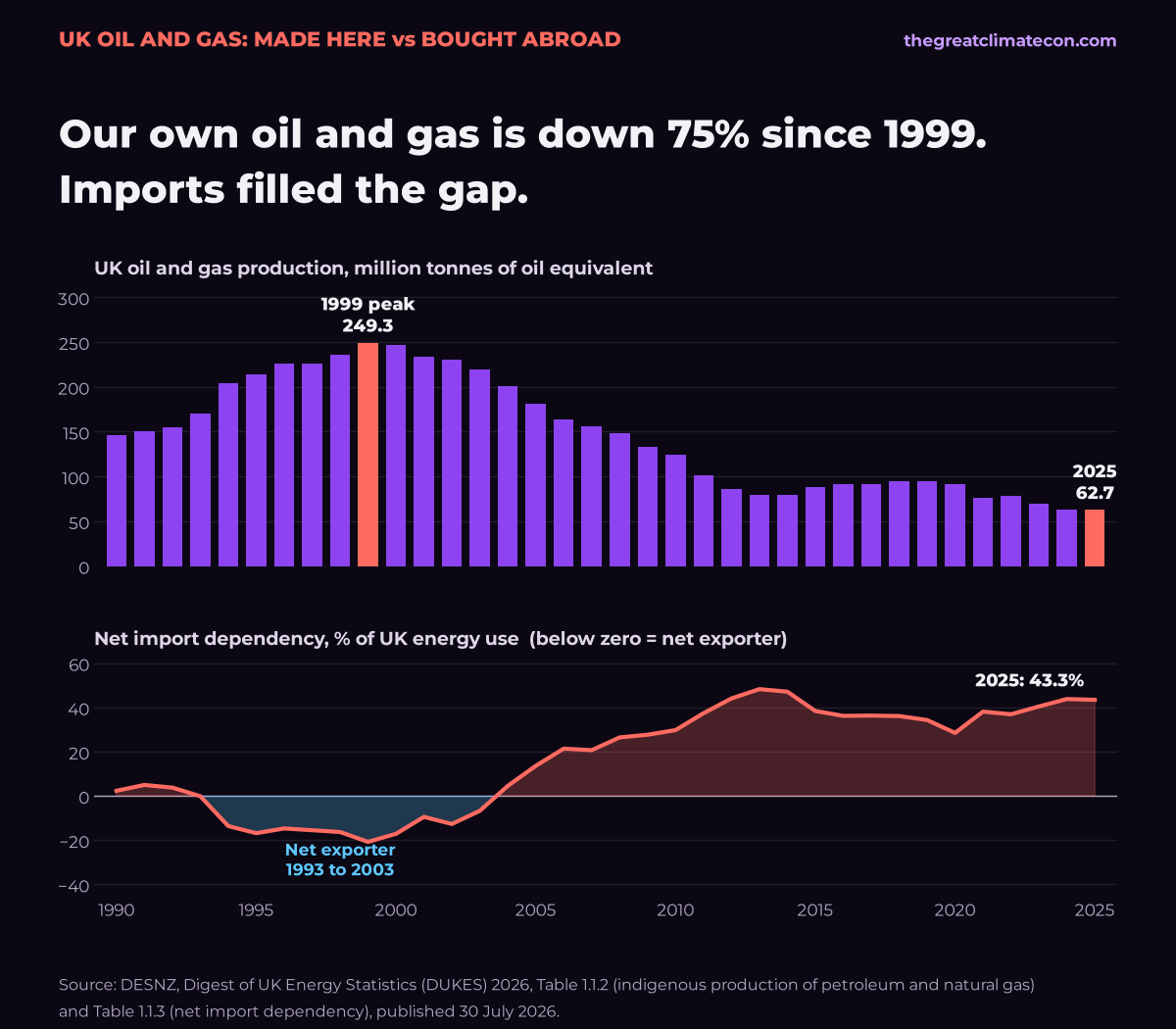
Chart: The Great Climate Con, from DESNZ DUKES 2026 Table 1.1.2 and Table 1.1.3.

The government’s own figures tell the story. According to DUKES 2026, net imports made up 43.3% of UK energy consumption in 2025. More than 90% of those imports were oil and gas. The largest share of our oil imports came from the United States, and Norway supplied the largest share of our gas.

Meanwhile, UK oil and gas production is 75% below its 1999 peak. From 1993 to 2003 Britain was a net exporter of energy. Now we buy in more than two fifths of what we use.

Net import dependency, 2025
0 %
Oil and gas output below 1999 peak
0 %
Of imports are oil and gas
0 %+

We covered the first signs of a Labour rethink on the North Sea here: North Sea gas and oil projects given a glimmer of hope as Labour begin U-turn.

The real choice

Same oil. Shipped in from somewhere else

Here’s the bit the letter leaves out. Leaving Rosebank in the ground doesn’t change how much oil Britain uses. Not one barrel. It only changes who we buy it from.

Even some Labour MPs see it. In the Westminster Hall debate the BBC covered, recently departed veterans minister Al Carns warned that Britain would need fossil fuels for decades. “Refusing to produce it here does nothing on its own to eliminate that demand,” he said. “It simply increases our reliance on imports.”

So the choice isn’t oil or no oil. It’s British oil, with British investment and British jobs, or someone else’s oil, with their investment and their jobs.

The objection

“But most of the oil will be sold abroad anyway”

That’s the line from Sheffield Central MP Abtisam Mohamed, who told the debate that Rosebank “will not strengthen our energy security because most of the oil will be sold on international markets” (BBC).

Oil is a world market. Every barrel Britain imports comes from that same market, so more supply from a stable neighbour on our own doorstep matters. Adura says the oil will go by tanker to customers’ refineries, and the gas will go through the West of Shetland Pipeline and “will ultimately end up in the UK grid” (Adura).

And wherever the barrels end up, the £8.5bn of investment and the 525 jobs only happen here if Rosebank is approved. Block it and that money doesn’t move to a wind farm. It goes elsewhere.

The bottom line

The bottom line

Want to know what would really change if Britain stepped back from the target driving all this? Read What Would Happen If The UK Dropped Net Zero Tomorrow?

Figures marked “our arithmetic” are worked out from the sources below: £6.6bn ÷ £8.5bn = about 78%. The chart’s production figures add DUKES Table 1.1.2 petroleum and natural gas output for each year (249.3 million tonnes of oil equivalent in 1999, 62.7 in 2025).

Want to win the North Sea argument every time? Unlock every lesson, book and course in The Climate Con Learning Centre. Join the membership or support the work, and stand with a movement 150,000+ strong.

Books, plus the free e-book Rich in Energy, Poor in Policy.

The Advanced Guide To The Climate Con

The Beginners Guide To The Climate Con

Continue Your Learning

842 UK wind farms mapped

Wind Farm Map UK

Every operational UK wind farm on one map: 834 sites and 31,519 MW (31.5 GW) from the government’s DESNZ Renewable Energy Planning Database, July 2026 extract.
Read More »

What Is A Photochrom?

A photochrom is a colour ink print made from a black-and-white photograph, produced and sold mainly from the 1890s to the 1910s. That is why these views are such useful dated evidence of historic coasts.

Read More »

Continue your learning at Thegreatclimatecon.com

Leave a Comment

The Climate Con

Sign up to our newsletter

The latest updates from The Climate Con, straight to your inbox.

No spam, unsubscribe anytime. We use Brevo as our marketing platform; by subscribing you agree your details are sent to Brevo for processing under their terms of use.

Continue your learning at Thegreatclimatecon.com