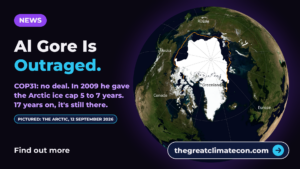
92,000 Registered, No Deal: Al Gore Is Outraged At COP31, 17 Years After He Gave The Arctic Ice 5 To 7 Years

Al Gore is outraged. 92,000 people registered for COP31 in Antalya. Two weeks of talks, two days of overtime, and on Sunday they walked away with no deal.

“The failure of COP31 is an outrage,” Gore wrote on X that afternoon. He blamed “a handful of petrostates” for having “veto power” over any mention of coal, oil and gas in the final text, and insisted: “World leaders no longer want to settle for the lowest common denominator.”

Do they? I’ve got a different take, and it’s actually good news. The scary predictions keep failing, the summits keep failing, and most of the world has quietly decided to get on with building the energy it needs. The only thing that never fails is the bill, and in Britain we’re the ones paying it.

The summit

Two weeks, two days of overtime, no deal

COP31 was due to finish on Friday 20 November. It ran late into Sunday, becoming, in the BBC‘s words, “the longest UN climate conference in history”. It still ended without its main deal.

The COP31 President, Türkiye’s environment minister Murat Kurum, told the final session: “I understand that there is no agreement on this text. For that reason, these decisions have not been adopted” (UN News). Some smaller side agreements still went through, but the main political agreement did not.

And look at the crowd it drew. The UNFCCC’s provisional list of participants shows 92,934 in-person registrations, plus another 3,335 virtual-only. That covers government delegations, observers, media, support staff and the host’s guests. Carbon Brief put it simply: “More than 92,000 people have registered to attend.”

Nearly 93,000 registrations, two weeks in a resort city, and no agreement. If world leaders really wanted the deal Al Gore describes, they had every chance to sign it.

Last time

Copenhagen, 2009: "within five to seven years"

The BBC says “the last time a COP’s main political agreement collapsed like this was in 2009 in Copenhagen”. Al Gore was at that summit too, and he made a prediction there that’s worth reading word for word.

According to The Telegraph, he told the conference: “Some of the models suggest to Dr Maslowski that there is a 75 per cent chance that the entire polar ice cap during some of summer months could be completely ice free within five to seven years.” CBS News and the Associated Press reported it as “a 75 percent chance the entire polar ice cap will melt in summer within the next five to seven years.”

Even at the time, the scientist he named wasn’t comfortable with it. Dr Wieslaw Maslowski told The Times: “It’s unclear to me how this figure was arrived at.”

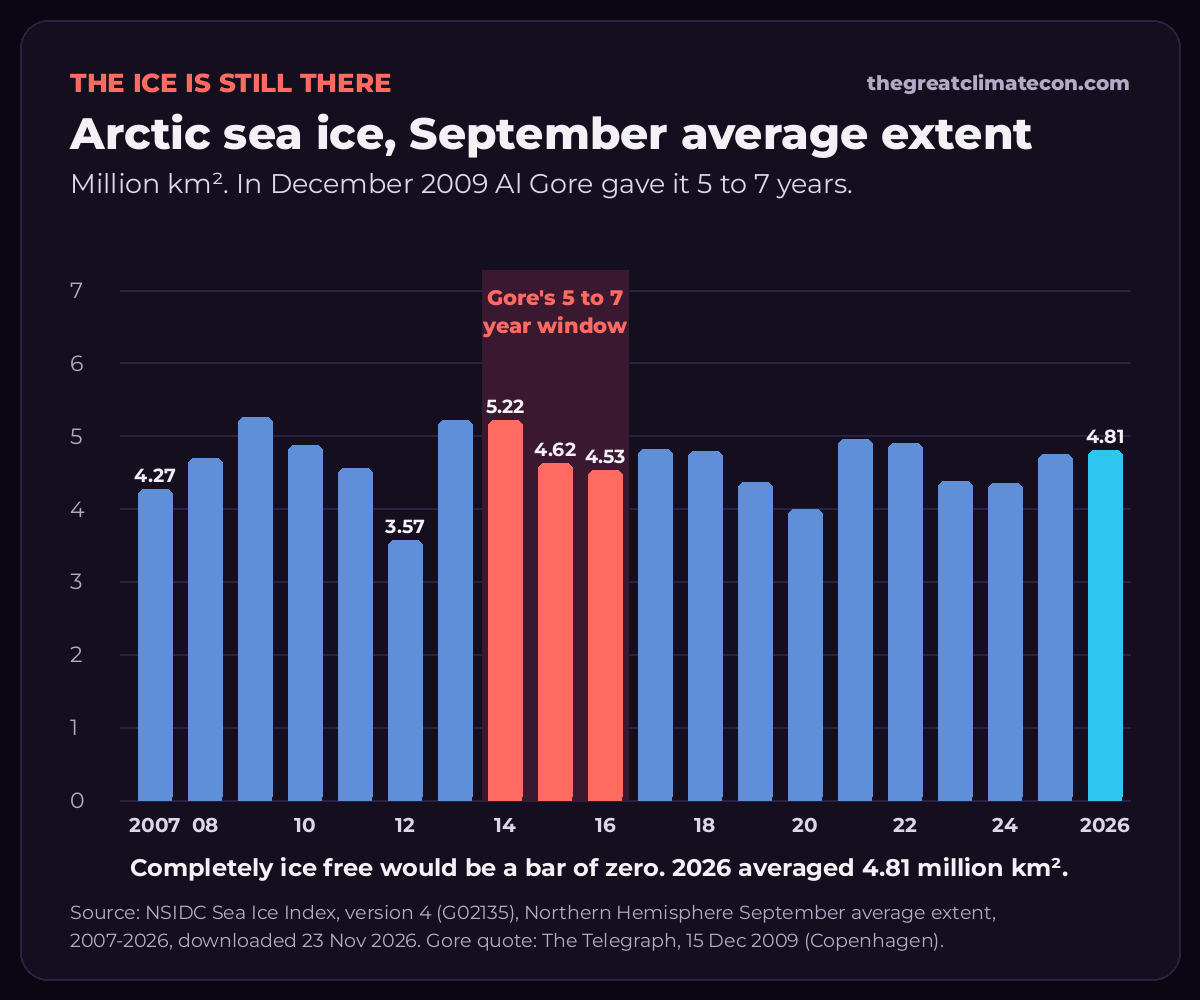
Five to seven years from December 2009 takes us to 2014 to 2016. So what happened? The US National Snow and Ice Data Center’s September figures show Arctic sea ice averaging 5.22 million square kilometres in September 2014, 4.62 million in 2015 and 4.53 million in 2016. Not zero. Not close.

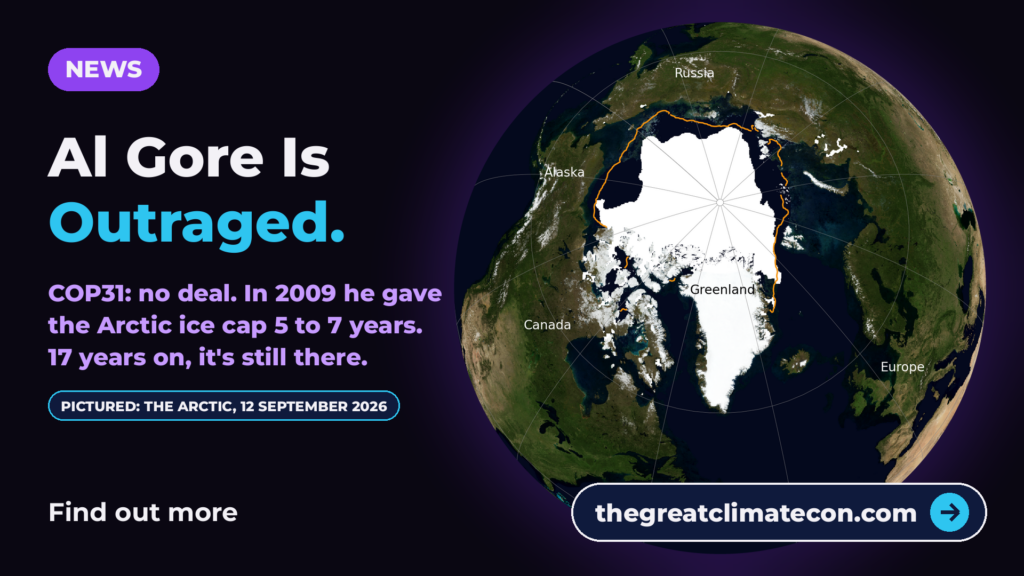
This year, the ice reached its smallest extent on 12 September 2026 at 4.60 million square kilometres, which NSIDC ranks tenth lowest in the nearly 48-year satellite record. Even the record low year, 2012, averaged 3.57 million square kilometres in September. Seventeen years on, the ice is still there.

It’s not the first prediction of his to miss. We’ve gone through 20 years of Al Gore getting it wrong, and the best of the ice-free Arctic predictions that came and went.

Bar chart of Arctic sea ice September average extent, 2007 to 2026, in million square kilometres. Al Gore's 5 to 7 year window, 2014 to 2016, is highlighted: 5.22, 4.62 and 4.53. The 2012 low was 3.57 and 2026 averaged 4.81. Source: NSIDC Sea Ice Index version 4.

The world

China and India aren't following us

Here’s what the rest of the world has been doing while the summits fail. China commissioned 1,052 GW of new coal power capacity between 2006 and 2025, according to Global Energy Monitor’s Global Coal Plant Tracker.

And it hasn’t stopped. In the first half of 2026, “over 30 gigawatts (GW) of coal power capacity began operating in China”, which was 85% of all the coal capacity commissioned worldwide in those six months. Another 25.4 GW entered construction in China over the same period (Global Energy Monitor).

India is still building too. Global Energy Monitor says 21.6 GW of coal capacity entered construction in India in the first half of 2026, “equivalent to the previous seven full years combined”.

Britain, meanwhile, closed its last coal power station, Ratcliffe-on-Soar, on 30 September 2024. We’ve written before about how Britain demolished its backup while China built 1,052 GW of coal.

The world isn’t following us. It never was. On that, Al, we agree. Where we differ is that I don’t think it’s a disaster. Countries are choosing affordable, reliable power for their people, and that’s exactly what Britain should be doing too.

The bill

While the summits fail, British families pay

So who carries the cost of all this ambition? We do. Nesta notes that the most frequently cited figures suggest “the UK had the highest industrial electricity prices among International Energy Agency countries in 2024, above Ireland and Switzerland.” When the factories, shops and farms that supply us pay more for power, that cost ends up in the price of everything we buy. It’s one reason Britain has some of the most expensive electricity in the world.

And now the government wants to tie us into the EU’s carbon market. The DESNZ explainer says the UK and EU are “aiming for the link to become operational on 1 January 2028”, subject to ratification. From that date the UK carbon market will also cover 50% of emissions from international voyages, and Britain will follow EU carbon trading rules as they change. We’ve set out what’s in that deal in Burnham signs Britain up to EU carbon tax rules.

Other countries walk away from the table and keep building. Britain stays at the table and keeps paying.

The bottom line

The predictions failed. The summits failed. The bill never does.

The good news is that none of the scary stuff came true. The ice is still there, the world is still turning, and it’s not the end of the world. What we can change is how much we keep paying for a policy the rest of the world has stopped following.

If you want to see how much better things could be, read what would happen if the UK dropped net zero tomorrow.

Want the failed predictions, and the rest of the evidence, in one place? Unlock every lesson, book and course in The Climate Con Learning Centre. Join the membership or support the work.

Books, plus the free e-book Rich in Energy, Poor in Policy.

The Advanced Guide To The Climate Con

The Beginners Guide To The Climate Con

Continue Your Learning

Continue your learning at Thegreatclimatecon.com

Leave a Comment

The Climate Con

Sign up to our newsletter

The latest updates from The Climate Con, straight to your inbox.

No spam, unsubscribe anytime. We use Brevo as our marketing platform; by subscribing you agree your details are sent to Brevo for processing under their terms of use.

Continue your learning at Thegreatclimatecon.com