
Britain Demolished Its Backup: 34 GW of Reliable Power Gone While China Built 1,052 GW of Coal

By Travis Cook, The Great Climate Con. The original station list was first set out by Tony Brown (@agbdrilling) on 9 November 2026. The totals below expand that list with the other coal and oil stations named in this article, using verified nameplate figures.
The stations
34 GW of reliable plant taken off the grid
- 33.9 GW closed and off the Great Britain grid from 21 stations, 2006 to 2025 (the original 32.2 GW, plus Drax's two remaining coal units and Uskmouth B)
- 3.1 GW converted to biomass and still generating (Lynemouth 420 MW and four Drax units 2,640 MW)
- 560 MW of coal plant closed at Kilroot in Northern Ireland in 2023, on a separate grid
- High Marnham and Drakelow C, 2.1 GW, demolished later but closed in 2003, so not in the 33.9 GW total
- 30 September 2024, Britain's last coal plant ended generation
The 25 stations (nameplate capacity)
Demolished: 2015
Demolished: 2014 to 2018
Demolished: 2016 to 2019
Demolished: 2014 to 2020
Demolished: By 2021
Demolished: By 2021
Demolished: By 2021
Demolished: By 2022
Demolished: By 2022
Demolished: 2021 to 2026
Demolished: 2010 to 2013
Demolished: 2014 to 2016
Demolished: Towers 2012; turbine hall 2016
Demolished: 2019
Demolished: 2019 to 2023
Demolished: Under demolition
Demolished: Largely demolished in 2026
Demolished: Under demolition
Demolished: Under demolition
Demolished: Converted, not demolished. Still generating
Demolished: Converted, not demolished. Still generating
Demolished: Standing. Coal units decommissioned
Demolished: Decommissioned. Main station standing
Demolished: Coal units closed. Gas plant on the same site, not demolished
Demolished: 2004 to 2012
Demolished: 2005 to 2006
Main total, Great Britain, 2006 to 2025, closed and off the grid: 33.9 GW (the original 19 stations, plus Drax’s two remaining coal units and Uskmouth B). A further 3.1 GW was converted to biomass and is still generating (Lynemouth 420 MW and four Drax units 2,640 MW). Kilroot in Northern Ireland closed 560 MW of coal plant in 2023; it is on a separate grid. High Marnham (1,000 MW) and Drakelow C (1,075 MW) were later demolished, but both closed in 2003, before the 2006 to 2025 comparison period, and are not in the 33.9 GW total.
China
China built 1,052 GW of new coal
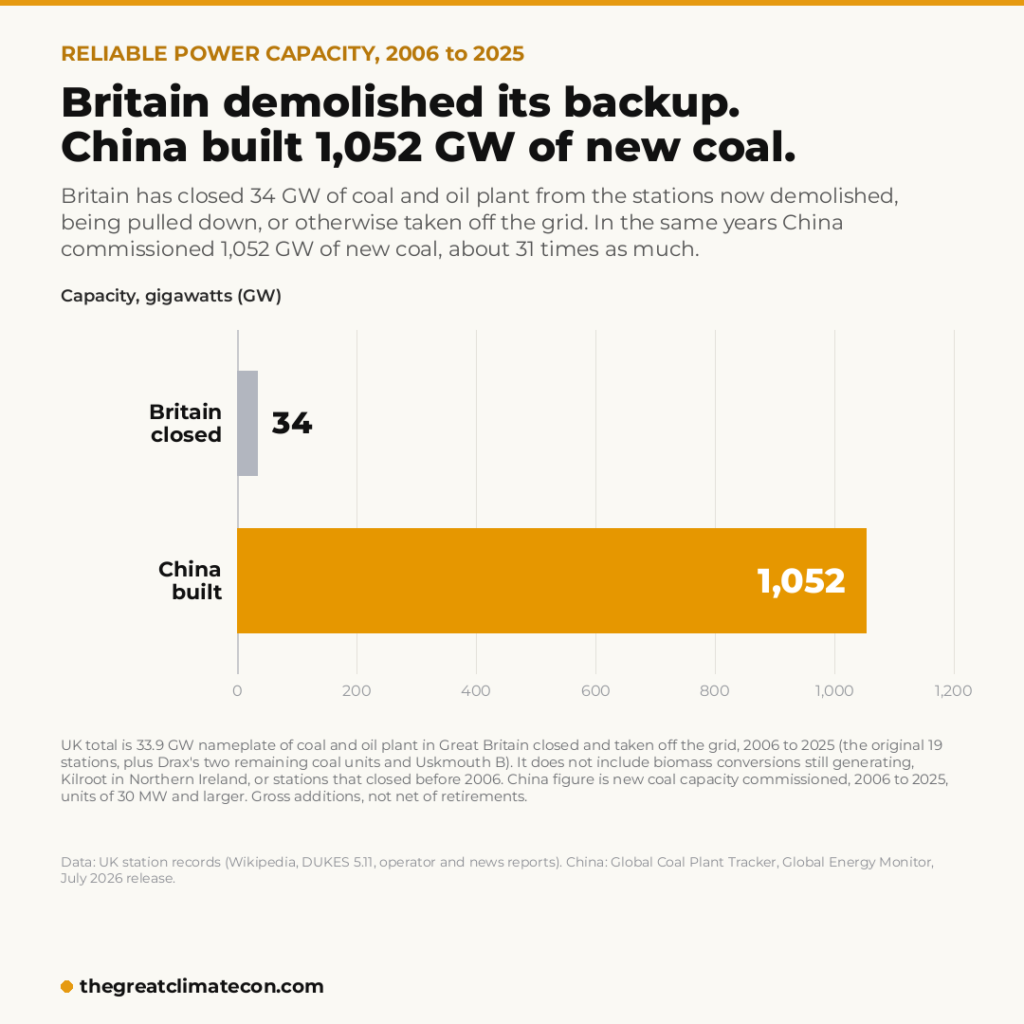
- 1,052 GW, new coal China commissioned, 2006 to 2025 (GEM, gross)
- 134 GW retired in the same years; 918 GW net in that series
- About 31 times the 33.9 GW Britain took off this list
- 77.1 GW commissioned in China in 2025 alone
The lull
When the wind drops, the backup is gone
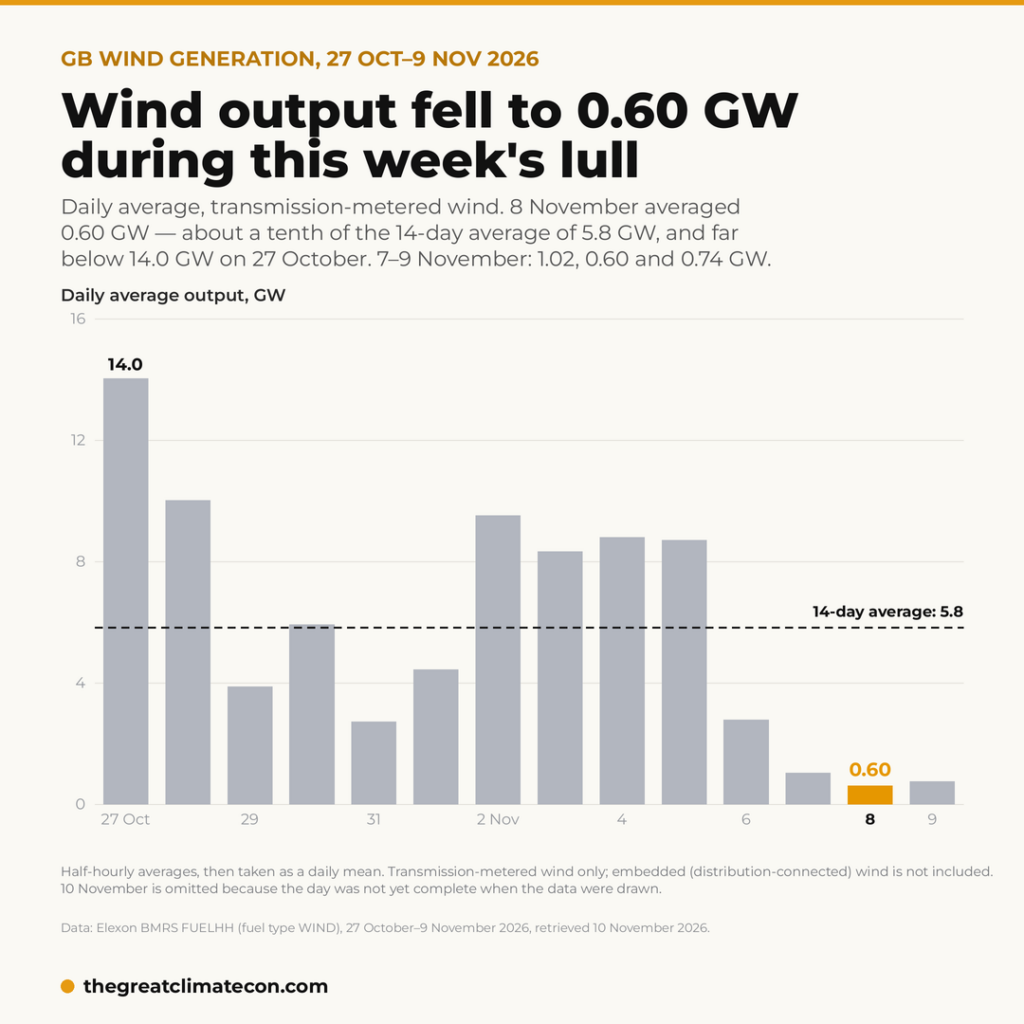
- 0.60 GW, transmission-metered wind, 8 November 2026
- 5.8 GW, 14-day average, 27 October to 9 November
- 14.0 GW on 27 October; 1.02, 0.60 and 0.74 GW on 7 to 9 November
- 253 MW, lowest half-hour on 8 November (08:00 to 08:30 Europe/London)
The bill
The grid leaned on gas, and paid emergency prices
- Electricity Margin Notice issued for the morning of 9 November 2026, then cancelled
- Telegraph: around £1,500/MWh paid to named gas plants that evening
- Customer interruptions down in 2024/25, not up
- No evidence of a blackout or emergency brownout on 9 November
The margin
34 GW is more than five times the official winter margin
- 6.1 GW, NESO base-case de-rated margin, Winter Outlook 2025/26
- 61 GW, implied ACS peak (6.1 GW is 10.0% of peak)
- 67 GW, de-rated capacity in that outlook; 33.9 GW is about half of it
- 5.9 GW, de-rated margin in the 2026/27 outlook
The objection
"But that's just old plant we didn't need"
The bottom line
The bottom line
- 33.9 GW of coal and oil plant in Great Britain is already off the grid from 21 stations closed in the 2006 to 2025 period, 24.7 GW from the original list already demolished, 7.5 GW closed and still being demolished, plus Drax’s two remaining coal units and Uskmouth B. A further 3.1 GW was converted to biomass and is still generating. Kilroot’s 560 MW in Northern Ireland, and 2.1 GW at High Marnham and Drakelow C that closed in 2003, are listed separately.
- Britain’s last coal plant, Ratcliffe-on-Soar, ended generation on 30 September 2024.
- In the same years, 2006 to 2025, China commissioned 1,052 GW of new coal, about 31 times as much. That is what was built, not net of 134 GW retired.
- On 8 November 2026, transmission-metered wind averaged 0.60 GW, about a tenth of the 14-day average of 5.8 GW.
- An Electricity Margin Notice on 9 November was issued and cancelled. The Telegraph reported gas plants paid around £1,500/MWh that evening. Household power cuts are not rising. Customers are paying for tightness in price, not in darkness.
Sources
Sources
- Tony Brown (@agbdrilling), station-list post, 9 November 2026, https://x.com/agbdrilling/status/2119877035946606980
- Global Coal Plant Tracker, Global Energy Monitor, July 2026 release (China commissioned 1,052 GW of new coal, 2006 to 2025), https://globalenergymonitor.org/projects/global-coal-plant-tracker
- Global Energy Monitor, Boom and Bust Coal 2026, https://globalenergymonitor.org/research/boom-and-bust-coal-2026
- Ember, Yearly Electricity Data (China operating coal stock, 2006 and 2025), https://ember-energy.org/data/yearly-electricity-data/
- Uniper, Ratcliffe-on-Soar ends coal generation, 30 September 2024, https://www.uniper.energy/united-kingdom/news/the-end-of-an-era---ratcliffe-on-soar-power-station-ends-coal-generation/
- AP News, UK’s last coal power station closes, https://apnews.com/article/uk-last-coal-power-station-closing-9e6b792f27513e3b02904da1eaedfbf3
- NESO, Winter Outlook 2025/26, 9 October 2025, https://www.neso.energy/document/369621/download
- NESO, strongest winter electricity margins in six years, https://www.neso.energy/neso-sets-out-expectations-strongest-winter-electricity-margins-six-years
- NESO, British electricity supplies secure this winter (2026/27 outlook, 23 October 2026), https://www.neso.energy/british-electricity-supplies-secure-winter-despite-global-instability-1
- Elexon BMRS, FUELHH transmission-metered wind, 27 October to 9 November 2026, https://data.elexon.co.uk/bmrs/api/v1/datasets/FUELHH?fuelType=WIND&settlementDateFrom=2026-10-27&settlementDateTo=2026-11-02&format=json
- Elexon BMRS, Electricity Margin Notice issued and cancelled, 9 November 2026, https://bmrs.elexon.co.uk/whats-new
- The Guardian, NESO call for more electricity supplies as wind drops, 9 November 2026, https://www.theguardian.com/business/2026/nov/09/rare-call-more-electricity-supplies-windpower-drops-britain-energy-shortfall
- The Telegraph, gas power stations fired up over electricity shortfall (around £1,500/MWh), 9 November 2026, https://www.telegraph.co.uk/business/2026/11/09/gas-power-stations-to-fire-up-over-electricity-shortfall/
- Energy Review compilation of Ofgem RIIO-ED2 network reliability data (CI/CML, 2024/25), https://www.energy-review.co.uk/energy-data/network-reliability
- Ofgem, RIIO-2 Electricity Distribution Annual Report 2024 to 2025, https://www.ofgem.gov.uk/sites/default/files/2026-01/ED-annual-report-2024-2025.pdf
- EDF, Cottam cooling towers demolition, Guinness World Record, 14 August 2025, https://www.edfenergy.com/media-centre/cooling-towers-demolition-guinness-world-record
- BBC News, Cottam cooling towers demolished, https://www.bbc.co.uk/news/articles/cgqnlvxgq9qo
- BBC News, Inverkip chimney demolition, https://www.bbc.co.uk/news/uk-scotland-23330157
- BBC News, Fawley chimney demolition, https://www.bbc.co.uk/news/uk-england-hampshire-59108792
- Power Stations of the UK, coal countdown, https://www.powerstations.uk/coal-countdown/
- DESNZ, Digest of UK Energy Statistics, Table 5.11 (Drax biomass units 2,640 MW, Drax coal units 1,320 MW, Lynemouth 420 MW, Kilroot 559 MW)
- EP UK Investments, Lynemouth Power Station (420 MW, converted to biomass 2018), https://www.epuki.co.uk/about/our-power-stations/lynemouth/
- Power Technology, Lynemouth last coal December 2015, conversion completed early 2018, https://www.power-technology.com/projects/lynemouth-biomass-power-station-northumberland/
- Drax, end of commercial coal generation planned for March 2021, formal closure September 2022, 27 February 2020, https://www.drax.com/uk/investors/end-of-coal-generation-at-drax-power-station/
- Drax, official end of coal-fired generation after the winter contingency, 25 April 2023, https://www.drax.com/uk/press_release/drax-ends-half-a-century-of-coal-fired-power-generation/
- Power Stations of the UK, Uskmouth B (original 363 MW, refurbished to 393 MW; last coal April 2017), https://www.powerstations.uk/uskmouth-b-power-station-newport/
- BBC News, Uskmouth coal station to shut, 9 May 2014, https://www.bbc.co.uk/news/uk-wales-south-east-wales-27344515
- South Wales Argus, demolition of Uskmouth cooling structures approved, planned by 13 May 2024; main station standing, https://www.southwalesargus.co.uk/news/23994767.demolition-cooling-towers-uskmouth-power-station-can-go-ahead/
- EP Kilroot, closure of Kilroot coal units on 30 September 2023, https://kilrootenergypark.co.uk/news/ep-kilroot-comment-on-closure-of-kilroot-coal-units
- BBC News, Kilroot generates electricity from gas for the first time, 28 March 2024, https://www.bbc.com/news/uk-northern-ireland-68681247
- BBC News, job losses as High Marnham and Drakelow C close, 9 January 2003, http://news.bbc.co.uk/1/hi/england/2643351.stm
- BBC News, five High Marnham cooling towers demolished, 15 July 2012 (station closed 2003), https://www.bbc.co.uk/news/uk-england-nottinghamshire-18847674
- BBC News, Drakelow C boiler houses to be demolished, 23 April 2006, http://news.bbc.co.uk/2/hi/uk_news/england/derbyshire/4935914.stm
- Global Energy Monitor, Drakelow C units retired 2003: 350 MW, 350 MW and 375 MW (1,075 MW remaining at closure), https://www.gem.wiki/Drakelow_power_station
- Power Stations Revisited, Drakelow C designed 1,450 MW; Unit 11 reported scrapped after 1978 boiler damage; closed March 2003; towers September 2006, https://www.powerstationsrevisited.org.uk/drakelow/drakelow-c/
- Wikipedia station pages used for nameplate, closure and demolition dates, cross-checked as above: Cockenzie, Kingsnorth, Tilbury, Didcot, Ironbridge, Rugeley, Longannet, Ferrybridge, Eggborough, Cottam, Inverkip, Grain, Richborough, Littlebrook, Fawley, West Burton, Aberthaw, Fiddler’s Ferry, Ratcliffe-on-Soar, Lynemouth, Drax, Uskmouth, Kilroot, High Marnham, Drakelow
Want the evidence on net zero, bills and energy security in one place? Unlock every lesson, book and course in The Climate Con Learning Centre. Join the membership or support the work.
Books, plus the free e-book Rich in Energy, Poor in Policy.
The Advanced Guide To The Climate Con

The Beginners Guide To The Climate Con

Continue Your Learning

Britain Demolished Its Backup: 34 GW of Reliable Power Gone While China Built 1,052 GW of Coal
Britain Demolished Its Backup: 34 GW of Reliable Power Gone While China Built 1,052 GW of Coal Britain closed 33.9 GW of coal and oil

33% Ordered, 26.6% Bought: Why Ministers Are Set To Cut Britain’s EV Target As COP31 Opens
Buyers chose 26.6% electric against a legal 33% target. Now ministers are set to cut it, in the same week COP31 opens.

£40m For Caribbean Green Energy Schemes. 5.6 Million British Homes Going Hungry. Charity Begins At Home?
In the 1920s, floods, droughts, storms and wildfires killed around 485,000 people a year. Today it’s about 12,000, on a planet with more than four times as many people. Lucy Biggers asked the question the climate lobby can’t answer: if the climate is so deadly, why doesn’t it show up in the death toll?

Climate Disaster Deaths Are Down 97.5%. So Where Exactly Is The Climate Emergency?
In the 1920s, floods, droughts, storms and wildfires killed around 485,000 people a year. Today it’s about 12,000, on a planet with more than four times as many people. Lucy Biggers asked the question the climate lobby can’t answer: if the climate is so deadly, why doesn’t it show up in the death toll?

The World’s Most Expensive Electricity Is Made In Britain: Here’s Exactly Where Your Money Goes
Britain now pays more for electricity than any of the 92 countries in Bjørn Lomborg’s IEA-based ranking, 2.7 times the US and 3.7 times China. It isn’t bad luck. It’s a stack of grid charges, green subsidies and carbon taxes added to every bill to keep a weather-dependent grid running. Here they are, line by line.

New Satellite Study Puts Greenland’s Ice Loss At About Half The Official Estimates, And Even Those Are 0.01% A Year
A new Chinese satellite study puts Greenland’s ice loss at about 120 billion tonnes a year, about half the international benchmark for the same years and 55% below NASA’s headline 264. Even the biggest official figure is about one hundredth of one per cent of the ice sheet a year.