



Made In Brussels: Burnham Signs Britain Up To EU Carbon Tax Rules 'At The Same Time, On An Ongoing Basis'
As usual, the government is calling it a win, so we need to bring some truth to the matter.
On Friday, at the UK-EU summit in Brussels, Prime Minister Andy Burnham agreed to link Britain’s carbon market to the European Union’s, and in doing so signed Britain up to EU carbon tax rules. The government’s own explainer says the deal means the UK and EU will “interpret and apply the same rules at the same time, on an ongoing basis”.
Read that line again. This is not a one-off trade arrangement. It is a standing promise to follow whatever Brussels decides about carbon trading, for as long as the link lasts.
Brussels’ rules, Brussels’ price, Britain’s bill. The good news is that the paperwork is public, it is written in plain English, and it does not take long to see what has been signed. Here is what is in it.
The rules
Brussels writes the rules. Britain applies them.
The link is due to start on 1 January 2028, subject to ratification. From then, UK and EU carbon permits can be used interchangeably across both schemes. To make that work, Britain has agreed to “dynamic alignment” with EU emissions trading law.
The Department for Energy Security and Net Zero spells out how it works. A new Joint Committee on ETS Linking decides which new EU laws are added to the agreement’s annex. Disputes go to an independent arbitration panel. The rulebook even includes a “financial contribution framework”.
And what does Britain get in return? An “early decision-shaping role on EU rules in development”. Shaping, not deciding. Britain does not vote on the EU laws it will now have to follow.
The Guardian’s explainer put it bluntly: the UK “will be required to align with EU law in these areas, including new rules that it never had a say in writing.”
Getting out is not quick either. Either side can end the link with written notice, but the notice period runs from 18 to 30 months, depending on when it is given.
Ten years after Britain voted to take back control, this hands the carbon rulebook straight back to Brussels.
The price
Brussels' market, Brussels' price
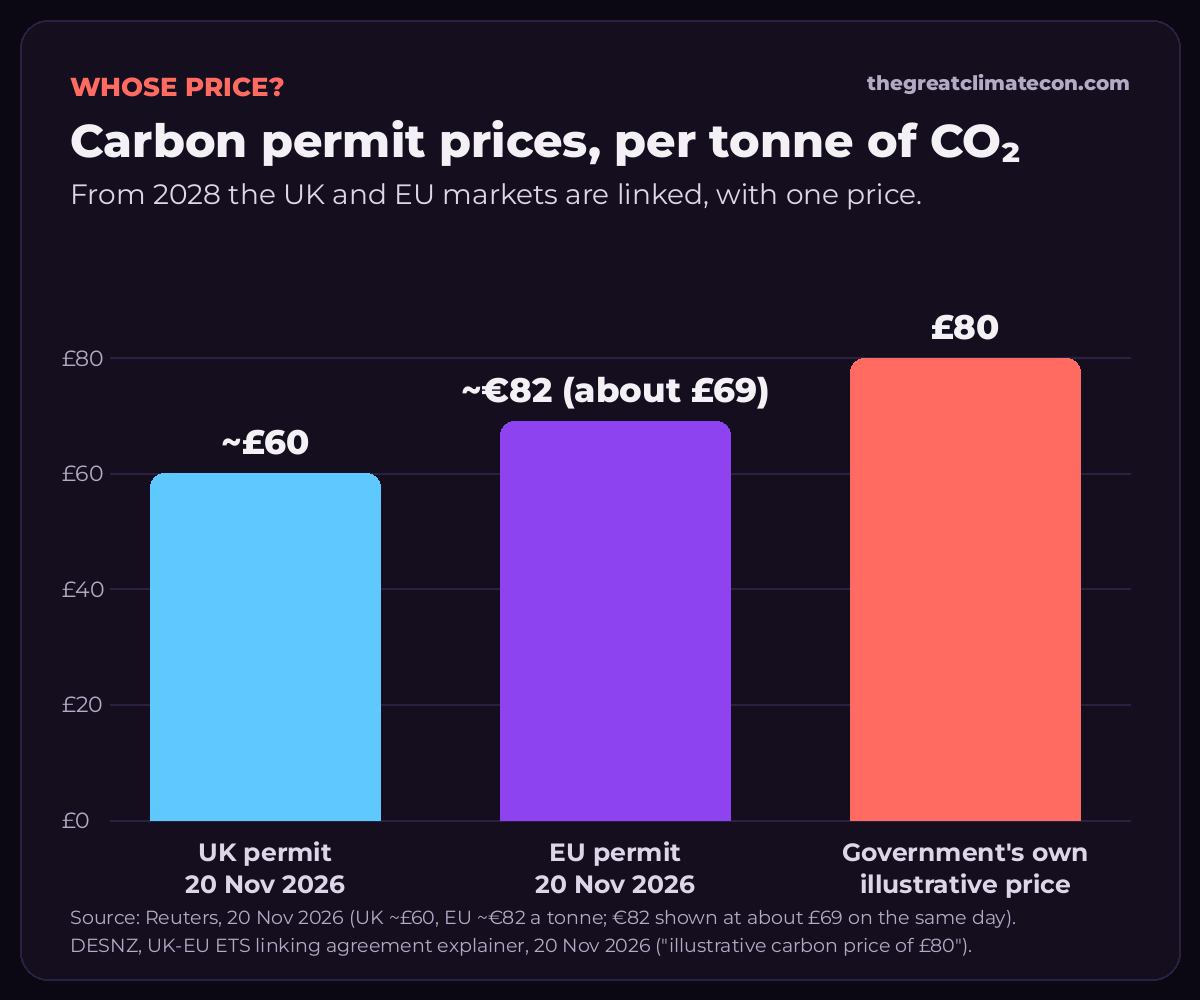
On summit day, Reuters reported the EU carbon price at around €82 a tonne and the UK price at around £60. British fossil fuel power stations also pay an extra £18 a tonne through Carbon Price Support, which the government has signalled will end in April 2028.
Join the two markets and there is one price, and it will not be set in London. The UK’s 2026 cap is 77.4 million allowances against the EU’s 1,210 million, about 6% of the size, according to broker CFP Energy. It expects convergence to “come mostly from UKAs rising towards EUAs, not EUAs falling to meet them.”
The deal also strips out Britain’s own controls. The UK scraps its Auction Reserve Price, its price floor. Its brake on price spikes is swapped for the EU’s Article 29a, with a trigger “based on prices in the EU ETS”. A new UK reserve moves at 6.7% of whatever the EU’s reserve does, and the UK auction calendar will be “determined with the Commission” (DESNZ explainer).
Then look at the number the government uses in its own paperwork. When it values 1.5 million allowances set aside for aviation fuel at around £120 million, it says this is “based on an illustrative carbon price of £80”. That is the government’s own working figure, against around £60 for UK permits on summit day.
The Prosperity Institute think tank has estimated that linking would raise UK carbon prices by around 30%.
The creep
Shipping now, bin burning next
The carbon tax does not just follow Brussels’ price. It follows Brussels into new parts of the economy.
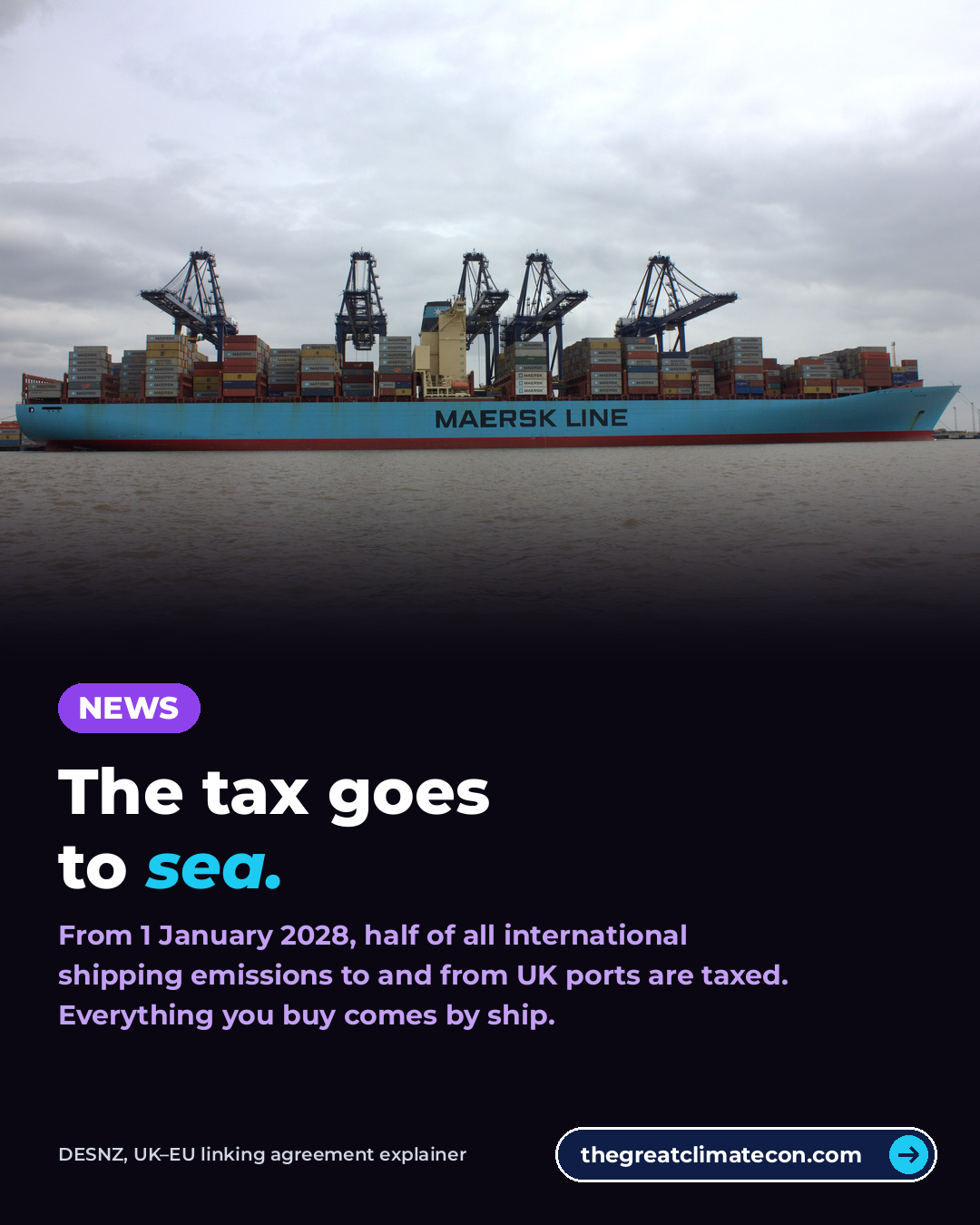
Since 1 July 2026 the UK scheme has covered domestic voyages and in-port emissions from big ships. Under the link, from 1 January 2028 it adds 50% of emissions from international voyages between UK ports and the rest of the world, for ships of 5,000 gross tonnes and above (DESNZ explainer). An island nation that trades by sea now pays carbon tax on the voyage.
Waste incineration is next. The UK ETS “will dynamically align with the EU ETS rules for bringing waste incineration emissions into scope”. Brussels has proposed doing that from 2031, phased in until 2034. Those proposals are not final, but whatever Brussels settles on, Britain follows, and mandatory monitoring for plants of 20MW and above starts in 2028.
Free allowances, which shield producers of steel, aluminium, cement, fertilisers and hydrogen from the full carbon cost, will be phased out “in line with the EU trajectory” from 2028. The explainer even admits the EU’s 2026 review “may change” that trajectory, and that the UK “would need to reflect those changes in the UK ETS”.
It does not stop at carbon trading. The summit Joint Statement says any deal for Britain to join the EU electricity market “would be linked to a UK financial contribution to reducing economic, social and territorial disparities between regions of the EU”, with talks to finish in 2027. Ed Miliband told the BBC there was “no cost” to the taxpayer from Friday’s summit. The price tag for the next step is already written down.
The bill
Who pays for Brussels' price
Every carbon permit is a cost that lands on someone. The firms that buy them pass that cost down the line, to their customers and, in the end, to all of us.
The Office for Budget Responsibility’s October 2026 forecast puts UK ETS receipts at £2.1 billion in 2025-26 and £2.8 billion in 2026-27. It has not included the link at all. The OBR says “the economic impact will depend on the outcome of these negotiations”. The government has not published an impact assessment for the linking deal either. That is promised only alongside the secondary legislation.
So the deal has been signed before the public has been shown what it costs.
Industry has already said what it expects. INEOS told GB News: “Linking the EU and UK ETS schemes will add further cost to businesses in addition to sky-high energy prices.” Fuels Industry UK said Britain’s four remaining refineries “already face carbon costs of £50m each a year”, costs it says are “set to triple by 2030”. Its warning: “Alignment with the EU could make this worse.”
Reform UK’s Richard Tice said the plan would “leave British businesses and households at the mercy of carbon prices set in Brussels”. This is a country that already pays for some of the most expensive electricity in the world, run by a government that found £40m for Caribbean green energy schemes.
The sales pitch
'Up to', 'by 2040', and not yet checked
The government claims the carbon market link will add “up to £3.8 billion a year to the UK economy by 2040”. It also claims the whole summit package could add “up to 0.5% to UK GDP by 2040”, which it puts at around £17 billion a year (Number 10).
Notice the words “up to”, and notice the date. 2040 is 14 years away, and these are the government’s own estimates. The OBR has not scored them, and the impact assessments are still to come.
The other selling point is the EU’s carbon border tax, CBAM, which we warned about back in July. The government says the link frees around £6.5 billion of UK exports from it. But the EU exemption is only “expected to apply from 1 January 2028”, subject to EU legislation, while Britain will exempt EU, EEA and Swiss goods from its own CBAM from 1 January 2027 (DESNZ explainer). Britain goes first. Brussels follows, if its own law-makers agree.
The bottom line
Brussels' rules, Brussels' price, Britain's bill
- Brussels' rules: the UK applies EU carbon trading law "at the same time, on an ongoing basis", with a role in shaping it but no vote
- Brussels' price: a UK market about 6% the size of the EU's, its price floor scrapped and its price-spike brake handed to Article 29a
- Britain's bill: half of international voyage emissions taxed from 2028, waste incineration on the EU's timetable, free allowances phased out, and the electricity market tied to a payment towards EU regions
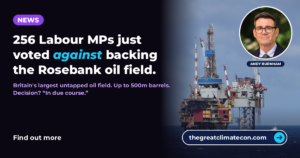
None of this was needed. Britain is free to set its own energy policy, and the cheapest energy is energy nobody slaps a carbon tax on. In the same week that 256 Labour MPs voted against backing Rosebank, the government chose to hand the carbon rulebook to Brussels.
The deal still has to go through Parliament, and that is where it can be argued. Make sure your MP knows what is in it. And if you want to see how much better things could be, read what would happen if the UK dropped net zero tomorrow.
Want the carbon tax argument, and the rest of the evidence, in one place? Unlock every lesson, book and course in The Climate Con Learning Centre. Join the membership or support the work.
Books, plus the free e-book Rich in Energy, Poor in Policy.
The Advanced Guide To The Climate Con
The Beginners Guide To The Climate Con
Continue Your Learning
- CBAM: Yet Another Carbon Tax Set To Increase The Cost Of Living In The UK Even More
- The World's Most Expensive Electricity Is Made In Britain: Here's Exactly Where Your Money Goes
- £40m For Caribbean Green Energy Schemes. 5.6 Million British Homes Going Hungry. Charity Begins At Home?
- 256 Labour MPs Voted Against Backing Rosebank. The Score Was 90 To 270.
- What Would Happen If The UK Dropped Net Zero Tomorrow?

Made In Brussels: Burnham Signs Britain Up To EU Carbon Tax Rules ‘At The Same Time, On An Ongoing Basis’
At the 20 November 2026 summit, Andy Burnham agreed to link Britain’s carbon market to the EU’s, with the UK applying EU rules “at the same time, on an ongoing basis”. The carbon tax spreads to shipping and, on the EU’s timetable, waste incineration. Brussels’ rules, Brussels’ price, Britain’s bill.

Sea Squirt Mince For Swedish Schoolkids: 26% Sea Creature, 30% Less Protein, And 450 Children Fed It ‘Without Knowing’
Swedish councils are feeding children sea squirt mince with more water in it than sea squirt and 30% less protein than beef, to shave an invisible crumb off a country responsible for 0.09% of global emissions.

Geoengineering On Your Taxes: Britain Is Paying To Refreeze The Arctic, To Save Ice That Was Meant To Be Gone By 2013
Geoengineering On Your Taxes: Britain Is Paying To Refreeze The Arctic, To Save Ice That Was Meant To Be Gone By 2013 https://thegreatclimatecon.com/wp-content/uploads/2026/11/ssstwitter.com_1795169072879.mp4 Real Ice
Continue your learning at Thegreatclimatecon.com
Climate Con Common Sense
Available in hardcopy
The Beginners Guide
Available in hardcopy