Sea Squirt Mince For Swedish Schoolkids: 26% Sea Creature, 30% Less Protein, And 450 Children Fed It 'Without Knowing'

Swedish councils are feeding children sea squirt mince with 30% less protein than beef, to shave an invisible crumb off a country responsible for 0.09% of global emissions.

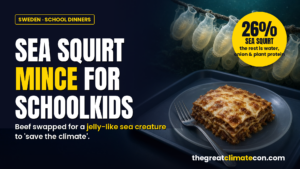
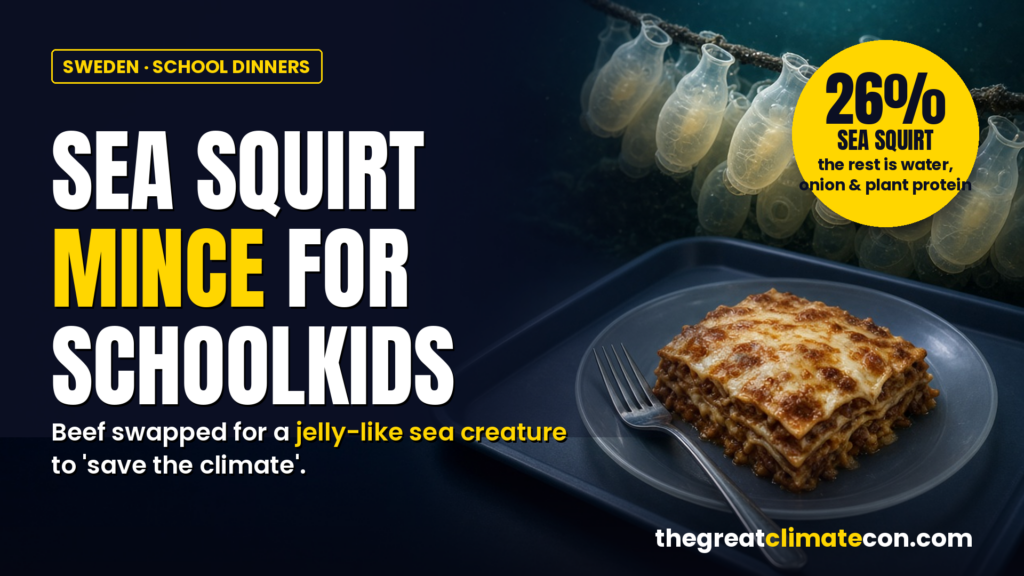
School lunch tray with lasagne beneath translucent Ciona sea squirts hanging on a rope underwater, with text: Sweden, school dinners. Sea squirt mince for schoolkids. Beef swapped for a jelly-like sea creature to 'save the climate'. Badge: 26% sea squirt, the rest is water, onion and plant protein.

Sea squirt mince on the school dinner menu. It’s happening in Swedish school canteens right now, and it’s being done to children in the name of the climate.

PeterSweden broke it to the English-speaking world this afternoon: “Schools in Sweden are now feeding students minced meat made of sea vases instead of beef to save the climate” (PeterSweden on X, 18 November 2026).

We went through the Swedish local papers, SVT, the trade press and the manufacturer’s own product sheets. It’s true. And the details he didn’t have room for make it worse.

The “mince” is only 26% sea squirt, and the first ingredient is water. It has 30% less protein than the beef it replaces. One council pulled it because it “can’t guarantee 100%” it’s safe. The company bragged that 450 children ate it “without knowing”. And all of it is meant to shave a rounding error off a country that produces about 0.09% of the world’s emissions.

What They're Putting On Children's Plates

The animal is Ciona intestinalis, the vase tunicate, which is where “sea vase” comes from (Wikipedia). In Swedish it’s tarmsjöpung, a sea squirt: a soft, see-through, tube-shaped blob that clings to ropes and harbour walls and sieves plankton out of seawater. SVT called it “den slemmiga nyheten”, the slimy newcomer (SVT, October 2022).

It’s ground up and sold to council kitchens as Purply “mouldable mince” by the Norwegian company Pronofa (Pronofa). Then it goes into lasagne, meatballs and burgers, food children trust because it looks like what they already eat.

More Water Than Sea Squirt

Here’s what’s actually in the catering pack, according to the company’s own product sheet on Dabas, the catalogue Swedish public kitchens order from (Dabas):

Water, Ciona meat 26%, onion, pea protein, rapeseed oil, sunflower protein, stabiliser methylcellulose, salt, beetroot, natural flavouring, pepper, paprika, coriander.

Water comes first. Ingredients are listed by weight, so there’s more tap water in this “mince” than sea creature. The rest is plant protein, held together with methylcellulose, a thickener, and coloured with beetroot so it looks like meat. An earlier version of the product said 65g of Ciona went into every 100g (Dabas, earlier sheet). It’s now down to 26%. And it’s made in Norway.

Now put it side by side with real grass-fed beef mince:
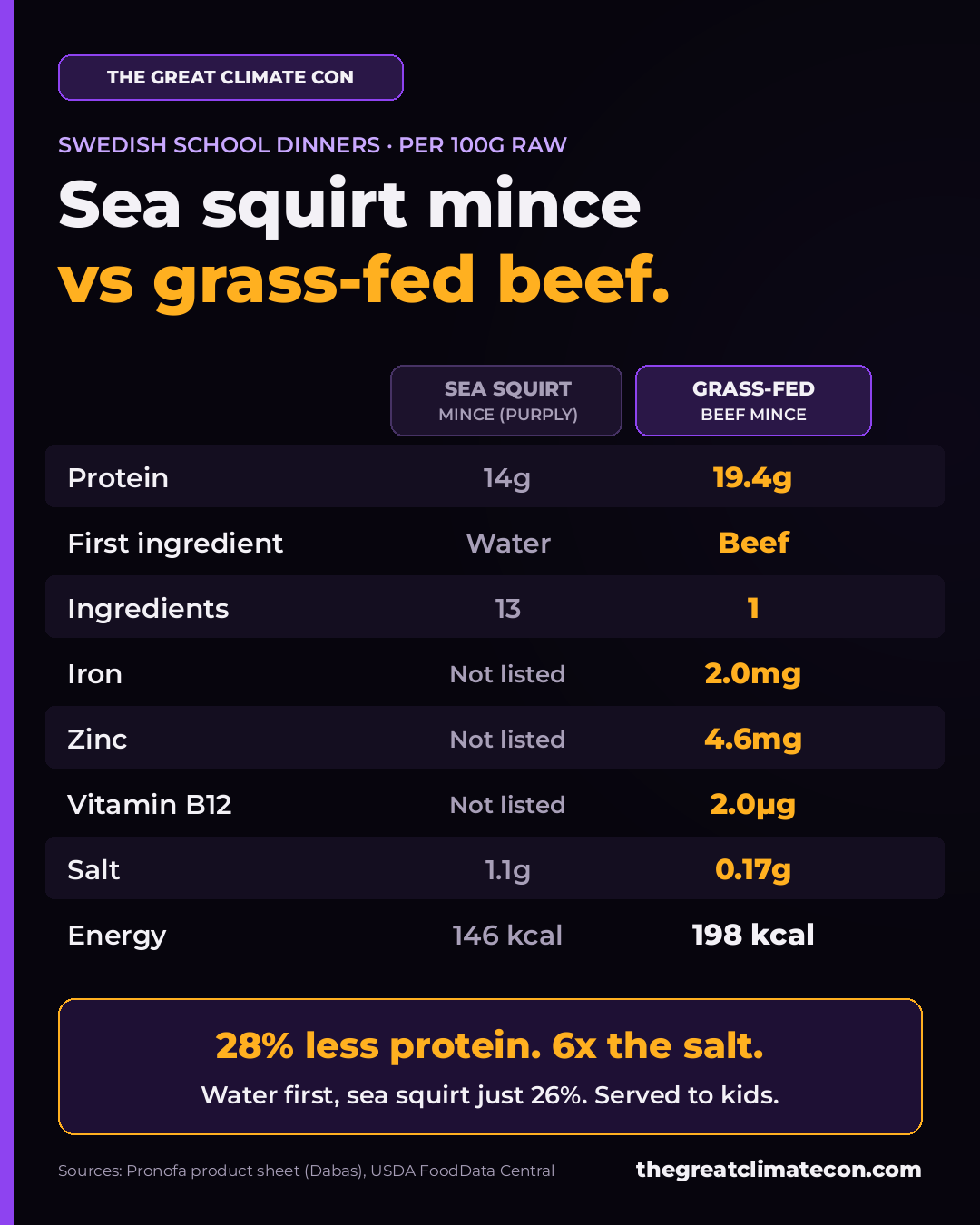
Comparison chart, per 100g raw: sea squirt mince (Purply) vs grass-fed beef mince. Protein 14g vs 19.4g; first ingredient water vs beef; 13 ingredients vs 1; iron, zinc and B12 not listed vs 2.0mg, 4.6mg and 2.0µg; salt 1.1g vs 0.17g; energy 146 vs 198 kcal. 28% less protein, 6x the salt.

Per 100g, rawPurply sea squirt minceGrass-fed beef mince
Energy146 kcal198 kcal
Protein14g19.4g
Fat8.4g12.7g
Saturated fat0.8g5.3g
Carbohydrate2.9g0g
Fibre2.2g0g
Salt1.1g0.17g (68mg sodium)
IronNot listed2.0mg
ZincNot listed4.6mg
Vitamin B12Not listed2.0µg
First ingredientWaterBeef
Number of ingredients131

28% less protein than grass-fed beef, six times the salt, no iron, zinc or B12 even listed, and a 13-ingredient list that starts with water.

Sources: Purply figures from Pronofa’s product sheet on Dabas; grass-fed beef from USDA FoodData Central, “Beef, grass-fed, ground, raw”. Against Sweden’s standard beef mince (20.1g protein, Livsmedelsverket food database), the protein gap is 30%.

Thirty per cent less protein, served to growing children at school lunch.

Why Beef Belongs On The Plate

Beef isn’t the villain here. For a growing child it’s one of the best foods there is.

  • Complete protein: 20.1g per 100g of ordinary beef mince (Livsmedelsverket).
  • Haem iron: the form found mainly in meat. The US National Institutes of Health says haem iron “has higher bioavailability than nonheme iron”. The iron requirement for vegetarians is 1.8 times higher, because iron from plants is absorbed so much less well (NIH Office of Dietary Supplements).
  • Zinc and B12: 5mg of zinc and 1.52µg of vitamin B12 in every 100g of beef mince (Livsmedelsverket).

And Swedish children need it. According to Sweden’s own Food Agency, almost one in three teenage girls in Sweden shows signs of iron deficiency: 30% in year 8 and 26% in the second year of upper secondary (Livsmedelsverket, Riksmaten ungdom, Riksmaten ungdom report). Its 2024 follow-up found that girls with iron deficiency ate less red meat and less haem iron than the girls with the best iron status (Livsmedelsverket, L 2024 nr 10).

So in a country where almost a third of teenage girls show signs of iron deficiency, councils are swapping the iron-rich meat on the menu for a watery sea squirt paste. You couldn’t make it up.

Want the full case for meat? The Truth About Meat module in our Learning Centre takes apart the biggest claims against meat and the farmers who produce it, and the first lesson is free to watch.

"Without Knowing"

This is the line every parent should read twice. After serving it at Noblaskolan in Lännersta, run by AcadeMedia, the Nordic region’s biggest school group, Purply posted on LinkedIn (Purply on LinkedIn, September 2026):

“450 pupils ate a Greek patty, without knowing that half of it came from the sea.” (our translation)

Read that again. 450 children were fed a sea creature without being told, and the company thought it was something to boast about. The patties were half Purply and half beef mince, a “hybrid”, so the children never stood a chance of noticing.

The ones who were told weren’t fooled. “It feels weird,” said Fanny before her first forkful in Söderbärke (SVT Dalarna). “It feels weird that we’re eating a slimy thing like that,” said nine-year-old Lily in Enköping (Enköpings-Posten). Her choice that day was vegetarian lasagne or sea squirt lasagne. Beef wasn’t an option.

And the company’s own plan for winning children over? A chef working with Purply to get it into schools and hospitals told TriplePundit: “We have to really make a smashing impact with presentation and not try to challenge people’s eating habits too much.” In other words: make it look normal, and don’t make a fuss.

"We Can't Guarantee 100% That It's Safe"

In Ronneby, the council planned to serve Purply lasagne to the children of Parkdalaskolan on 3 September. One father asked the questions nobody in charge had asked. What’s its nutritional value? This animal filters seawater all day, so what about metals and toxins? And was it going to quietly replace ordinary mince for good (Bulletin, reporting Sydsvenskan)?

The council had no answers. Its catering chief, Elena Johansson, wrote back:

“We can’t guarantee 100% that the product is safe to serve. Until we’ve found out all the facts, we’re stopping the serving.” (our translation)

The brakes were pulled at the last minute (Blekinge Läns Tidning). Asked why nobody had checked first, she said: “No, we don’t go and read the Food Agency’s website for every new product we introduce. I don’t think anyone does” (Fria Tider, quoting Sydöstran). When the council did look, it found an older Food Agency report with four tests on mussels and oysters, and just two on Ciona (Bulletin).

Two tests. That was the evidence base for serving it to children.

A month later, Enköping put the very same supplier’s product on the menu at 14 of its 27 primary schools and preschools (Enköpings-Posten). (For the record, Ciona was approved as food in Sweden in 2019, the same paper notes. Approval didn’t stop Ronneby’s own catering chief saying she couldn’t vouch for it.)

Spreading Council By Council

This isn’t a one-off stunt. It has been creeping through Sweden’s school kitchens for four years:

When Where What happened
Oct 2022 Spekeröd preschool, Stenungsund Billed as the first in the world to serve sea squirt mince, to preschoolers
Winter 2025/26 Mariebergsskolan, Motala Trial, with more planned this autumn before a possible rollout to every kitchen
Mar 2026 Kyrkskolan, Söderbärke Served “as part of the school’s sustainability work”
Sep 2026 Noblaskolan, Lännersta 450 pupils fed it “without knowing”
Sep 2026 Parkdalaskolan, Ronneby Halted: “can’t guarantee 100%” it’s safe
Oct 2026 Enköping On the menu at 14 of 27 schools and preschools

Sources: SVT, Motala Vadstena Tidning, SVT Dalarna, Purply on LinkedIn, Bulletin, Enköpings-Posten.

About 20 councils had tried it by January (Food Supply, 7 January 2026). By September, the company said it had contracts with 42 councils, and that in several of them it had become a recurring dish (Food Supply, 14 September 2026). Sweden has 290 councils, so that’s about one in seven. No national decision, no vote: just contract by contract, canteen by canteen.

And make no mistake about the reason. Ronneby’s catering chief sold it on its “low climate footprint” (Fria Tider). Purply’s own pitch to school kitchens: “Same hands, same recipe, same feel in the pan, with a significantly lower climate footprint” (our translation, Purply on LinkedIn).

The Climate "Saving" Is A Rounding Error

The whole justification rests on one number: Pronofa’s claim that Purply comes to 0.8kg of CO₂-equivalent per kilo (Dabas). Look closer:

  • It’s their own figure. It’s the company’s number on the company’s product sheet, and it’s measured “cradle to gate”, which stops at the factory door, before the drive from Norway to a Swedish school kitchen.
  • Even they can’t agree on it. The same company quotes 0.97kg on its Norwegian site (Pronofa) and 0.22kg for the raw Ciona (Purply). That’s three numbers for one product.
  • The saving is invisible. All of Sweden emitted 47.5 million tonnes in 2024 (Jordbruksverket), against a global total of 53.2 billion tonnes (EDGAR / EU Joint Research Centre). That makes Sweden about 0.09% of the world. All of Swedish farming, every cow, pig and field, is 6.3 million tonnes, roughly 0.01% of global emissions. A sea squirt lasagne in some school canteens is a sliver of a sliver of that.

Comparing it with the global-average beef figure of 99.5kg (Our World in Data) changes nothing. Swap every school dinner in Sweden for sea squirt paste, forever, and no thermometer on Earth would notice. Sweden’s own Board of Agriculture even warns that cutting Swedish food production just shifts it abroad, and emissions “would then increase in the exporting country” (our translation, Jordbruksverket).

We’ve made the wider case before in Eating Meat Is Good For The Planet – Here’s Why.

A Failing Start-Up And A Captive Audience

So who is this really for? Pronofa’s Swedish company made a loss of nearly 24 million kronor (about £1.8m), and in May 2026 it “temporarily” shut its Stenungsund factory and moved production to Norway, according to its 2025 annual report (Food Supply, 8 October 2026). It’s now hunting for new manufacturing partners.

We’ve seen this before. When grown-ups get a choice, fake meat flops, as Beyond Meat’s plummeting sales showed. So where do you go when the shoppers won’t buy? You go to the council canteen, where the diners are children who eat what they’re given and can’t take their custom elsewhere.

It Never Stops At Lunch

This is how it always works. First it’s what we drive: petrol and diesel cars squeezed off the market by EV mandates. Then it’s how we heat our homes, with Britain now paying some of the most expensive electricity in the world. Then it’s taxes on cows. And now it’s what our children eat at school, decided by catering managers and green start-ups, not by parents. We’ve already seen classrooms used for Net Zero campaigning, in BBC Bitesize And Net Zero: When A Lesson Becomes A Campaign. Now it’s the dinner hall.

Each step is sold as small. “Just a trial.” “Just one day a week.” “Half and half, they won’t even notice.” That’s the point. If nobody pushes back, the trial becomes the menu, and the menu becomes the norm.

The Bottom Line

Children were fed a watery paste that’s only 26% sea squirt, with 30% less protein than real beef, in a country where almost a third of teenage girls show signs of iron deficiency. Some of them weren’t even told. One council admitted it couldn’t guarantee it was safe. And it was all to shave an invisible crumb off a country responsible for 0.09% of the world’s emissions.

This isn’t about saving the planet. It’s about getting the public used to less: less meat, less choice, less say. And it starts with the people least able to say no.

It only goes ahead if we let it. So don’t:

  • Ask your school and your council what’s on the menu, what’s in it, and who decided. Ask for the ingredients list. You’re entitled to know what your child is eating.
  • Speak up as a parent. One father in Ronneby asked a few polite questions, and a sea squirt lasagne was stopped. One voice made the difference.
  • Refuse to let unelected officials and struggling green start-ups decide what goes on children’s plates. Raise it with governors, at parents’ evenings and with your local councillors.
  • Share this article. Most parents have no idea this is happening. Make sure they do.

Real food for real kids. It’s not much to ask, and it’s worth standing up for.

Sources

  1. PeterSweden on X, 18 November 2026
  2. Dabas, “Purply formbar färs” product sheet (Pronofa AB, GTIN 07090022032656)
  3. Dabas, earlier “Purply formbar färs” product sheet (GTIN 07350104650032)
  4. Livsmedelsverket food database, “Nöt färs rå fett 10%”
  5. Bulletin, “Elever skulle serveras sjöpung – provet stoppades” (September 2026, reporting Sydsvenskan)
  6. Fria Tider, “Eleverna skulle serveras sjöpung – pappa satte stopp för klimatsatsningen” (24 September 2026)
  7. Blekinge Läns Tidning, “Larm om gifter stoppade skolans sjöpungslasagne” (18 September 2026)
  8. Enköpings-Posten, “Eleverna testar sjöpung: ‘Ganska god och inte ganska dålig'” (8 October 2026)
  9. Enköpings-Posten, “Sjöpung serveras i Enköpings skolor – men stoppas i en annan” (8 October 2026)
  10. SVT Dalarna, “Här testar eleverna färs gjord på sjöpung: ‘Smakar nästan som kött'” (20 March 2026)
  11. SVT Väst, “Här äter förskolebarnen i Stenungsund sjöpungfärs till lunch” (20 October 2022)
  12. Motala Vadstena Tidning, “Efter positiva responsen – sjöpungen återkommer på skolmatsedeln” (9 August 2026)
  13. Purply on LinkedIn, “450 elever åt grekisk biff – utan att veta att hälften kom från havet” (September 2026)
  14. Food Supply, “Från sjöpung till miljardpotential – ny färs utmanar köttindustrin” (7 January 2026)
  15. Food Supply, “Efter kommunens stopp: Purply svarar om säkerheten” (14 September 2026)
  16. Food Supply, “Miljonförlust och produktionsstopp – så ska Purply-ägaren gå vidare” (8 October 2026)
  17. Pronofa, “Purply”
  18. Purply, “Vad är Purply?”
  19. TriplePundit, “A New ‘Red Meat’ From the Sea Could Be Coming to Menus Near You” (2025)
  20. Jordbruksverket, “Jordbruket och klimatet”
  21. EU Joint Research Centre, EDGAR “GHG emissions of all world countries”, 2025 report
  22. Our World in Data, “Greenhouse gas emissions per kilogram of food product” (Poore & Nemecek 2018)
  23. Wikipedia, “Ciona intestinalis”
  24. Livsmedelsverket, “Har ungdomar näringsbrist?” (Riksmaten ungdom)
  25. Livsmedelsverket, “Riksmaten ungdom 2016–17, del 2: Näringsintag och näringsstatus” (2018 nr 23)
  26. Livsmedelsverket, “Järnintag och järnstatus med fokus på ungdomar i Sverige” (L 2024 nr 10)
  27. NIH Office of Dietary Supplements, “Iron: Fact Sheet for Health Professionals”
  28. USDA FoodData Central, “Beef, grass-fed, ground, raw” (FDC ID 168608)

We're Doing A Thousand Mile Walk With The Board

Thanks to the support of the community I’ve now purchased this board and have started waking up the people with it. Soon I will do a 1000 mile walk. It would be great if you were to join and support!

This Story Is Funded By Readers Like You

The Great Climate Con is 100% community funded. We read the product sheets, the official statistics and the local papers so you don’t have to, and we link every number to its source.

If you value that, please become a member. Tiers are £2.99, £8.99 and £19.99 a month, and every member gets access to our Learning Centre, with 14 video lessons across 3 modules on CO2, energy and Net Zero. Your membership keeps this work independent and growing.

Climate Common Sense

The Beginners Guide To The Climate Con

Continue Your Learning

📊

Track The Cost Of Net Zero

Stay ahead of the transition with real-time cost monitoring and optimization tools.

Access Cost Trackers →

Leave a Comment

The Climate Con

Sign up to our newsletter

The latest updates from The Climate Con, straight to your inbox.

No spam, unsubscribe anytime. We use Brevo as our marketing platform; by subscribing you agree your details are sent to Brevo for processing under their terms of use.

Continue your learning at Thegreatclimatecon.com