



33% Ordered, 26.6% Bought: Why Ministers Are Set To Cut Britain's EV Target As COP31 Opens
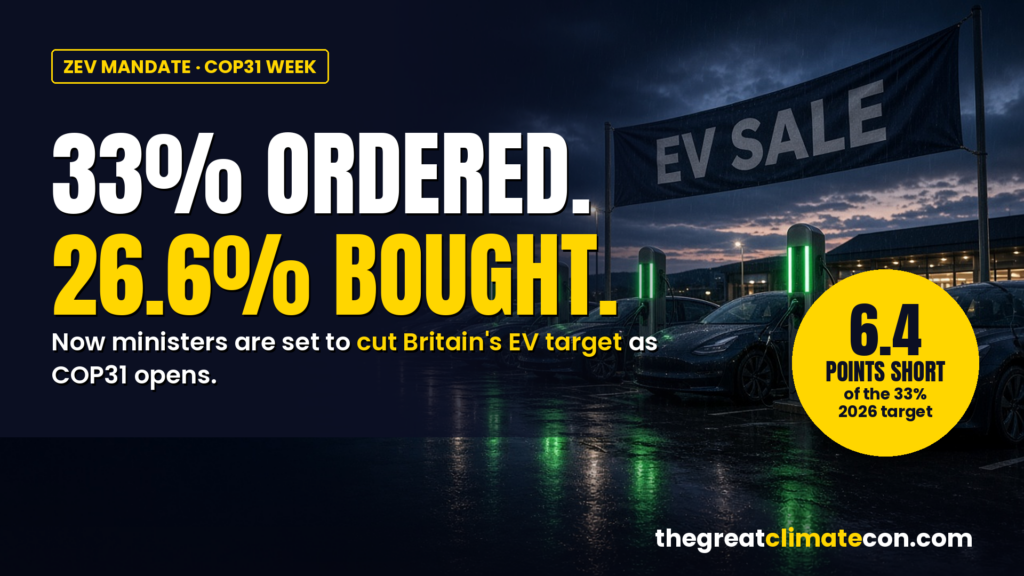
Buyers chose 26.6% electric against a legal 33% target. Now ministers are set to cut it, in the same week COP31 opens.

Today, 9 November, the UN’s COP31 climate summit opens in Antalya, Türkiye. Britain is sending one of the biggest delegations there: the Prime Minister Andy Burnham, the Foreign Secretary Ed Miliband and the Energy Secretary Miatta Fahnbulleh, according to The Independent. The Guardian reports that Burnham and Miliband will “champion electrification on a global scale” while they are there.
Back home, the same paper says, ministers are expected to cut Britain’s own electric car target this week, by about a quarter.
Those two things are happening in the same week. The reason is simple, and it’s in the official sales figures. Government told carmakers what share of new cars must be electric, and British buyers haven’t bought that many.
What The ZEV Mandate Actually Says
The zero emission vehicle (ZEV) mandate is written into law through the Vehicle Emissions Trading Schemes (VETS) Order 2023. It sets the share of each manufacturer’s new car sales that must be zero emission, in practice battery electric, each year. The Department for Transport’s own summary sets out the car targets:
| Year | Car ZEV target |
|---|---|
| 2024 | 22% |
| 2025 | 28% |
| 2026 | 33% |
| 2027 | 38% |
| 2028 | 52% |
| 2029 | 66% |
| 2030 | 80% |
Look at the jump after 2027. The target rises by 5 percentage points a year to 2027, then by 14 points a year after that.
If a manufacturer falls short, and can’t cover the gap any other way, the summary says it pays £12,000 per car from 2025. That is not a tax on drivers in name. But a carmaker facing a £12,000 penalty on each petrol car it sells “too many” has every reason to raise petrol prices, cut EV prices or simply sell fewer cars in Britain. Either way, the cost lands somewhere in the showroom.
What Drivers Actually Bought
The Society of Motor Manufacturers and Traders (SMMT) reported 2,020,520 new cars registered in the UK in 2025. Of those, 473,348 were battery electric, a 23.4% share against that year’s 28% target.
This year is no better. The SMMT’s October 2026 figures, published on 5 November, show 503,805 battery electric cars registered in the first 10 months, out of 1,892,000 in total. That is a 26.6% share against a 33% target. On those figures, about 120,000 more electric cars would have had to be sold so far this year to hit the headline number.
October itself looked better, with a 32.0% electric share. The SMMT says that came as “manufacturers intensified efforts to bring registrations closer to the annual mandated target, repeating the pattern of the previous two years”. By the SMMT’s own account, then, the year-end jump is driven by carmakers chasing the target, not by a sudden change in what buyers want.
It’s also worth being clear about what people are still choosing. Year to date, petrol cars (including mild hybrids) took 41.1% of the market, diesel 4.4%, plug-in hybrids 14.1% and full hybrids 13.7%. Add those together and roughly 73% of new cars sold in Britain this year still have a combustion engine.
To be fair to EVs, the battery electric share is rising. It was 22.4% at this point last year and 26.6% now, and sales are up 30.4%. Electric cars are not collapsing. The story is the gap between the speed ministers wrote into law and the speed buyers are moving at.
The Gap Is Getting Wider, Not Narrower
The SMMT’s latest market outlook expects battery electric cars to end 2026 at 27.2%, against the 33% target. It expects 32% in 2027 against a 38% target. By 2028 it forecasts 37.5% against 52%, which is “14.5 percentage points behind the required 52%, more than double this year’s shortfall”.
And that is with what the SMMT calls “billions in incentives, including government’s Electric Car Grant”, plus £14.3 billion committed to UK EV manufacturing since 2020. Its chief executive Mike Hawes told the Guardian: “The gap between demand and mandated targets continues to widen.”
The targets have already been softened more than once. That’s why the official headline numbers don’t tell the full story. The DfT summary lists a set of “flexibilities”: banking, borrowing, converting credits between schemes, pooling and trading. In the government’s own words, these “mean that manufacturers and the vehicle market as a whole can be compliant without meeting the headline ZEV targets through the registration of zero emission vehicle registrations alone.”
Some of those flexibilities are now tightening. The cap on how much of the target carmakers can borrow from future years falls from 19.6% of registrations in 2025 to 8.25% in 2026. Borrowed allowances must be paid back by 2030, with 3.5% a year compound interest. So the room to fall short this year without paying out has shrunk, just as the target has risen.
Five Options, Four Departments, One Decision
In August, the Department for Transport opened a review of the ZEV mandate. It ran from 14 August to 23 October 2026 and asked for views on “the current ZEV trajectory and yearly headline targets” and the “effectiveness of existing compliance flexibilities”.
The Guardian reports that the review put forward five options for 2030:
- Keep the mandate unchanged at 80%.
- Keep 80% but extend the flexibilities by four years, to 2034.
- Cut the 2030 target to 70%.
- Cut it to 60%.
- Cut it to 50%.
According to the paper, the Business Secretary Jonathan Reynolds wants 50%, and the Transport Secretary Heidi Alexander is believed to favour about 60%. Fahnbulleh and Miliband want it to stay at 80%.
Burnham has stepped back from the decision because his wife advises the board of the EV charging firm Be.EV, the Guardian says. That leaves Louise Haigh to settle it after a meeting in Downing Street on Wednesday. Government insiders told the paper she will “probably sign off on a 2030 target of about 60%”, with the flexibilities extended to 2034.
The official line is more cautious. A government spokesperson said: “The government is united in its commitment to the ZEV mandate and no decisions have been taken.” So until an announcement is made, treat the 60% figure as a well-sourced report, not a done deal.
Why This Matters More Than Any Other Green Policy
This is not a side issue. The Guardian says the ZEV mandate is expected to deliver nearly 14% of all the emissions cuts the UK has pledged between 2028 and 2032. That makes it, in the paper’s words, the government’s “single biggest decarbonisation policy”.
That’s exactly why it is so revealing. When the biggest single plank of Net Zero runs into what real households will pay for, the plank bends. And the running-cost case for EVs depends on electricity prices, where Britain already pays some of the highest electricity prices in the world. EVs are only cheap to run if electricity is cheap, and in Britain it isn’t. We’ve written before about why your electricity bills keep going up.
The charging industry sees it differently. Shane Brennan of ChargeUK told the Guardian that weakening the mandate “puts £1.7bn of charging infrastructure at risk”. That is a fair point about investor confidence. But it also shows how much of the market has been built around a legal quota rather than around what customers choose. Britain’s car industry is already under pressure elsewhere too, as we covered in our piece on EV shipping restrictions.
What About The Emissions Case?
It’s only fair to look at the climate argument on its own terms. Volvo, a company that is pushing electric, published a lifecycle study of its C40 Recharge against the petrol XC40. The electric car starts with a bigger carbon debt from making its battery and materials. It only pulls ahead after about 110,000 km on the global average electricity mix, 77,000 km on the EU-28 mix, or 49,000 km on wind power.
Over 200,000 km, Volvo puts the electric car at 50, 42 or 27 tonnes of CO2-equivalent depending on the electricity used, against 59 tonnes for the petrol XC40. So on Volvo’s numbers the EV does come out lower over a full life. But how much lower depends heavily on the grid, and the saving only arrives after years of driving. That’s one model from one maker, not a universal rule.
Then there’s the bigger picture. The UK produces only a small share of the world’s emissions. Forcing the pace of EV sales here, against what buyers want, changes very little for the world’s climate. It does change a lot for car prices, factory jobs and household budgets.
The Public Conversation
None of this will surprise anyone who’s been watching social media. Our weekly scan of the biggest climate posts on X found that the best-performing ones were about the cost of Net Zero and green policies that backfired. Last week’s top examples included a TV panel clip on Britain’s tiny share of emissions with more than 17,000 likes, and a post on paper straws with more than 2,600. People respond when a policy sold as good for the planet turns out to cost them more, or simply doesn’t work as promised. An EV target that buyers aren’t meeting, cut in the same week ministers fly out to urge the world to electrify, fits that pattern exactly.
The Bottom Line
The ZEV mandate set a legal pace for the car market that Britain’s drivers have not followed. Even with grants, heavy discounting and a year-end push by manufacturers, battery electric cars are at 26.6% this year against a 33% target. The industry’s own forecast shows the gap doubling by 2028.
If ministers do cut the 2030 target to around 60% this week, it won’t be because the climate has changed. It will be because the market hasn’t, and the people paying for it have noticed. The awkward part is that the announcement may come while Britain’s leaders are at COP31, urging the rest of the world to go faster.
Sources
- The Guardian, “Labour expected to cut EV targets for UK’s car industry despite MPs’ protests”, 8 November 2026
- SMMT, “Year-end push lifts EV sales but Mandate gap set to widen” (October 2026 registrations), 5 November 2026
- SMMT, “UK new car market breaches two million as almost one in four buyers go electric” (2025 full year)
- Department for Transport, “Updates to the Vehicle Emissions Trading Schemes (VETS) Order 2023”
- Department for Transport, “Zero emission vehicle mandate review” consultation, 14 August to 23 October 2026
- The Independent, “UK weather extremes show why climate action and Cop31 are vital, minister says”, 9 November 2026
- Volvo Cars, “Carbon footprint report: Volvo C40 Recharge”
- PeterSweden7 on X, paper straws post, 27 October 2026
We're Doing A Thousand Mile Walk With The Board
Thanks to the support of the community I’ve now purchased this board and have started waking up the people with it. Soon I will do a 1000 mile walk. It would be great if you were to join and support!
This Story Is Funded By Readers Like You
The Great Climate Con is 100% community funded. We read the official tables so you don’t have to, and we link every figure to its source.
If you value that, please become a member. Tiers are £2.99, £8.99 and £19.99 a month, and every member gets access to our Learning Centre, with 14 video lessons across 3 modules on CO2, energy and Net Zero. Your membership keeps this work independent and growing.
Climate Common Sense
The Beginners Guide To The Climate Con
Continue Your Learning

33% Ordered, 26.6% Bought: Why Ministers Are Set To Cut Britain’s EV Target As COP31 Opens
Buyers chose 26.6% electric against a legal 33% target. Now ministers are set to cut it, in the same week COP31 opens.

£40m For Caribbean Green Energy Schemes. 5.6 Million British Homes Going Hungry. Charity Begins At Home?
In the 1920s, floods, droughts, storms and wildfires killed around 485,000 people a year. Today it’s about 12,000, on a planet with more than four times as many people. Lucy Biggers asked the question the climate lobby can’t answer: if the climate is so deadly, why doesn’t it show up in the death toll?
Climate Disaster Deaths Are Down 97.5%. So Where Exactly Is The Climate Emergency?
In the 1920s, floods, droughts, storms and wildfires killed around 485,000 people a year. Today it’s about 12,000, on a planet with more than four times as many people. Lucy Biggers asked the question the climate lobby can’t answer: if the climate is so deadly, why doesn’t it show up in the death toll?
The World’s Most Expensive Electricity Is Made In Britain: Here’s Exactly Where Your Money Goes
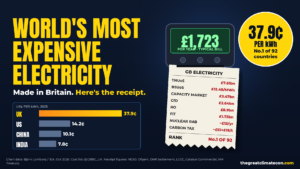
Britain now pays more for electricity than any of the 92 countries in Bjørn Lomborg’s IEA-based ranking, 2.7 times the US and 3.7 times China. It isn’t bad luck. It’s a stack of grid charges, green subsidies and carbon taxes added to every bill to keep a weather-dependent grid running. Here they are, line by line.

New Satellite Study Puts Greenland’s Ice Loss At About Half The Official Estimates, And Even Those Are 0.01% A Year
A new Chinese satellite study puts Greenland’s ice loss at about 120 billion tonnes a year, about half the international benchmark for the same years and 55% below NASA’s headline 264. Even the biggest official figure is about one hundredth of one per cent of the ice sheet a year.

BBC Bitesize And Net Zero: When A Lesson Becomes A Campaign
A BBC Bitesize net zero lesson tells 11 to 14-year-olds they “may need to fly less, eat less meat” and asks if they could petition the council. Is that a lesson or a campaign?
Track The Cost Of Net Zero
Stay ahead of the transition with real-time cost monitoring and optimization tools.
Access Cost Trackers →