The charges loaded onto every bill
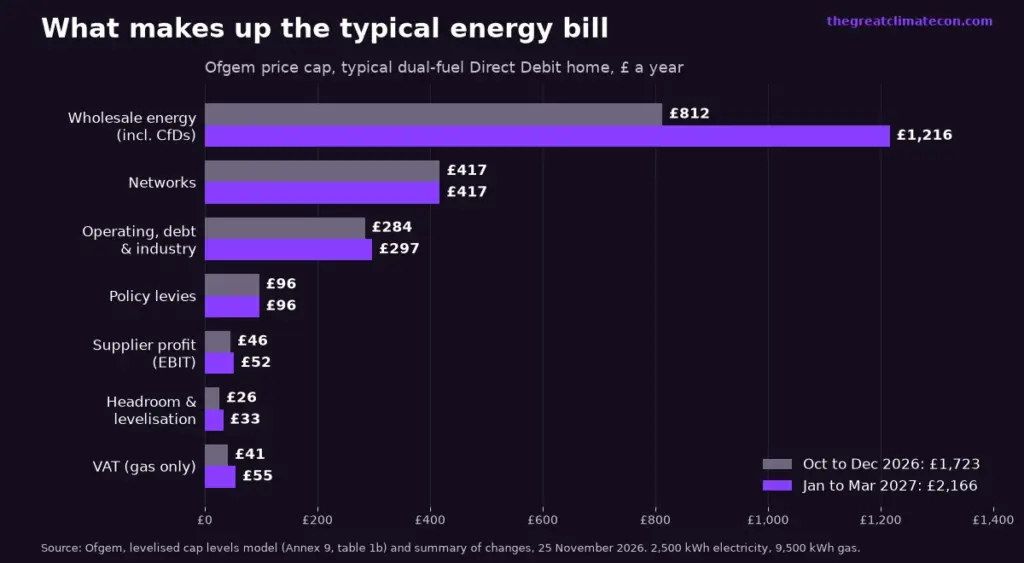
The wholesale jump sits on a bill already built from policy, which we itemised in
The World’s Most Expensive Electricity Is Made In Britain. Here is how each charge reaches you, and you can split your own bill the same way with our
Energy Bill Calculator.
Levies. Ofgem’s own policy line is £96 a year on the typical bill. On the current cap that covers the Renewables Obligation (£20.46), Feed-in Tariffs (£20.13), the nuclear levy for Sizewell C (£11.59) and the Warm Home Discount, among others. Almost all of it lands on electricity: 2.88p of policy cost on every kWh of electricity against 0.26p on gas. That £96 is flattered: from April 2026, 75% of the household share of the Renewables Obligation moved off your bill and onto your taxes. You still pay it.
Contracts for Difference. CfDs guarantee wind and solar farms a fixed strike price, and bill payers make up the gap. They sit inside Ofgem’s “wholesale” line, not the policy line. In 2025 the scheme paid out £2.64 billion, £2.09 billion of it to wind farms, according to
Low Carbon Contracts Company data.
Constraint payments. When the grid cannot carry the power, wind farms are paid to switch off and gas plants to switch on. Wind farms received £382 million for switching off in 2025, for 10.2 TWh of power they never made, says the
Renewable Energy Foundation. Balancing the grid cost £2.7 billion in 2024/25, £1.7 billion of it constraint costs. See
Wind Farms Increase Profits 60% By Doing Nothing.
Network costs. £417 of the typical bill is networks, before a single unit of energy. Much of it pays for pylons and sea cables to reach wind farms in northern Scotland and offshore. The high-voltage network alone is recovering £7.61 billion in 2026/27.
Carbon costs. Every gas power station pays the UK Emissions Trading Scheme, about £61 a tonne of CO₂ at the end of September 2026, plus the Carbon Price Support tax of £18 a tonne, charged only in Great Britain. Gas sets the price of power most of the time, so that tax runs straight into every unit of electricity. CO₂ is plant food, and Britain taxes it. Instead of scrapping it, the government is
linking Britain’s carbon market to the EU’s.
What it means at the kitchen table
Allison Pearson
posted on 24 November about a mother of three young children who told her their monthly energy bill had just hit £350.
“I can remember it being £85.” “That’s what it costs now to keep my kids warm and put hot food in their mouths.”
Pearson warns that millions of families will not be able to pay this winter. Citizens Advice chief executive Dame Clare Moriarty told the BBC: “We are staring down the barrel of a brutal winter.”
The government’s answer is a £100 payment to around 20 million households from 4 January. Against a £443 rise, that covers less than a quarter of it, and it is your own taxes coming back to you. Energy Secretary Miatta Fahnbulleh blamed “volatile fossil fuel markets”. Then she should want more of our own.
Cold kills. A Lancet study found 60,573 cold deaths in a typical year in England and Wales, against 791 from heat (
Cold Still Kills More Than Heat). Making warmth dearer costs lives. More in Renewable Energy Is Creating Fuel Poverty For Millions In The UK.
The answer is under the North Sea
Ofgem blames a war thousands of miles away. Britain is exposed to that war because it has chosen to be. UK gas production is at its lowest since 1973 and Britain has been a net importer since 2004, according to the government’s own
energy statistics (DUKES 2026). In 2025, Norwegian pipelines supplied 40% of our gas, and American LNG another 13%. Overall, Britain imported 43% of the energy it used.
Norway drills the same North Sea and awarded 57 new production licences in January. Britain keeps its ban on new licences, taxes producers through the 38% Energy Profits Levy, and on 18 November
voted down a motion to back Rosebank by 270 to 90, with 256 Labour MPs voting against it (
256 Labour MPs Voted Against Backing Rosebank).
Gas from our own waters cannot be held back by a war zone. It pays tax here and keeps jobs here. Every price shock teaches the same lesson: the most secure energy is the energy you produce yourself.
The bottom line
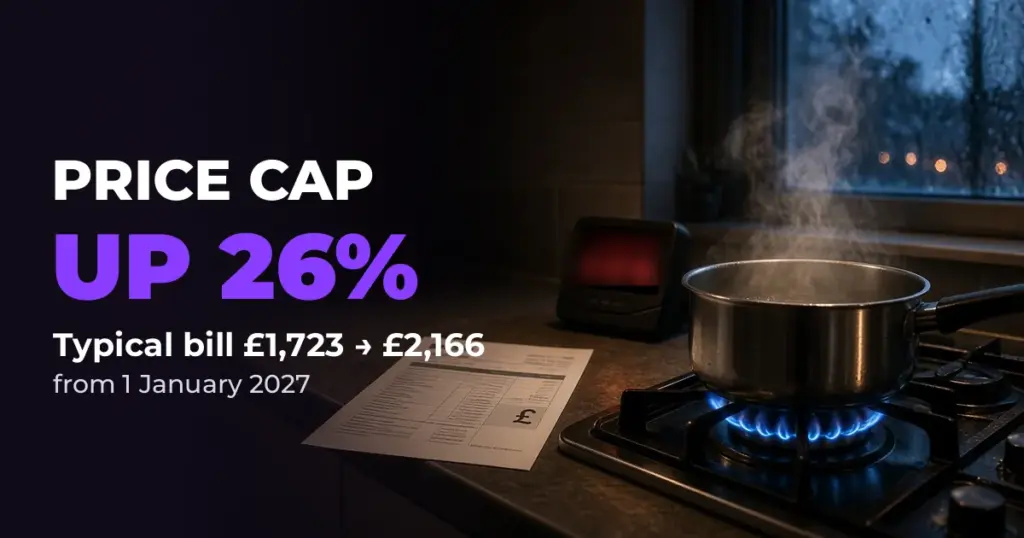
- The price cap rises 26% on 1 January 2027: £1,723 to £2,166 a year for a typical home, £443 more (Ofgem).
- Wholesale costs now make up 56% of the bill, up from 47%, driven by imported gas prices.
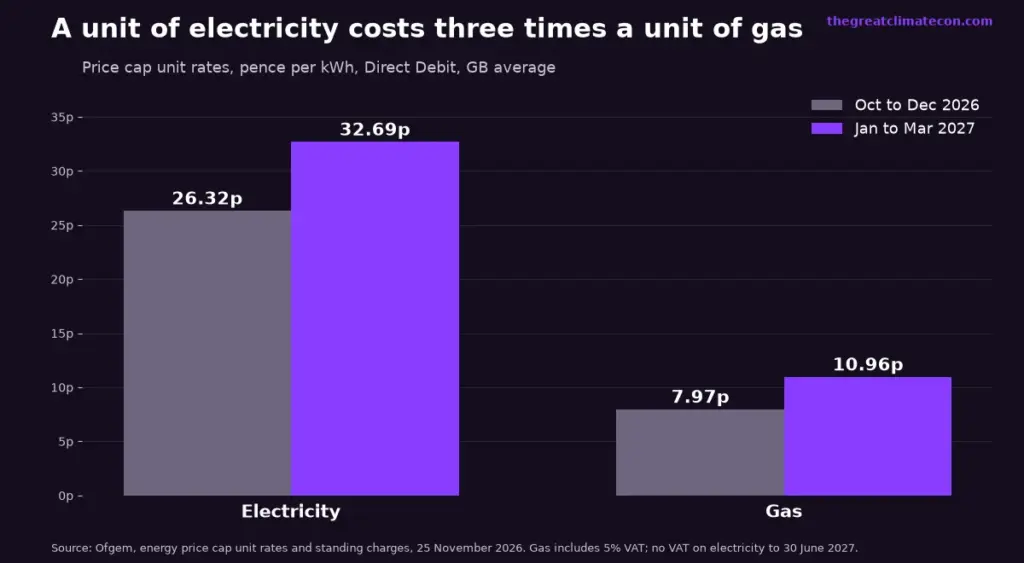
- Electricity costs 32.69p a unit against 10.96p for gas, three times as much, with the policy costs loaded onto electricity.
- Britain imports most of its gas while leaving its own in the ground. Drill the North Sea, approve Rosebank, and stop paying the world’s price for our own winter.
Read next: The Real Reason Your Electricity Bills Keep Going Up.






 Climate Con Common Sense
Available in hardcopy
 The Beginners Guide
Available in hardcopy