
How Much Warming Does Doubling CO₂ Really Cause? Climate Sensitivity, the Saturation of the CO₂ Greenhouse Effect, and Why Earth Cannot Become Venus
Climate sensitivity, the warming from a doubling of CO₂, is the single most important number in climate policy. This review sets out what the physics, the observations and the planetary science say about it, and why Earth cannot become Venus.
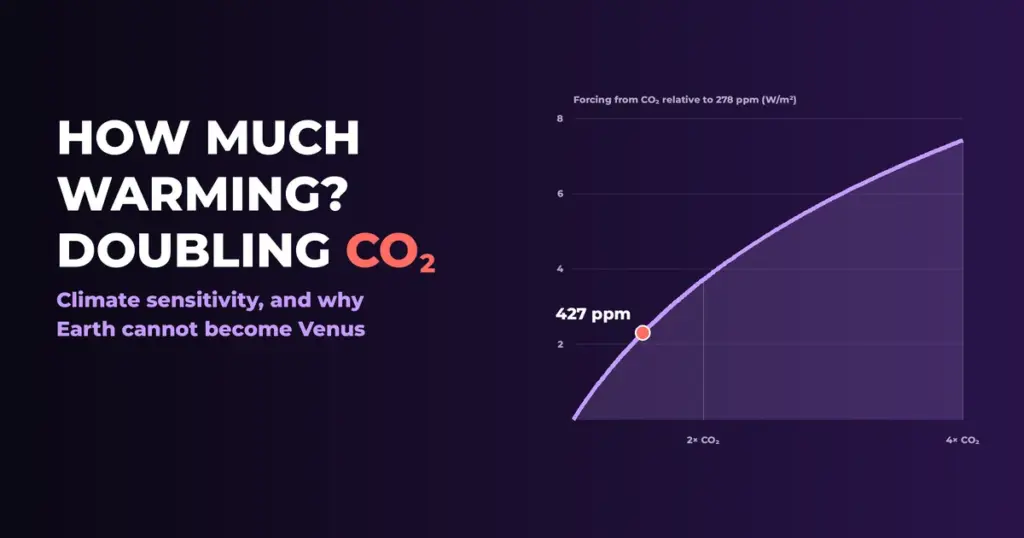
Every scary projection rests on one number: how much the world warms when CO₂ doubles. The warming effect of CO₂ is real, but it is logarithmic and diminishing, the best observational evidence points to the lower half of the IPCC range or below, and a runaway greenhouse on Earth is not on the cards.
This is the full review: 42 references, 5 charts, and the strongest counter-arguments set out and answered.
The Abstract and the Introduction are open to everyone below. The rest of the paper, including the saturation physics, the sensitivity estimates, the Venus comparison, the counter-arguments and a PDF of the whole thing, is for members.
Abstract
Abstract
Climate sensitivity, the warming produced by a doubling of atmospheric CO₂, is the single most important number in climate policy. This review examines what is known about it from three directions: the radiative physics of CO₂, the observational and model-based estimates of sensitivity, and the claim, still made in popular debate, that rising CO₂ could push Earth towards a Venus-like runaway greenhouse. First, the warming effect of CO₂ is logarithmic. The centre of the 15 µm absorption band is saturated many times over, and additional CO₂ acts only through the weaker wings of the band, so that each doubling adds the same forcing, about 3.7 W m⁻² by the simplified expression of Myhre et al. (1998) and 3.93 ± 0.47 W m⁻² in the IPCC Sixth Assessment Report (AR6). At today’s 427 ppm, more than 60% of the forcing of the first doubling from 278 ppm has already been realised, and each additional 100 ppm adds less than the last: 1.54 W m⁻² from 300 to 400 ppm, but 0.56 W m⁻² from 900 to 1,000 ppm. The effect is diminishing, not zero. Second, sensitivity estimates still span a wide range. AR6 gives a best estimate of 3 °C with a likely range of 2.5–4 °C. Energy-budget studies based on observed warming have produced median values of 1.5–1.7 °C (Lewis & Curry, 2015, 2018), and an objective-Bayesian re-analysis of the influential multi-evidence assessment behind AR6 gives a median of 2.16 °C (Lewis, 2023). Line-by-line radiative calculations give 1.4 °C with no water-vapour feedback and 2.3 °C with fixed relative humidity (van Wijngaarden & Happer, 2020). The newest generation of climate models spans 1.8–5.6 °C, and leading modellers have acknowledged a “hot model” problem in which about one-fifth of models show at least 5 °C per doubling. Third, a runaway greenhouse on Earth is not a realistic outcome of burning fossil fuels. Venus has a surface pressure of 92 bar, an atmosphere of 96.5% CO₂ holding roughly 150,000 times as much CO₂ above each square metre as Earth’s, 1.9 times Earth’s sunlight and almost no water. The threshold for a runaway on a wet planet is set mainly by sunlight, not CO₂: one-dimensional models put it at about 1.4 times present solar flux, nearly independent of CO₂, and three-dimensional models at about 10% more sunlight than today, which the Sun will not supply for at least a billion years. The specialist literature, the IPCC’s own scoping documents and even James Hansen’s later peer-reviewed work conclude that human emissions cannot trigger a true runaway. Earth itself has held CO₂ at one to two thousand ppm for long stretches of the past 420 million years with oceans and life intact. The review sets out the strongest counter-arguments to each of these conclusions and answers them. It concludes that the evidence favours a sensitivity in the lower half of the IPCC range or below, that the logarithmic physics of CO₂ rules out runaway behaviour from CO₂ alone, and that the Venus comparison has no place in serious discussion of Earth’s climate.
Keywords: climate sensitivity; equilibrium climate sensitivity; transient climate response; radiative forcing; CO₂ saturation; logarithmic forcing; energy budget; CMIP6; hot models; runaway greenhouse; moist greenhouse; Venus; palaeoclimate
Section 1
1. Introduction
Ask how dangerous carbon dioxide is, and the honest answer begins with a single number: how much the world warms when the amount of CO₂ in the air doubles. Climate scientists call this climate sensitivity. If it is low, the warming from any plausible emissions path is modest and slow, adaptation is cheap and the case for drastic and costly policy weakens. If it is high, the opposite follows. Almost every headline projection, every carbon budget and every estimate of the “social cost of carbon” depends on it.
The number has proved remarkably stubborn. In 1979 a US National Research Council panel chaired by Jule Charney gave a range of 1.5–4.5 °C. Thirty-four years later the IPCC’s Fifth Assessment Report (AR5) gave exactly the same likely range, 1.5 °C to 4.5 °C, and stated that “No best estimate for equilibrium climate sensitivity can now be given because of a lack of agreement on values across assessed lines of evidence and studies” (IPCC, 2013). The Sixth Assessment Report (AR6) narrowed the likely range to 2.5–4 °C (Forster et al., 2021), but it did so by raising the bottom of the range, while studies based on observed warming continued to point lower.
Two other questions sit alongside the number itself. The first is physical: why does more CO₂ produce less additional warming per unit, and what does the “saturation” of the CO₂ absorption bands really mean? This question is often answered badly on both sides of the debate. Some claim that saturation means CO₂ can cause no more warming at all; others deny that diminishing returns exist. Neither is correct. The second is rhetorical but influential: the claim that rising CO₂ could set off a runaway greenhouse and turn Earth into another Venus. The idea has appeared in books by prominent scientists, in documentaries and across social media. It deserves a direct examination against the planetary science.
This review takes all three questions in turn. It argues a clear position: the warming effect of CO₂ is real but logarithmic and diminishing; the best observational evidence points to a climate sensitivity in the lower half of the IPCC range or below it; the high values produced by some of the newest climate models are not supported by observations; and a runaway greenhouse on Earth driven by human CO₂ is not physically realistic. It also states plainly where these conclusions differ from the IPCC’s, and it sets out the strongest objections to each, because a case that leaves them out is not worth making. Section 2 describes the approach. Section 3 defines climate sensitivity. Section 4 sets out the physics of saturation. Section 5 reviews the estimates. Section 6 explains why the number matters. Section 7 compares Venus and Earth. Section 8 takes the counter-arguments in turn, and Sections 9 and 10 set out the discussion and conclusions.
The rest of the paper
What the full paper covers
Want to win the CO₂ argument every time? Unlock every lesson, book and course in The Climate Con Learning Centre. See the membership or support the work.
Books, plus the free e-book Rich in Energy, Poor in Policy.
The Advanced Guide To The Climate Con

The Beginners Guide To The Climate Con

Continue Your Learning
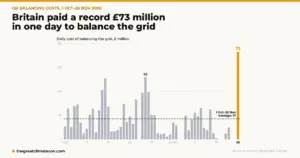
£73 Million In One Day: Britain Paid Wind Farms To Switch Off, Then Paid Gas Plants To Switch On
Ofgem’s price cap rises 26% on 1 January, taking the typical bill from £1,723 to £2,166. Here is what is really in your bill, from levies and CfDs to carbon taxes, and why our own North Sea gas is the way out.
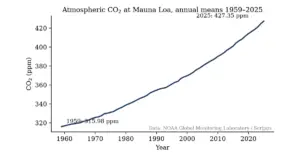
Why We Want More CO₂
Carbon dioxide is plant food. As it has risen, the planet has been getting greener, harvests have grown, and cold still kills far more people than heat. Here is the short version of the evidence.
More Carbon Dioxide, a Greener Planet: A Review of the Evidence for the Benefits of Rising Atmospheric CO₂
More Carbon Dioxide, a Greener Planet: A Review of the Evidence for the Benefits of Rising Atmospheric CO₂ Carbon dioxide is the raw material of
 Climate Con Common Sense
Available in hardcopy
 The Beginners Guide
Available in hardcopy