

CO2

Carbon dioxide is plant food. As it has risen, the planet has been getting greener, harvests have grown, and cold still kills far more people than heat. Here is the short version of the evidence.

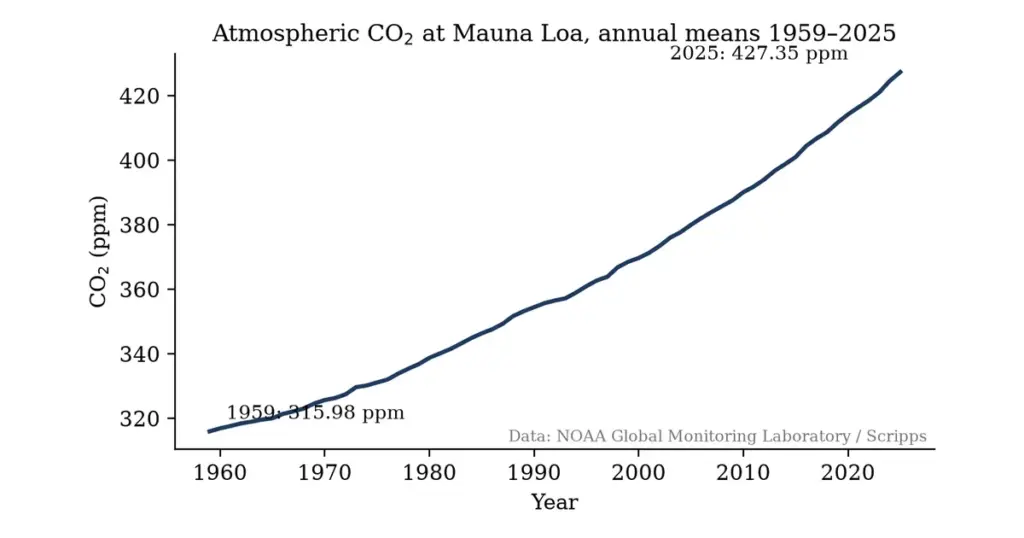
Carbon dioxide is usually talked about as a pollutant. To a plant, it is food. Every carbon atom in a loaf of bread, a forest or a human body was once CO₂ in the air, captured by a leaf. So when that gas in the atmosphere rose from about 278 parts per million before industry to 427 ppm in 2025, the interesting question is not only about warming. What did that rise do for the living world? It has been good for plants, harvests and people, and we want more of it.

The full paper on this site answers that with real studies and real datasets, not slogans. This is the short version.

Where we are

Today’s level is low

First, today’s level is low in the history of plants. In the ice ages, CO₂ fell to around 180 ppm, among the lowest concentrations land plants have ever lived with. For most of the past 420 million years it was higher than now. Wheat, rice, potatoes and almost all trees are C₃ plants, and they grow better with more CO₂ in the air.

The satellite record

The planet has been getting greener

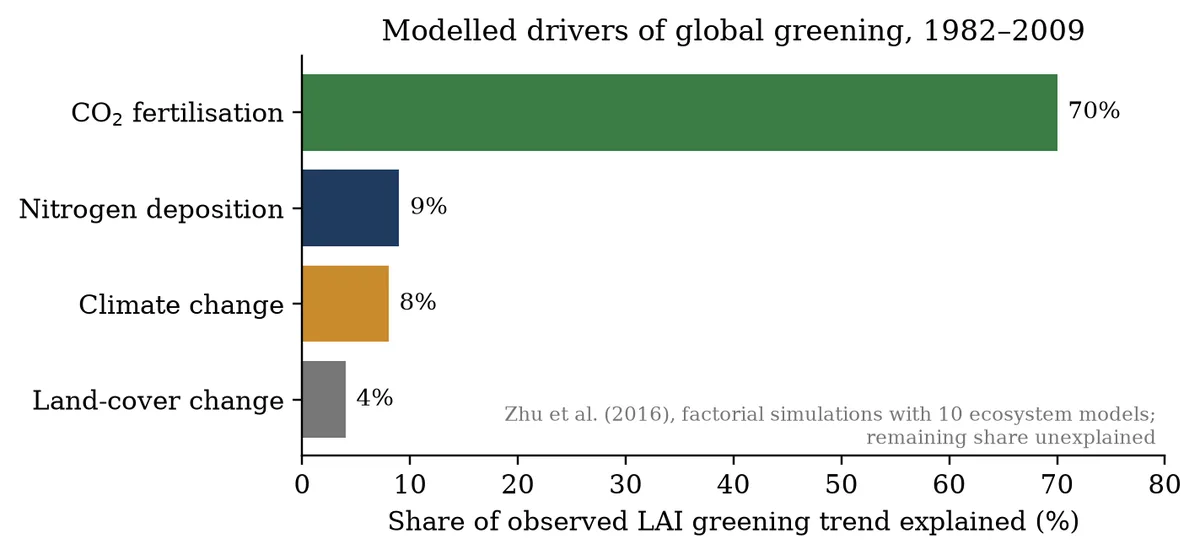
Second, the planet has been getting greener. Satellites show that between 1982 and 2009, a quarter to a half of the world’s vegetated land put on more leaf, and less than 4% went browner. Models used in that study put about 70% of the greening down to the extra CO₂. China and India have also greened through tree planting and farming, and in the Sahel the returning rains mattered most. Rising CO₂ is not the only cause, but it is the largest single one in the global picture. Forests have also been using water more efficiently, which helps most where water is scarce.

Chart. Figure 6. Modelled shares of the observed 1982–2009 greening trend attributed to each driver. Source: Zhu et al. (2016), factorial simulations with ten ecosystem models.
Modelled shares of the observed 1982–2009 greening trend attributed to each driver. Source: Zhu et al. (2016), factorial simulations with ten ecosystem models.

Food

More CO₂, more food

Third, it has helped grow food. In open-field experiments that raise CO₂ by about 200 ppm, the yield of C₃ crops rises by about 18% when other conditions are decent, and by about 10% if nitrogen is short or it is a couple of degrees warmer. Maize and sorghum, which are C₄ plants, gain little except in drought. Greenhouse guidance already recommends about 1,000 ppm, because at that level photosynthesis in most crops rises by about 50%. World cereal yields have more than tripled since 1961, mostly from better seeds, fertiliser and machinery, with a real but smaller share from the rise in CO₂.

The physics

Each extra ppm warms less

Fourth, the warming effect of each extra unit of CO₂ gets smaller as the concentration rises. That is a basic result in the physics, often described as a logarithmic effect. It does not mean further warming is nothing. It does mean the first 150 ppm of increase has already done more warming work than the next 150 ppm will.

People

Cold still kills far more than heat

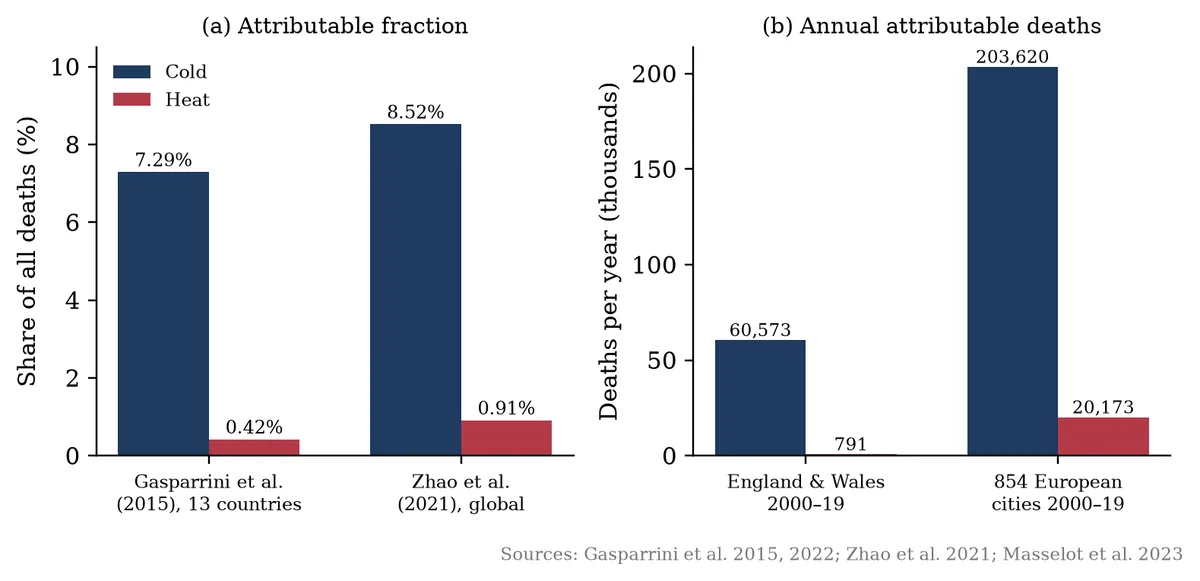
Fifth, in today’s climate cold still kills far more people than heat. Across 13 countries, 7.29% of deaths were linked to cold and 0.42% to heat. Worldwide the split is about 8.52% to 0.91%. In England and Wales, a typical year has had about 60,573 deaths linked to cold and 791 linked to heat. Moderate warming would cut cold deaths in temperate countries. Under high emissions, the hottest and poorest regions would still face a net increase.

Chart. Figure 8. Deaths attributable to cold and heat. (a) Share of all deaths: Gasparrini et al. (2015), 13 countries, 1985–2012; Zhao et al. (2021), global, 2000–2019. (b) Annual attributable deaths: England and Wales, 2000–2019 (Gasparrini et al., 2022); 854 European cities, adults aged 20 and over, 2000–2019 (Masselot et al., 2023).
Deaths attributable to cold and heat. Sources: Gasparrini et al. (2015), Zhao et al. (2021), Gasparrini et al. (2022) and Masselot et al. (2023).

The costs

What the paper does not dodge

There are real costs, and the paper does not dodge them. Grain grown at higher CO₂ can have a little less zinc, iron and protein, though breeders already have varieties that hold those levels. In wild ecosystems, a shortage of nitrogen or phosphorus can limit the extra growth. Greening may be slowing in some places. Warming can cut yields in some regions even as CO₂ lifts them in others. The oceans have become a little less alkaline as they take up CO₂, and sea level has risen by about 20 cm since 1901.

The full paper

Read the full paper

The rise in CO₂ has already given us a greener planet, more photosynthesis, more efficient use of water, and higher yields of wheat, rice and soybeans. Carbon dioxide is plant food, and it is the foundation of the food chain. We want more of it. The evidence, the data and the charts are in the full paper:

More Carbon Dioxide, a Greener Planet

The opening is free to read.

Want to win the CO₂ argument every time? Unlock every lesson, book and course in The Climate Con Learning Centre. See the membership or support the work.

Books, plus the free e-book Rich in Energy, Poor in Policy.

The Advanced Guide To The Climate Con

The Beginners Guide To The Climate Con

Continue Your Learning

See all articles

Browse every article in the War Room.

Leave a Comment

The Climate Con

Sign up to our newsletter

The latest updates from The Climate Con, straight to your inbox.

No spam, unsubscribe anytime. We use Brevo as our marketing platform; by subscribing you agree your details are sent to Brevo for processing under their terms of use.

For more information go to Thegreatclimatecon.com