
What Is A Photochrom?
A photochrom is a colour print made from a black-and-white photograph. The Library of Congress and the Zentralbibliothek Zürich still hold thousands of them, published mainly from the 1890s to the 1910s. That is why they are such useful dated evidence of the coasts as they stood then.
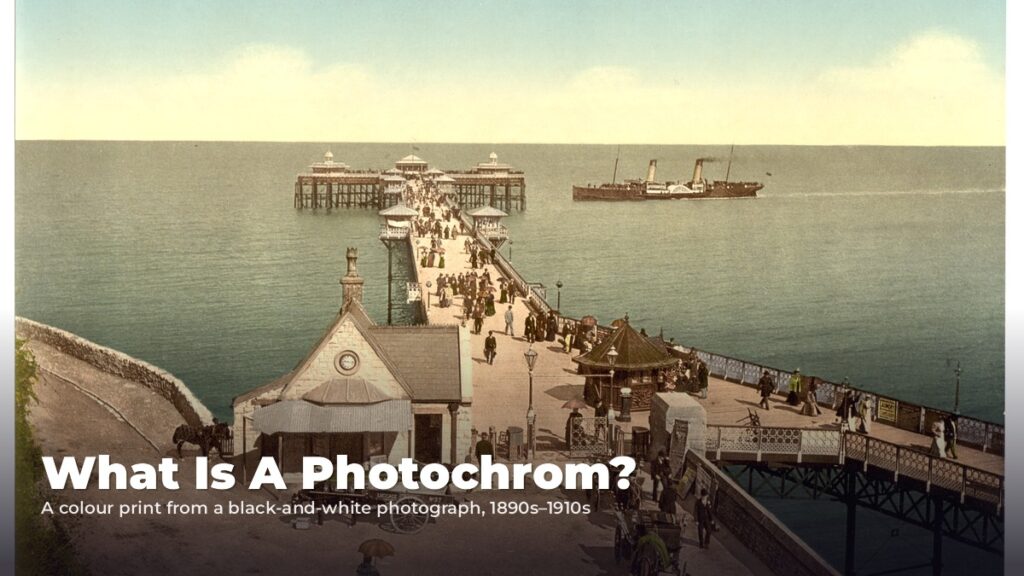
By Travis Cook, The Great Climate Con.
When people first see a photochrom, they often think they are looking at a modern colour photograph, or at a computer colouring-in of an old black-and-white view. They are not.
A photochrom is an ink print, made from a black-and-white photographic negative and sold as a souvenir at a time when colour photography was still rare. The colours can be rich enough to fool the eye. Look closer, and you are looking at a physical print that was catalogued, numbered and offered for sale then, not a reconstruction made now.
We are fortunate that libraries kept them. The Library of Congress Photochrom Prints collection holds thousands of views of Europe, the Middle East and North America. So does the Zentralbibliothek Zürich, which was given the Zurich publisher’s annual production for years as the prints came out. When we set one of these views beside a photograph taken from the same spot today, we are not looking at a guess. We are looking at a coast that was recorded, printed and sold at the time.
What it is
A colour print from a black-and-white negative, not a colour photograph
The Library of Congress describes photochrom prints as ink-based images, produced through “the direct photographic transfer of an original negative onto litho and chromographic printing plates.” They look like colour photographs. They are not. They are photolithographs, usually about 6.5 by 9 inches, printed in ink.
The Library attributes the invention of the technique to Hans Jakob Schmid (1856–1924), who worked for the Swiss firm Orell Füssli, in the 1880s. Füssli published the prints through a company using the imprint Photochrom Zürich, later Photoglob Zürich. From the mid-1890s the process was licensed to the Detroit Photographic Company — later the Detroit Publishing Company — in the United States, and to the Photochrom Company in London.
The prints flourished in the 1890s and early 1900s. The Library says the wider span of production ran from the late 1880s well into the 1900s, and that the views in its collection were published primarily from the 1890s to the 1910s. They were sold at tourist sites and through mail-order catalogues, collected in albums or framed for display. A typical print carries a gold-lettered caption along one edge, an inventory number, and, on Zurich issues, the initials “P.Z.”
The Zentralbibliothek Zürich holds more than 10,000 photochrom prints in its Graphische Sammlung und Fotoarchiv. Between 1892 and 1914 it received each year’s production, except the large formats, as a gift from the publisher, along with sales catalogues and the Photoglob Bulletin. That is not a modern image bank assembled after the fact. It is a library collection built as the prints were being made and sold.
- Ink, not a colour photograph: a photolithograph from a black-and-white negative
- Invented in Zurich in the 1880s, at Orell Füssli, and published as Photochrom / Photoglob Zürich
- Licensed in the mid-1890s to the Detroit Photographic Company (later Detroit Publishing Company) and to the Photochrom Company in London
- Published mainly from the 1890s to the 1910s, and still held in the thousands by the Library of Congress and the Zentralbibliothek Zürich
How it was made
One asphalt-coated stone for each colour, usually six and often more than ten
The method was a printing process, not a single exposure on colour film. The Library of Congress explains that each colour in the final print required a separate asphalt-coated lithographic stone, usually a minimum of six stones and often more than ten. The original was a black-and-white negative. Each stone carried one colour, and the finished print was built up by printing those colours onto the sheet.
That is why the prints can look so convincing, and why they are still not colour photographs. Under a magnifying glass, the Library notes, the small dots of the ink-based photomechanical image become visible. The same process also allowed the prints to be produced in quantity and sold cheaply as souvenirs.
The names of the original photographers are rarely printed on the views themselves. What the buyer got was a numbered colour print of a named place, issued by a publisher whose catalogues we can still read.
- Start with a black-and-white negative, transferred photographically onto lithographic printing stones
- One asphalt-coated stone for each colour, usually at least six and often more than ten
- The finished sheet is an ink print, mass-produced and sold, not a unique hand-coloured photograph
Not AI
These were made and sold at the time, as physical prints with numbers you can still look up
None of this is artificial intelligence, and it is not a modern colourisation applied to an old photograph last week. The prints were physical objects, made and sold at the time. They carry inventory numbers. Publishers listed them in sales catalogues. The Library of Congress still catalogues them as photomechanical prints, and often dates an individual European view “between ca. 1890 and ca. 1900.” Titles in its records are frequently taken from the Detroit Publishing Company’s 1905 Catalogue J, foreign section.
That dating needs an honest caveat, and the Library gives it. Clues to when a photochrom was first published can be taken from those catalogues. The original negative, though, may have been taken years before the colour print was issued. A photochrom is evidence of a view that had been photographed and then published as a numbered print. It is not, by itself, a shutter date.
The colours also need an honest caveat. They were chosen in the print shop. The Zentralbibliothek Zürich has pointed out that printers could even turn a daylight view into a so-called night effect. So we do not treat the tint as a colour photograph of the sky or the sea. We treat the print as a contemporary, published record of a real view, with a number and a catalogue trail you can still look up.
- Made and sold at the time, as souvenirs and catalogue prints, not generated yesterday
- Physical ink prints with captions, inventory numbers and, on Zurich issues, the initials P.Z.
- Still catalogued by the Library of Congress and the Zentralbibliothek Zürich, often with a date range rather than a single year
- The negative may be older than the print, and the colours were chosen by the printer
The coasts
That is why they are such useful dated evidence in then-and-now sea-level comparisons
That is why these prints are so useful in our Sea Level Rise Meme Catalogue. If you want to know how a named stretch of coast appeared around the turn of the twentieth century, a photochrom gives you a published view of that place, made from a photograph, issued with a number, and kept in a public collection. Set it beside a later photograph taken from the same sort of standpoint, and you can see what has changed in the scene and what has not.
You can still walk many of these places. The pier, the promenade and the harbour wall are often still there. That is rather good news, and it is also a reason to be careful. A photograph shows how a coast looked at a moment, not a tide-gauge reading of global mean sea level. Tide, viewpoint, weather and the movement of the land all affect what you see. We say so, because the truth is stronger than a scare story, and stronger than an over-claim.
Used honestly, the prints are a gift. They are dated closely enough to be useful, public enough to be checked, and old enough to sit beside the claims we have all been told about coasts that were supposedly about to vanish. For the wider measurements, see New Study Confirms No Acceleration In Sea Level Rise and The Fact That Sea Levels Have Not Risen, Is Not Proof That Sea Levels Haven’t Risen.
- A named place, a numbered print, a public catalogue — the view can be looked up, not merely asserted
- Then-and-now comparisons work best from a similar standpoint, with tide and later building changes kept in mind
- A photochrom is not a tide gauge, and it is all the more useful when we do not pretend otherwise
The views
Llandudno, Aberystwyth and Ilfracombe, as the Library of Congress still holds them
Here are three British views from the Library of Congress collection, each dated there “between ca. 1890 and ca. 1900,” each with a Photoglob print number, and each still easy to recognise. Ilfracombe also appears as a then-and-now pair in our Sea Level Rise Meme Catalogue.
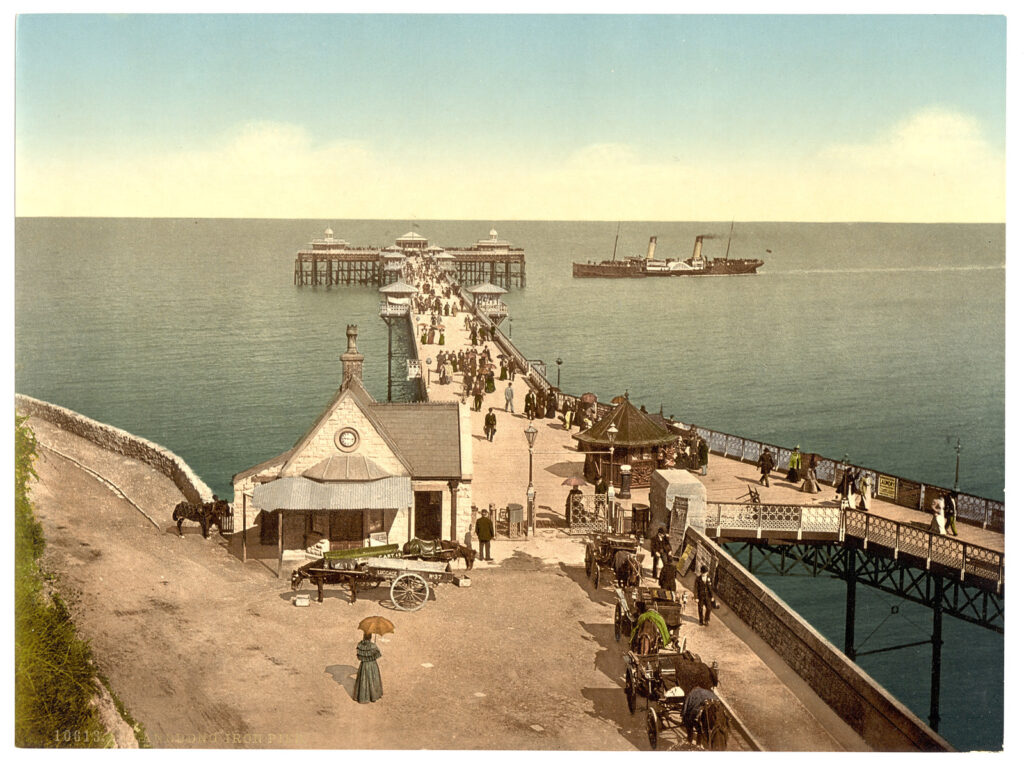
Iron pier, Llandudno, Wales. Photochrom print no. 10613, published between ca. 1890 and ca. 1900. Library of Congress, Prints & Photographs Division, Photochrom Prints Collection, LOT 13408, no. 108; LC-DIG-ppmsc-07444.
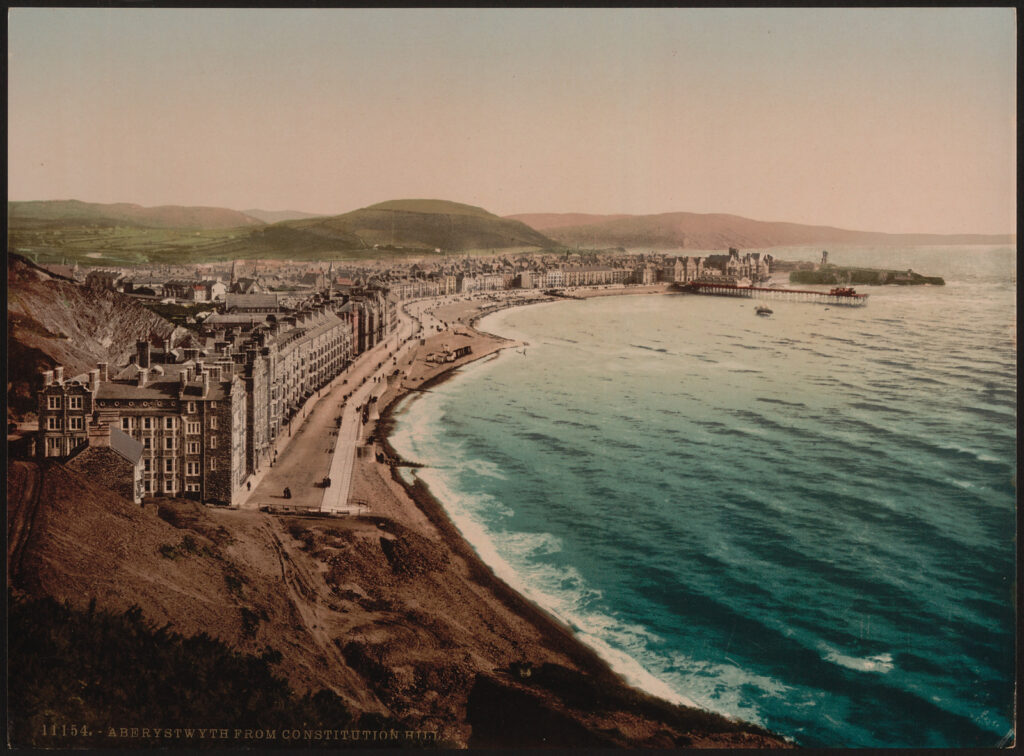
From Constitution Hill, Aberystwith, Wales. Photochrom print no. 11154, published between ca. 1890 and ca. 1900. Library of Congress, Prints & Photographs Division, Photochrom Prints Collection, LOT 13408, no. 007; LC-DIG-ppmsc-07343.
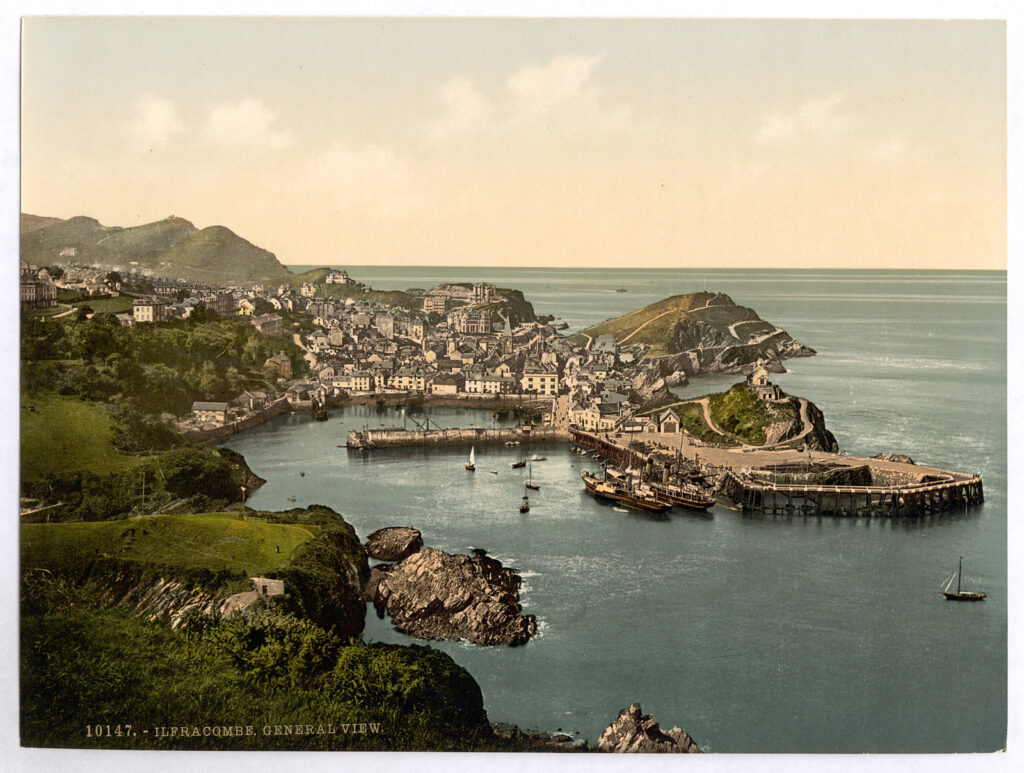
From Hillsborough, Ilfracombe, England. Photochrom print no. 10147, published between ca. 1890 and ca. 1900. Library of Congress, Prints & Photographs Division, Photochrom Prints Collection, LOT 13415, no. 469; LC-DIG-ppmsc-08456.
The objection
“But the colours were added by the printer, so these are not evidence”
“But the colours were added by the printer, so these are not evidence.”
The colours were added by the printer. That is true, and it is worth saying plainly. A photochrom is not a colour photograph, and it is not a laboratory measurement of the sea. The Zentralbibliothek Zürich has shown how far the colouring could be taken, including night effects worked up from daylight views.
The evidence we rely on is not the tint. It is the photograph underneath, transferred onto printing stones and issued as a numbered print that was sold at the time and is still held in public collections. The pier, the terrace, the harbour wall and the skyline are in the original view. The catalogue number is on the print. The Library of Congress and the Zentralbibliothek Zürich still have the records. That is a very different thing from a modern colourisation, and a very different thing from a claim with no picture behind it.
The bottom line
The bottom line
A photochrom is a colour ink print from a black-and-white photograph, made and sold around the turn of the twentieth century. It is not AI, and it is not a modern colourisation. Used with the caveats the libraries themselves give us — catalogue dates rather than invented shutter years, and printer-chosen colour rather than colour photography — it is one of the clearest windows we have onto named coasts as they were then published. The places in these pictures are, in many cases, still there to visit. That is worth being grateful for.
- A photochrom is an ink print from a black-and-white negative, not a colour photograph and not an AI colourisation
- They were produced from the late 1880s well into the 1900s and published mainly in the 1890s–1910s
- Prints carry numbers and catalogue entries you can still look up at the Library of Congress and the Zentralbibliothek Zürich
- The Library often dates a view “between ca. 1890 and ca. 1900”, and the original photograph may be older than the print
- The colours were chosen in the print shop; the value for then-and-now coastal comparisons is the photographed view itself
- Tide and viewpoint matter — a photochrom is historic evidence of a scene, not a tide-gauge reading
Books, plus the free e-book Rich in Energy, Poor in Policy.
The Advanced Guide To The Climate Con

The Beginners Guide To The Climate Con

Continue Your Learning

Wind Farm Map UK
UK Wind Farm Map: 834 Operational Wind Farms Onshore operational 785 15,508.35 MW Offshore operational 49 16,011 MW Offshore under construction 8 11,845 MW Open
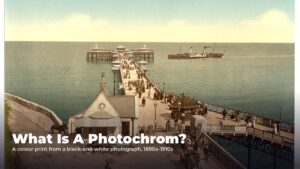
What Is A Photochrom?
A photochrom is a colour ink print made from a black-and-white photograph, produced and sold mainly from the 1890s to the 1910s. That is why these views are such useful dated evidence of historic coasts.

17.2 Million Trees, 8,611 Hectares, And That’s Only Public Land
17.2 Million Trees, 8,611 Hectares, And That’s Only Public Land Forestry and Land Scotland says 8,611 hectares of woodland have been felled for wind farms
Continue your learning at Thegreatclimatecon.com