
17.2 Million Trees, 8,611 Hectares, And That's Only Public Land
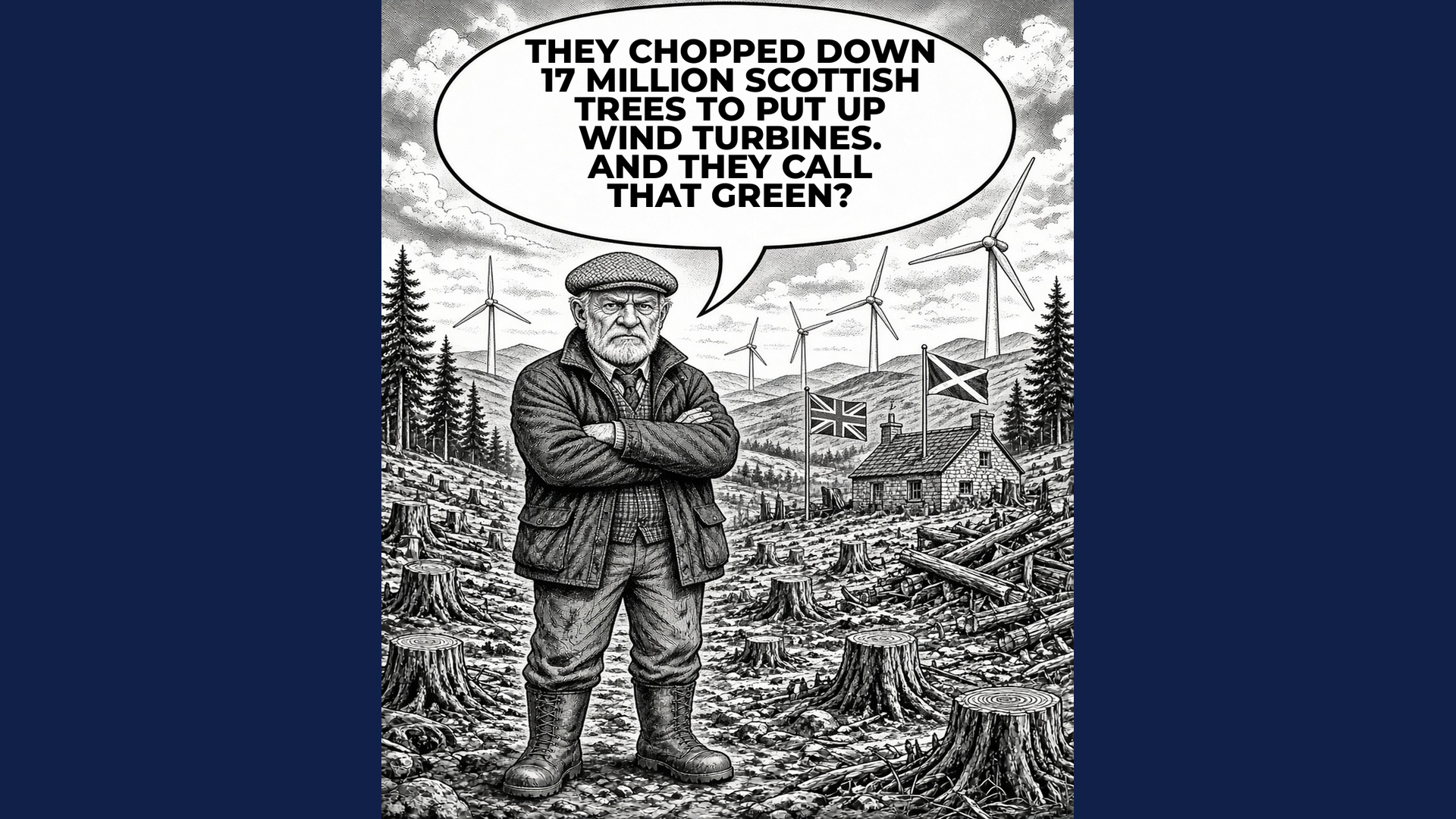
Forestry and Land Scotland says 8,611 hectares of woodland have been felled for wind farms on the national forest estate since 2000, an estimated 17.2 million trees. That figure covers only the land FLS manages. Private forests are not included, and FLS says it does not have the data to calculate how much woodland was actually lost.
They still call it green. They cut down millions of Scottish trees so the turbines could go up, and they use that word anyway. The official figures are in, and they only cover the national forest. Private woods come on top.
The good news, the part they will not tell you, is that this is not the end of the world. Carbon dioxide is plant food. The Earth is getting greener. We can be grateful we live in these times. Here is what the numbers actually say.
The official numbers
In an environmental information response dated May 2026, published by the Scottish Government in July, Forestry and Land Scotland said that 8,611 hectares of woodland had been felled for wind-farm development on the national forest estate since 2000. Using an average of 2,000 trees per hectare, FLS put the total at an estimated 17.2 million trees, “over 26 years”.
That is the official estimate. It is not a count of every stem. In a later reply, dated 10 August 2026, FLS said the 2,000 figure “is intended as a guide and is based on initial planting densities”, and that older crops naturally hold fewer surviving trees as they age (FLS, SEC-26-151). The firmer number is the area: 8,611 hectares.
The July response is also clear about scope. The data “relates to renewable developments on Scotland’s national forests and land, which Forestry and Land Scotland (FLS) manage on behalf of the Scottish Ministers.” FLS “do not hold information regarding land that we (FLS) do not manage.” Private forests are therefore not in the 17.2 million, and the Scotland-wide total is higher.
Only the national forest
FLS looks after 639,103 hectares, about 8% of Scotland’s land area. A little over half of that is woodland (FLS Corporate Plan 2026-2030). The 8,611 hectares felled for wind farms is 1.3% of the whole estate (our arithmetic).
The agency has published this total before, and it has grown. A January 2020 response put the figure, to the end of 2019, at 6,994 hectares, an estimated 13.9 million trees, on the same 2,000-per-hectare method (FOI/19/02646). By April 2024 it was 8,503 hectares and 17,005,100 trees (EIR/202400407867). FLS says the latest rise, from 8,503 to 8,611 hectares, “represents an additional year of data” (SEC-26-151).
It does not hold a year-by-year breakdown. What it did release, on 10 August 2026, is a scheme-by-scheme list: 33 development entries totalling 8,611.44 hectares (D Scheme Felling Totals 2026). With the exception of transmission infrastructure, that total includes woodland removed for access roads, substations, compounds, borrow pits and other associated works, as well as the turbine sites themselves. FLS says the figures “relate only to conifer plantations rather than to native or ancient woodland sites.”
The biggest schemes
One site stands out. Harestanes, in Dumfries and Galloway, accounts for 684 hectares on its own. Whitelee 2 and Whitelee 1, on the Eaglesham Moor, add 644 and 601 hectares. Together those two Whitelee entries come to 1,245 hectares. Halsary in Caithness is 613, Arecleoch 584, Beinn an Tuirc 2 550 and Kilgallioch 530. The ten largest entries come to 5,536 hectares, 64% of the official total (our arithmetic, from the FLS list).
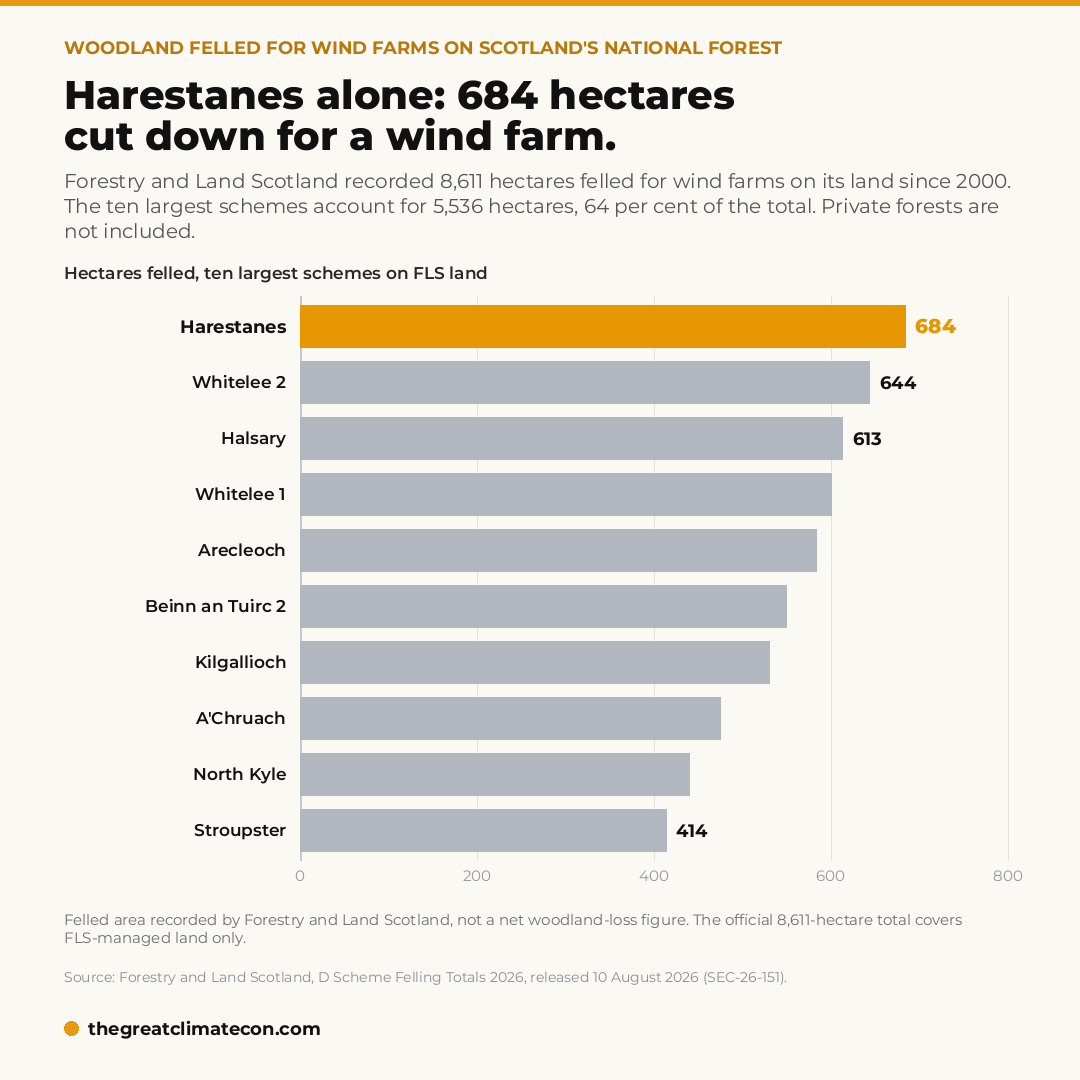
Chart credit: Areas are the woodland FLS recorded as felled for each development, including tracks, substations, compounds and borrow pits, but not transmission infrastructure. They are not a net woodland-loss figure. The official 8,611-hectare total covers FLS-managed land only. Source: Forestry and Land Scotland, D Scheme Felling Totals 2026, released 10 August 2026 (SEC-26-151).
The peat under the turbines
The trees are only part of what gets torn up. Much of upland Scotland sits on peat, ancient wet ground that has built up over thousands of years. More than 20% of Scotland is covered by it, according to NatureScot. To put up a turbine, they dig out its base, drain the ground for access tracks and clear the forest around it.
Now here is the absurd part. By the net zero crowd’s own rules, digging up peat releases carbon dioxide, the very gas they say the turbines exist to save. So the Scottish Government built an entire carbon calculator for wind farms on Scottish peatlands, a spreadsheet to prove that ripping up a bog and felling a forest is somehow good for the planet once enough electricity has been made. FLS assures us the “payback period is usually less than two years.” Yet in August 2026 the same agency admitted it “does not hold project-level carbon assessments” for its own sites.
Even their own scientists can’t make the sums add up. In 2014, Jo Smith, Dali Rani Nayak and Pete Smith of the University of Aberdeen, writing in Energy Policy, found that “by 2040 most sites will not reduce carbon emissions even with careful management,” and said “future policy should avoid constructing wind farms on undegraded peatlands.” So on their own terms, the turbines fail.
On ours, the whole exercise is upside down. Carbon dioxide is plant food, and more of it is greening the planet. A calculator for counting it is a monument to a wrong idea. The real losses are the ones you can see: millions of trees, miles of tracks gouged through the hills, and wild land turned into an industrial site.
And they want almost twice as many turbines
The good news they will not tell you
The bottom line
- 8,611 hectares of woodland have been felled for wind farms on Scotland’s national forest estate since 2000, according to Forestry and Land Scotland.
- FLS’s own estimate is 17.2 million trees, using 2,000 trees per hectare. That 2,000 figure is a planting-density guide, not a stem count. The firmer number is the area.
- The figure covers FLS land only. Private forests are not included, so the Scotland-wide total is higher.
- The ten largest schemes account for 5,536 hectares, 64% of the official total. Harestanes alone is 684 hectares.
- Policy says developers should replant or provide compensatory planting. FLS says it does not have the data to calculate the net woodland loss, and it does not hold the compensatory-planting totals.
- Turbine bases and tracks dig up and drain Scotland’s peat bogs. The government even built a carbon calculator to argue that is green, while FLS admits it holds no project-level carbon assessments. Carbon dioxide is plant food: the real losses are the trees and the wild land.
- Scotland already has 10.9 GW of onshore wind. The government wants a minimum of 20 GW by 2030.
- The planet is not dying. Carbon dioxide is plant food, and the Earth is getting greener.
Continue Your Learning
- Renewable Energy Is Causing Fuel Poverty For Millions In The UK
- The Real Reason Your Electricity Bills Keep Going Up
- The World’s Most Expensive Electricity Is Made In Britain: Here’s Exactly Where Your Money Goes
- Net Zero To Cost UK £803 Billion By 2050
- What Would Happen If The UK Dropped Net Zero Tomorrow?