


Debunking The 97% Consensus Myth
No, 97% of scientists do not agree we’re causing climate change
The Origins Of The 97% Consensus Lie
Other surveys fare no better. In 2009, University of Illinois researchers surveyed over 10,000 Earth scientists with two questions: Have global temperatures risen since pre-1800s? And is human activity a significant factor? Of 3,146 responses, 90% agreed temperatures had risen, but only 82% saw human activity as significant. Among meteorologists, just 64% agreed, showing a third of weather experts doubted a major human role. Media spotlighted 75 of 77 self-described climate experts agreeing, yielding a 97% figure—yet this was just 2% of respondents. This “consensus” only confirmed some warming since 1800 and partial human contribution, not danger or urgency, as those questions were absent or unreported and we want it to be a bit warmer!
Debunking The 97% Consensus Myth
The widely touted 97% scientific consensus on human-driven climate change, a linchpin of the mainstream climate agenda, is a myth rooted in flawed methodology and selective interpretation. This claim originates from a 2013 study by John Cook et al., published in Environmental Research Letters under the title “Quantifying the Consensus on Anthropogenic Global Warming in the Scientific Literature,” which analysed 11,944 abstracts of climate-related papers. The study’s assertion that 97% of scientists agree humans are the primary cause of recent warming has been used to silence dissent and justify aggressive net-zero policies. However, a critical examination reveals significant distortions, aligning with my skepticism of the climate narrative and its tendency to overstate the role of CO2, a natural atmospheric component, in global warming. This report dissects how this consensus was fabricated and its implications.
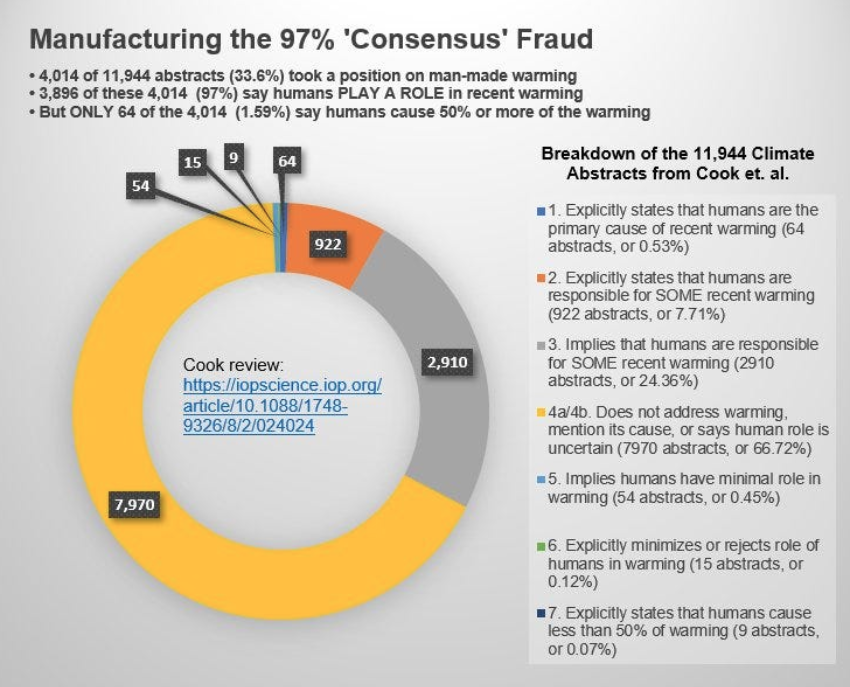
Cook’s study reviewed 11,944 abstracts, finding that 4,014 (33.6%) took a position on man-made warming. Of these, 3,896 (97% of the 4,014) suggested some human contribution, but only 64 (1.59%) explicitly stated humans cause 50% or more of the warming. The remaining 7,970 abstracts (66.72%) were neutral or uncertain. The study categorised them as follows: 64 (0.53%) affirmed humans as the primary cause, 922 (7.71%) linked humans to some warming, 2,910 (24.36%) implied a role, and 7,970 (66.72%) didn’t address it or expressed uncertainty, with 54 (0.45%) implying minimal impact and 15 (0.12%) rejecting human influence. The 97% figure, however, hinges on the narrow subset of 4,014 papers, misrepresenting the broader sample.
The fabrication stems from methodological flaws. Cook’s team pre-screened abstracts, excluding those challenging the narrative, and relied on a self-reported author survey where only 1,189 of 8,547 responded, with 1,079 agreeing to some human role, far from a 97% consensus. The study’s definition of “consensus” included any human contribution, not the dominant cause, inflating the statistic. Richard Tol’s 2016 critique highlighted that only 1.6% of all abstracts supported humans causing over 50% of warming, while David Legates’ re-analysis found just 0.3% fully endorsed the claim. These discrepancies were overlooked, with data misclassification and lack of independent verification further undermining the study.
The myth’s amplification by media, the IPCC, and policymakers turned it into a rallying cry, despite its shaky foundation. This along with the hockey stick graph are two of the most common pieces of propaganda used by the climate cult. However, this wasn’t the beginning of The Climate Con, no the roots of this agenda stretch back to the 1960’s which we covered in depth in this report. This 97% consensus myth is not based in reality and the truth is most scientists do not agree we are the primary causers of climate change.
There, that’s another piece of the scam dismantled before you even had a chance to finish your cup of tea. Don’t stop there though, there is still much more work to do, things to learn and people to educate. The Climate Cult work tirelessly day by day to shape the narrative and it is up to us to match their consistency with our own dedication. We have truth on our side so we have an advantage, only if we sit on our loins and don’t take action can the enemy win.
Continue Your Learning

36-Year High: They Said The Great Barrier Reef Was Dying. Then It Recorded The Most Coral Since Monitoring Began
In 2022 Australia’s official reef monitors recorded the most coral on the northern and central Great Barrier Reef in 36 years. Ten years earlier, the forecast was 5–10%.

75 Labour MPs Reportedly Want 300 Million Barrels Of British Oil Left In The Ground. So We Just Import It Instead?
A reported 75 Labour MPs have signed a letter against Rosebank, around 300 million barrels of oil west of Shetland. Stop it and Britain loses £8.5bn of investment and 525 UK jobs, and still buys the oil, just from abroad.

Wind Farm Map UK
Every operational UK wind farm on one map: 834 sites and 31,519 MW (31.5 GW) from the government’s DESNZ Renewable Energy Planning Database, July 2026 extract.

What Is A Photochrom?
A photochrom is a colour ink print made from a black-and-white photograph, produced and sold mainly from the 1890s to the 1910s. That is why these views are such useful dated evidence of historic coasts.

17.2 Million Trees, 8,611 Hectares, And That’s Only Public Land
Forestry and Land Scotland recorded 8,611 hectares felled for wind farms on Scotland’s national forest since 2000, about 17.2 million trees. Private forests are not included.

Britain Demolished Its Backup: 34 GW of Reliable Power Gone While China Built 1,052 GW of Coal
Britain closed 33.9 GW of coal and oil plant from 21 stations now demolished, being pulled down, or otherwise taken off the grid. In the same years China commissioned 1,052 GW of new coal, about 31 times as much. When transmission-metered wind averaged just 0.60 GW on 8 November, the grid leaned on gas and paid emergency prices.
Track The Cost Of Net Zero
Stay ahead of the transition with real-time cost monitoring and optimization tools.
Access Cost Trackers →