


CO2

£73 Million In One Day: Britain Paid Wind Farms To Switch Off, Then Paid Gas Plants To Switch On

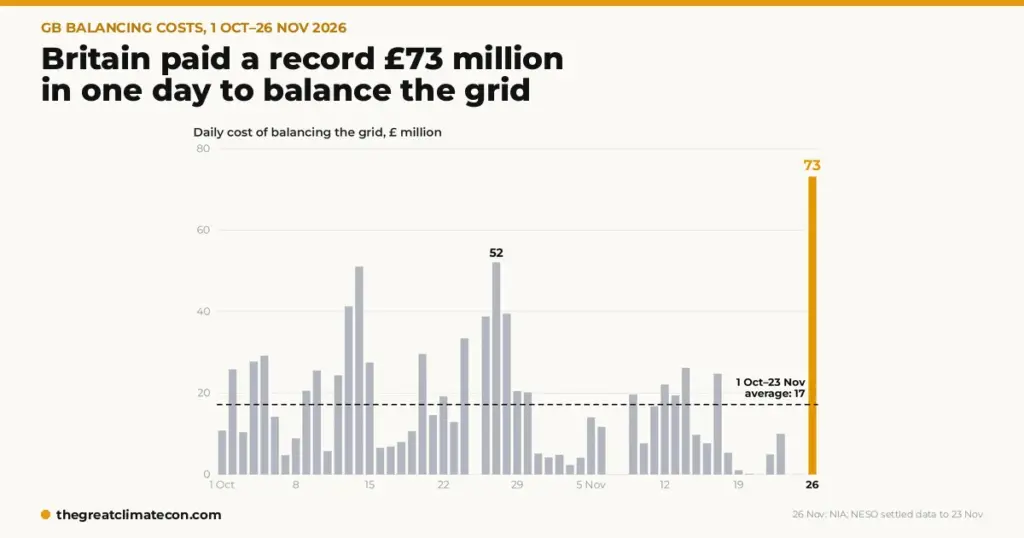
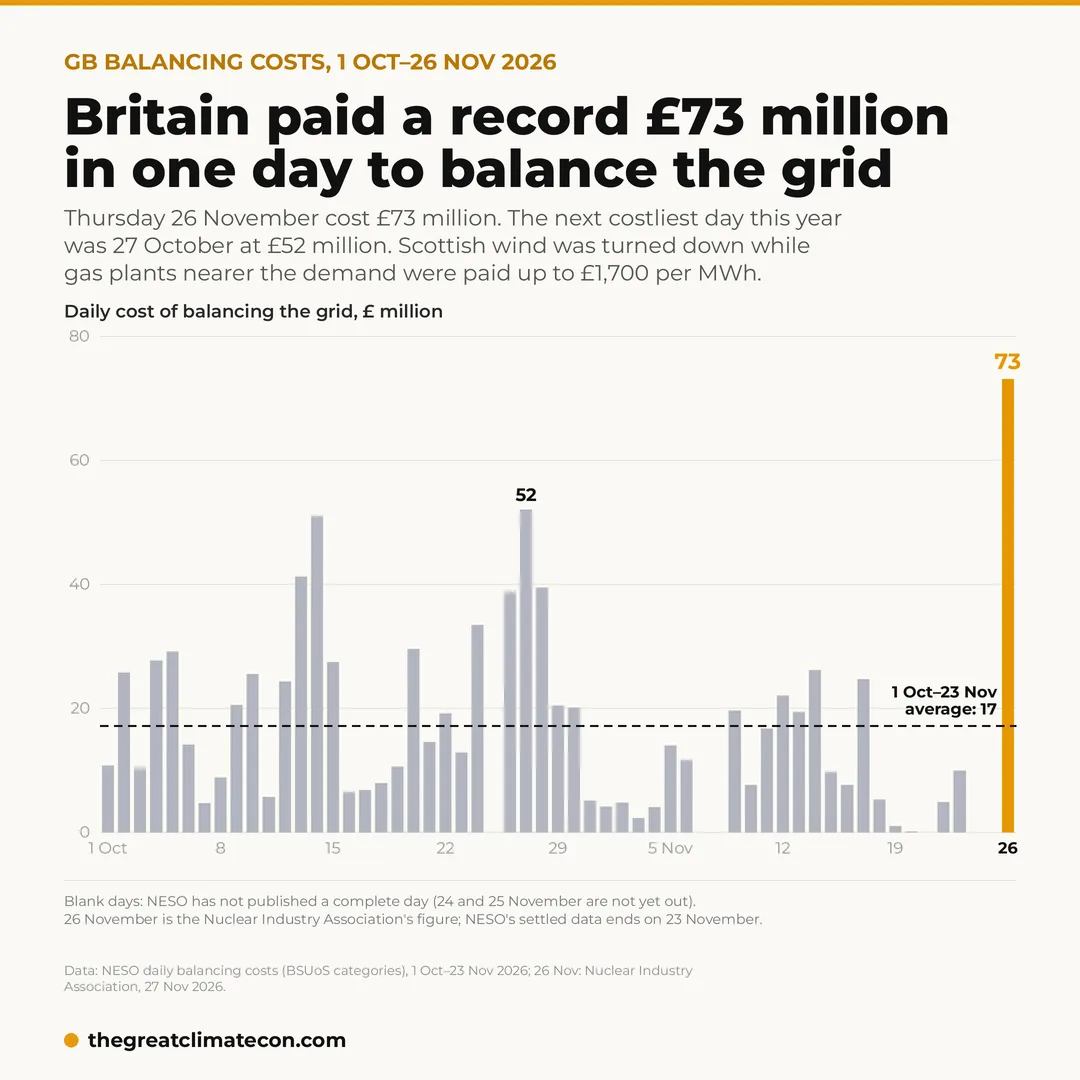
On Thursday, Britain paid more to balance its electricity grid in a single day than on any other day this year. The money was spent because the power was in the wrong place.

The Nuclear Industry Association put the cost of balancing the grid on Thursday 26 November at a record £73 million, with gas plants paid up to £1,700 per megawatt hour, ten times the normal price (NIA, 27 November). The costliest day before it this year was 27 October, at £52 million, in the National Energy System Operator’s own daily figures (NESO). NESO has not yet published its settled figure for the day, and online trackers had it above £60 million by late afternoon (GB News).

Wind in the north, demand in the south

Wind farms in Scotland and the North are often paid to switch off when the grid is too congested to carry their power further south (Telegraph). On Thursday, planned work on the north–south lines made that worse. NESO said there were “significant constraints on the network caused by maintenance and reinforcement work by transmission owners” (Telegraph). Montel, the energy data company, said the boundary that separates northern from southern Scotland was running at about half of its 3.4 GW maximum because of that work (Energy Voice).

So the wind that could not travel south was switched off, and the grid operator paid the wind farms to do it. Then it had to find the missing power somewhere else. Remote wind farms were paid to switch off while gas plants nearer the demand were paid to fire up, at short notice and at a steep price (GB News). Power that had been exported to the Continent was bought back at a higher price too.

Independent energy analyst Kathryn Porter described it like this: “Neso has to curtail this wind but then the market is short once it’s taken away. So Neso has to bring up gas plant in the balancing mechanism and buy back the exports.” She added: “Regularly now we see Neso doing expensive last-minute balancing actions instead of planning ahead properly” (Telegraph). On Thursday morning she put the day’s cost at £11 million by 7.30am and about £20 million by 11am (Energy Voice).

We have been tracking exactly this on our live map of wind farms being paid to switch off:

https://thegreatclimatecon.com/wind-constraint-payments-map/

October was already the costliest month ever

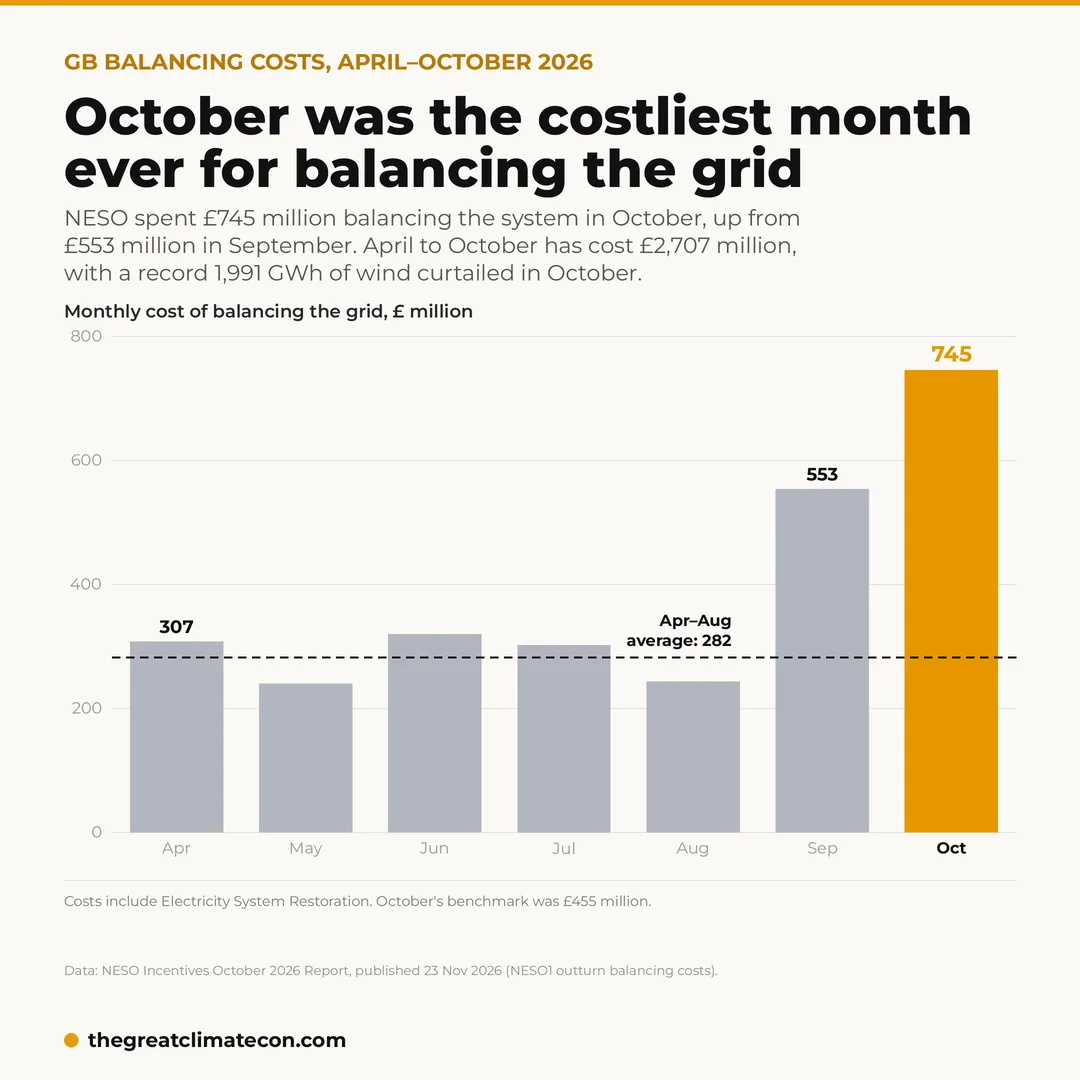
Thursday did not come out of nowhere. NESO says October was the highest-costing month on record for balancing the grid, at £745 million, ahead of the previous record of £553 million set in September. It also recorded a record 1,991 GWh of wind curtailed in October to manage network constraints (NESO Incentives October 2026 Report). NESO’s forecast, set in December 2025, for the whole six months from October to March was £1,489.8 million (NESO Final BSUoS Tariffs 2026/27). October on its own came in at £745 million.

Where the bill lands

Balancing costs are not paid by the wind farms or the gas plants. They are recovered through a charge called BSUoS, the Balancing Services Use of System charge. Since April 2023 it has been collected only from final demand, which means suppliers pay it to NESO (NESO) and then recover it from customers through their electricity prices (Professional Energy Services).

The charge is set in advance as a fixed rate for six months at a time: £13.74 per MWh from April to September and £12.49 per MWh from October to March. That is why your bill does not jump on the day of a record. NESO’s own paper says the daily cost of running the system is no longer directly connected with the money recovered, and that any shortfall “feeds into future fixed tariffs” (NESO). In other words, the bill comes later. Kathryn Porter’s warning was blunt: “This is going to hit consumers really quickly – this will be on bills within the next few months” (GB News).

That is on top of a price cap that already rises on 1 January. Ofgem’s typical bill goes from £1,723 to £2,166 a year, and networks already make up £417 of it. Our breakdown of what is in your bill is here:

https://thegreatclimatecon.com/energy-price-cap-up-26-january-2027/

The warnings keep coming

Thursday brought the third electricity margin notice in three days. These are NESO’s requests for generators to make extra capacity available when the safety cushion of spare power looks too thin. NESO called Thursday’s “routine and precautionary” and said it was not a warning of power cuts, and the lights stayed on (Telegraph).

But the number tells its own story. There have been 11 margin notices in 2026. That is more than the previous five years combined, when the highest annual number was three (Energy Live News, citing Montel). Montel put this week’s notices down primarily to system constraints, not a shortage of generation. Margins on 25 and 26 November were around 7 GW. Kathryn Porter’s reaction was simple: “We shouldn’t be having margin warnings on windy days” (GB News).

What would fix it

NESO says building more transmission is the main way to bring down constraint costs (GB News). That means more pylons and more cables, which are themselves recovered from bills. The Nuclear Industry Association argues for the other approach: “more stable, predictable, baseload power near to major demand centres”, so that Britain avoids paying both for the wires and for the gas (NIA).

We would put it more simply. Electricity is worth most when it can be delivered on demand, close to where people use it. A grid built around weather-dependent generation in the far north has to pay for the power it cannot move and then pay again for the power it can. Reliable power on the doorstep, from our own gas and from nuclear, does not need either bill.

Books, plus the free e-book Rich in Energy, Poor in Policy.

The Advanced Guide To The Climate Con

The Beginners Guide To The Climate Con

Continue Your Learning

Line chart of annual mean atmospheric CO2 at Mauna Loa, 1959 to 2025, rising to 427 ppm

Why We Want More CO₂

Carbon dioxide is plant food. As it has risen, the planet has been getting greener, harvests have grown, and cold still kills far more people than heat. Here is the short version of the evidence.

Read More »

See all articles

Browse every article in the War Room.

Leave a Comment

The Climate Con

Sign up to our newsletter

The latest updates from The Climate Con, straight to your inbox.

No spam, unsubscribe anytime. We use Brevo as our marketing platform; by subscribing you agree your details are sent to Brevo for processing under their terms of use.

For more information go to Thegreatclimatecon.com