



A Record Summer For Heat Deaths — And Cold Still Kills Far More
Sky News has gone out with a familiar headline: heat deaths in England have reached a record high. The figure behind it is real. What the headline leaves out is larger, and much older. In this country, cold still kills far more people than heat.
What the new figure actually is
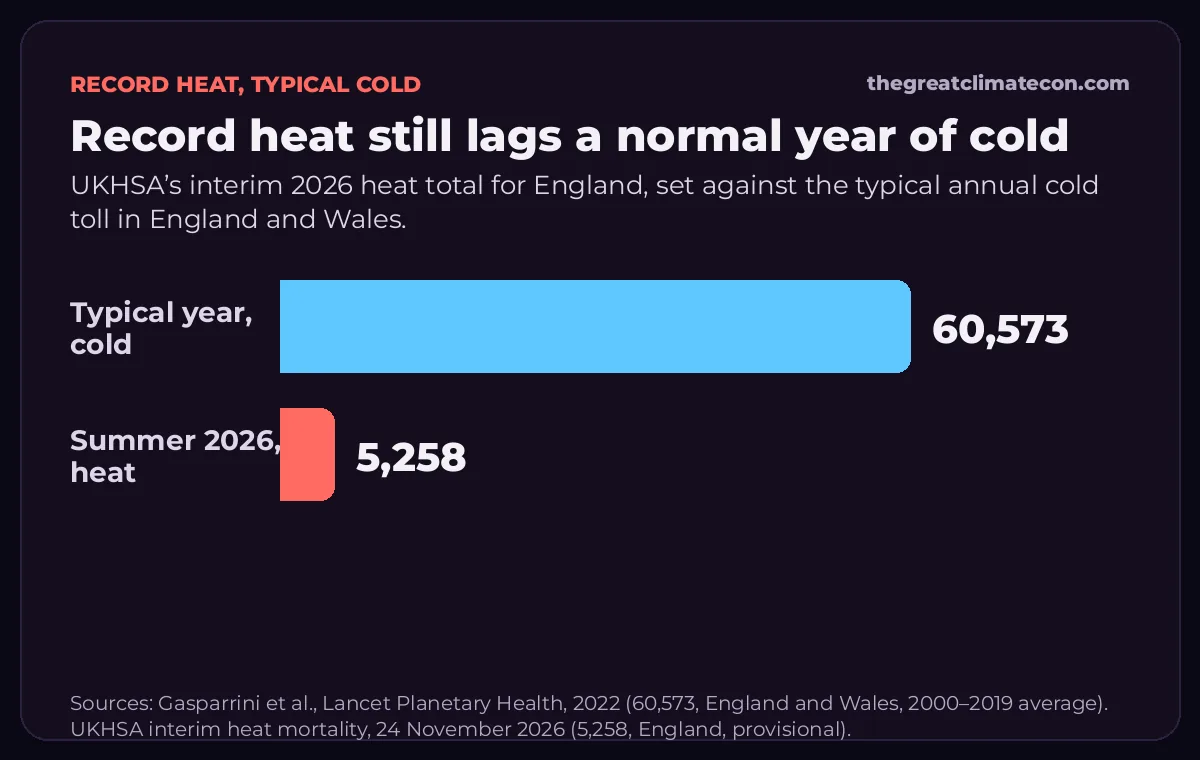
The UK Health Security Agency published an interim assessment on 24 November 2026. It estimates that 5,258 deaths were associated with heat in England across seven heat episodes between May and August, covering 41 days. The June episode alone, from 21 to 28 June, was associated with an estimated 2,401 deaths. UKHSA says this is the highest annual total since it began these reports in 2016. For comparison, it estimated 2,985 heat-associated deaths in summer 2022, 2,295 in 2023, 1,311 in 2024 and 1,504 in 2025.
Those 2026 numbers are not final. UKHSA is clear that they rest on provisional death-registration data, and that the official statistics will follow in early 2027. They also cover England only, and only the defined heat episodes, not every warm day in the year.
None of that makes a hot summer costless. Older people, in particular, are more vulnerable in both heat and cold. The question is whether this record is being reported in any kind of proportion.
We have been here before, with modelled heat-death figures rushed out before the official counts are in. See The BBC Clutch At Straws To Fiddle Heat Death Numbers. Today’s UKHSA number is at least based on observed deaths during heat episodes, not a pre-emptive model. The distortion is in what gets left out.
The figure they are not leading with
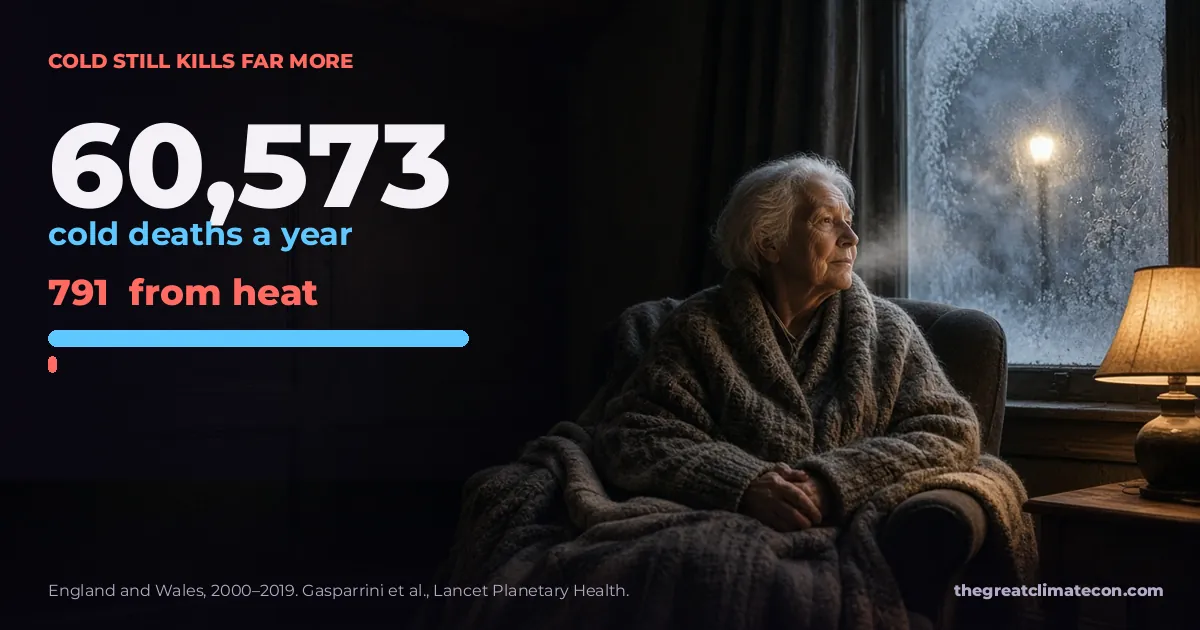
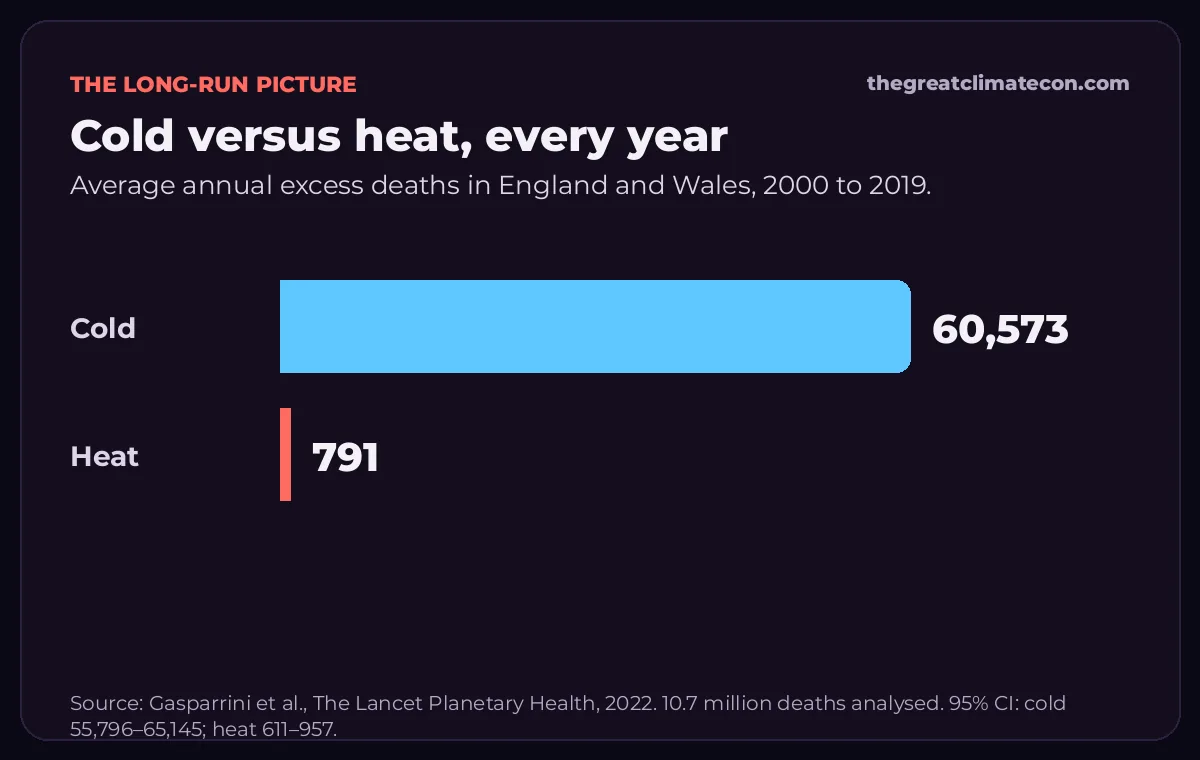
The most detailed assessment of temperature-related deaths in England and Wales was published in The Lancet Planetary Health in 2022, by Antonio Gasparrini and colleagues at the London School of Hygiene & Tropical Medicine, working with UKHSA. They analysed 10.7 million deaths between 2000 and 2019. Each year, on average, they estimated 791 excess deaths attributable to heat (95% confidence interval: 611 to 957) and 60,573 attributable to cold (55,796 to 65,145).
That is more than 75 times as many deaths from cold as from heat, over those two decades. Even if you set that typical annual cold toll against this summer’s record heat figure of 5,258, cold in a normal year still accounts for more than eleven times as many deaths.
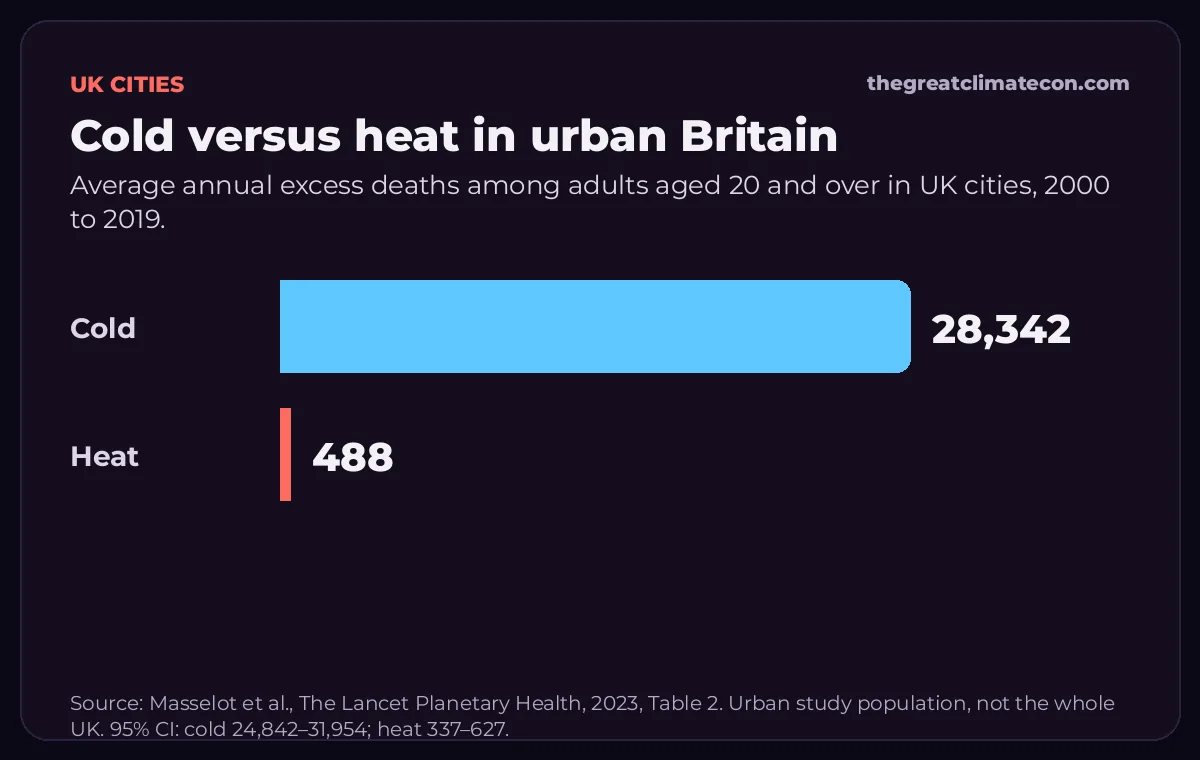
A second Lancet Planetary Health study, by Pierre Masselot, Gasparrini and colleagues in 2023, looked at 854 European cities. Across those cities they estimated 130,228 excess deaths a year from cold and 13,589 from heat. For UK cities, among adults aged 20 and over, the figures were 28,342 deaths a year from cold (24,842 to 31,954) and 488 from heat (337 to 627).
By the numbers
Heat makes the headlines. Cold takes the lives.
- 5,258 — UKHSA's interim estimate of heat-associated deaths in England in summer 2026, the highest in its series. Provisional, and not yet final.
- 791 — Average annual heat-related excess deaths in England and Wales, 2000 to 2019, from Gasparrini and colleagues in The Lancet Planetary Health.
- 60,573 — Average annual cold-related excess deaths in the same study, same period, same countries.
- 25,832 — Excess winter deaths in England in winter 2024 to 2025, using the old ONS method, as calculated for Parliament's POST note.
These are different measures, and they are not interchangeable. What they all show is the same direction: cold is the heavier burden.
Why some official “cold” numbers look smaller
If you have seen UKHSA’s own cold reports, the numbers will look closer than that. For winter 2025 to 2026, UKHSA estimated 2,200 cold-associated deaths in England across five cold episodes. For winter 2024 to 2025, after a correction in October 2026, the figure was 2,788 across three episodes.
UKHSA itself says these figures should not be directly compared with its heat reports, because the methods are different. A “cold episode” is also tightly defined: two or more consecutive days in which a region’s average daily mean temperature falls below 2°C. Most of the winter in England is colder than the temperature at which deaths are at their lowest, but milder than that 2°C threshold. The big academic studies count that broader cold burden. The episode reports do not.
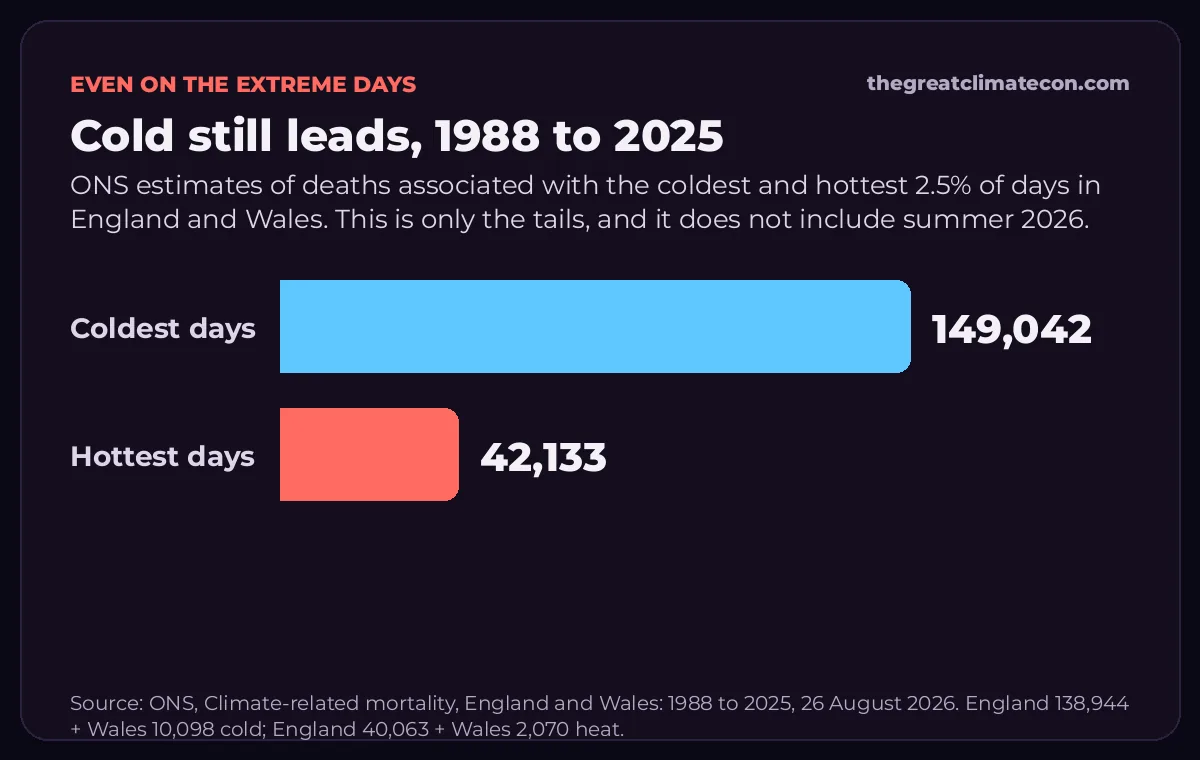
The Office for National Statistics, in official statistics published in August 2026, looked only at the hottest and coldest 2.5% of days between 1988 and 2025, roughly days warmer than 19°C and colder than 0°C. Even on that narrow slice of extreme days, and still excluding the 2026 heatwaves, it estimated 42,133 deaths associated with the hottest days in England and Wales (40,063 in England, 2,070 in Wales) and 149,042 associated with the coldest (138,944 in England, 10,098 in Wales). ONS notes that the gap has been narrowing. It has not closed.
Winter still takes a far heavier toll
ONS used to publish excess winter deaths every year: the extra deaths in December to March compared with the average of the surrounding eight months. That series was stopped after 2022, but the method was applied again for a Parliamentary Office of Science and Technology note in September 2025. In England, excess winter deaths were 35,482 in winter 2022 to 2023, 15,721 in 2023 to 2024, and 25,832 in 2024 to 2025. Between 2000 and 2019, the older ONS series for England and Wales typically ranged from 20,000 to 50,000 a year.
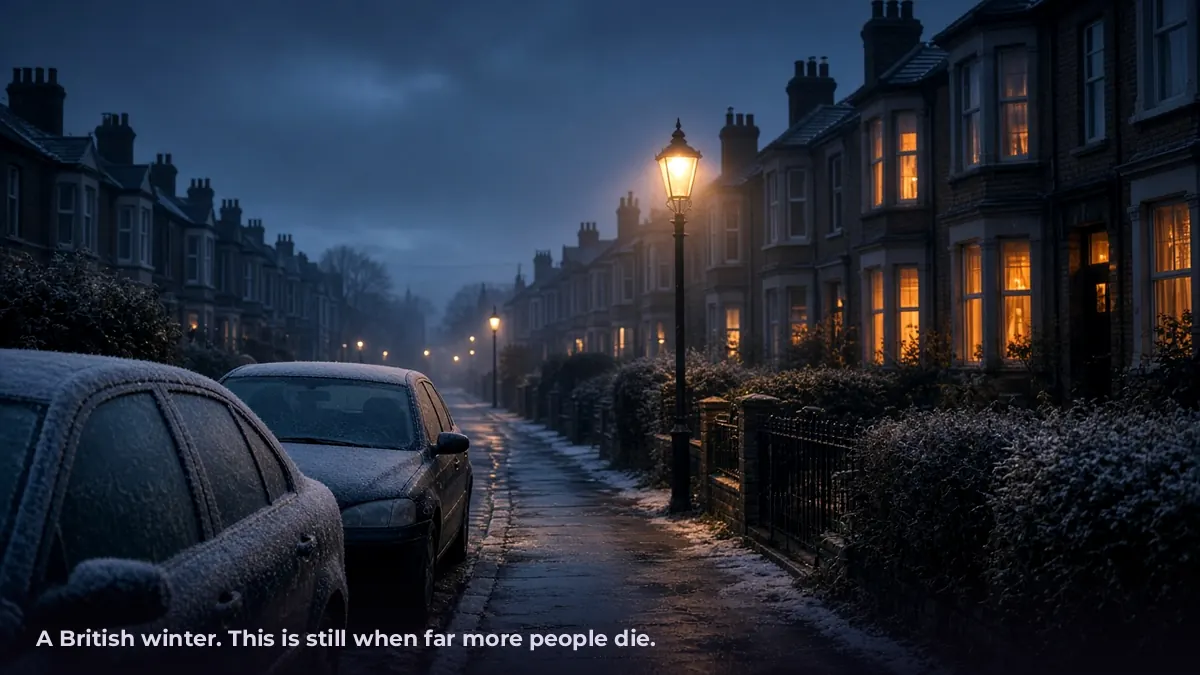
Excess winter deaths are not the same as deaths caused by low temperature. Flu, other winter infections and a more fragile elderly population all play a part. They still tell you something the heat headlines do not: many more people die in a British winter than in the rest of the year. Fuel poverty is one of the risk factors Parliament’s own researchers listed.
There is no official estimate for how many people will die from cold by the end of 2026. Winter 2026 to 2027 has only just begun, and no government source has published a year-end forecast. The honest comparison is with the latest completed winters, and with the long-run studies. Those already show cold in a different league from heat, including in a record heat year.
Billions to bury CO₂, and barriers to a simple air-conditioning unit
If the concern were really the people who died in the heat, the obvious response would be to make it easier to keep homes cool, and easier to keep them warm in winter. That is not where the money or the rules are going.
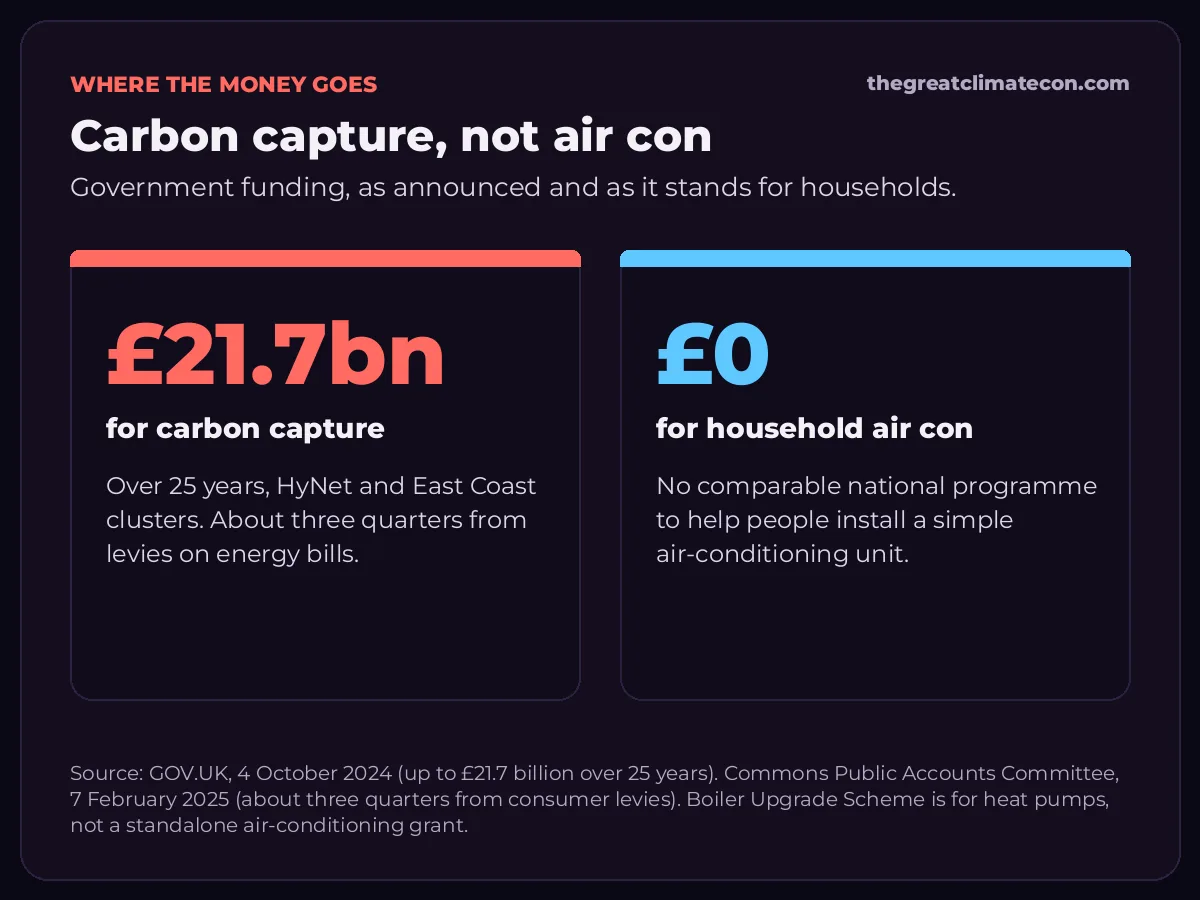
In October 2024, Energy Secretary Ed Miliband confirmed up to £21.7 billion of funding, over 25 years, for the first carbon capture, usage and storage projects in the HyNet and East Coast clusters. The Commons Public Accounts Committee reported in February 2025 that about three quarters of that support is expected to come from levies on energy consumers, and a quarter from the Exchequer. The same committee noted that the department had already said its old ambition, to capture and store 20 to 30 million tonnes of CO₂ a year by 2030, was no longer achievable, and that the first projects are not expected to operate before 2028. That is £21.7 billion, stretched over 25 years, to capture and bury CO₂, the gas plants use as food. There is no comparable national programme to help households install air conditioning.
The rules point the other way. For new homes, Approved Document O of the Building Regulations says overheating should be dealt with “using passive means as far as reasonably practicable”. If mechanical cooling is installed, the builder has to show that every practicable passive measure has already been designed in, and the energy calculations under Part L must reflect the cooling. It is not a ban. It is a clear steer against air conditioning in new housing.
Planning law draws a sharper line. Air source heat pumps can often be installed on a house under permitted development. Since 29 May 2025, that right has come with an explicit condition: the heat pump “is not solely used for the purpose of cooling”. A cooling-only air-conditioning unit does not get the same treatment. The government’s Boiler Upgrade Scheme will pay £7,500 towards an air source heat pump, or £2,500 towards an air-to-air heat pump, but only if you are replacing an oil, gas, electric or LPG heating system. There is no equivalent grant just to put air conditioning in a home.
From 2025, Great Britain has also banned the placing on the market of new small “single split” air-conditioning systems that contain less than 3 kg of refrigerant with a global warming potential above 750. That catches many of the common older refrigerants. It does not outlaw air conditioning, but it does narrow what can be sold.
And once a unit is on the wall, a council can make you take it off. This is not a hidden national programme to strip air conditioning out of every house. It is more ordinary than that, and that is the problem. Fit a cooling-only unit without planning permission, and an enforcement notice can require its removal. The London Borough of Havering has done so: in February 2024 it ordered five external condenser units removed from a house in Nelmes Road, Hornchurch, and in March 2026 it ordered three units removed from a house in Plumpton Avenue. The reasons given were appearance, neighbour amenity and noise. The practical result is the same. The units have to come down.
If ministers were serious about heat deaths, they would make it easier for people to cool their homes, and easier to heat them when winter returns, as it always does. Instead, the Energy Secretary is committing billions to bury CO₂, while a record heat headline is allowed to stand as if the cold had gone away. It has not.
Want the evidence on net zero, bills and energy security in one place? Unlock every lesson, book and course in The Climate Con Learning Centre. Join the membership or support the work.
Books, plus the free e-book Rich in Energy, Poor in Policy.

A Record Summer For Heat Deaths — And Cold Still Kills Far More
Sky News says heat deaths in England have hit a record high. A Lancet study found 60,573 cold deaths in a typical year in England and Wales, against 791 from heat.

92,000 Registered, No Deal: Al Gore Is Outraged At COP31, 17 Years After He Gave The Arctic Ice 5 To 7 Years
COP31 in Antalya ended with no deal after two weeks of talks and two days of overtime, and Al Gore calls it an outrage. At Copenhagen in 2009 he gave the Arctic ice cap a 75% chance of being ice free in summer within five to seven years. The ice is still there, China keeps building coal, and Britain keeps paying.

Made In Brussels: Burnham Signs Britain Up To EU Carbon Tax Rules ‘At The Same Time, On An Ongoing Basis’
At the 20 November 2026 summit, Andy Burnham agreed to link Britain’s carbon market to the EU’s, with the UK applying EU rules “at the same time, on an ongoing basis”. The carbon tax spreads to shipping and, on the EU’s timetable, waste incineration. Brussels’ rules, Brussels’ price, Britain’s bill.

Climate Con Common Sense
Available in hardcopy

The Beginners Guide
Available in hardcopy