
36-Year High: They Said The Great Barrier Reef Was Dying. Then It Recorded The Most Coral Since Monitoring Began
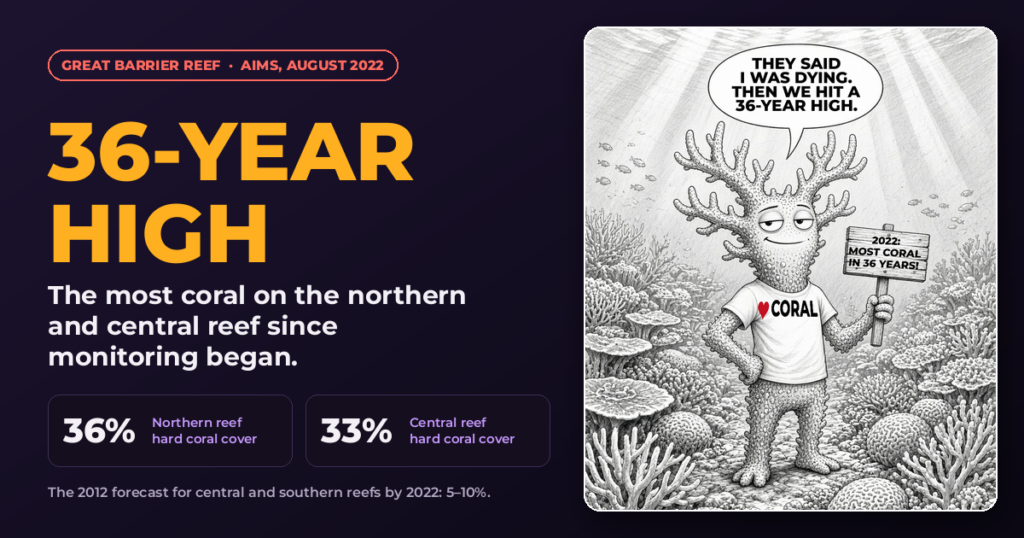
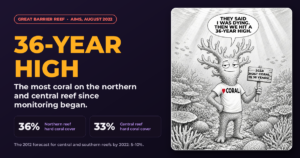
In 2022, Australia’s official reef monitors recorded the most coral on the northern and central Great Barrier Reef in 36 years of surveys. Ten years earlier, the forecast was 5–10%.
By Travis Cook, The Great Climate Con. Built on the Australian Institute of Marine Science’s Long-Term Monitoring Program reports.
For years we were told the Great Barrier Reef was dying. A magazine printed its obituary in 2016. Scientists forecast that coral on much of it would fall to just 5–10% by 2022. Plenty of people were made to feel they would never get to see it.
None of it came true.
In August 2022 the Australian Institute of Marine Science, the government body that has monitored the reef since 1985, reported the highest coral cover on the northern and central reef in 36 years of monitoring.
That is good news. Measured, official, wonderful good news. The reef is still there, the world is not ending, and we are lucky to live at a time when anyone can go and see it for themselves.
Here’s what they told you, and what the reef actually did.
The record
The most coral in 36 years of monitoring
AIMS published its Annual Summary Report of Coral Reef Condition 2021/22 on 4 August 2022. Its scientists surveyed 87 reefs by manta tow between August 2021 and May 2022.
The result, in AIMS’s own words: on the Central and Northern reef, region-wide hard coral cover reached “33% and 36%, respectively; the highest level recorded in the past 36 years of monitoring.”
In just one year the northern reef went from 27% to 36%, and the central reef from 26% to 33%.
- 36% hard coral cover on the northern reef, up from 27% in 2021
- 33% on the central reef, up from 26%
- 34% on the southern reef, down from 38% because of crown-of-thorns starfish
For scale, AIMS defines 30–50% hard coral cover as a “high value”. All three regions of the reef were in that band in 2022.
The forecast
In 2012 they said it would halve again by 2022
In October 2012 an AIMS study in the journal PNAS reported that coral cover had fallen from 28.0% to 13.8% since 1985. AIMS’s own press release said: “If the trend continued coral cover could halve again by 2022.”
The paper went further: “coral cover in the central and southern regions of the GBR is likely to decline to 5–10% by 2022.” For the central reef alone, its estimate for 2022 was 10.7%.
The Guardian ran it as “Great Barrier Reef loses more than half its coral cover”.
- Forecast for 2022: 5–10% on the central and southern reef
- Measured in 2022: 33% central, 34% southern
- Central reef: about three times the paper's own 10.7% estimate
Same institute, same monitoring programme, ten years apart. The forecast said a sliver. The reef said otherwise.
The obituary
“Climate change and ocean acidification have killed off” the reef
In October 2016 Outside magazine published “Obituary: Great Barrier Reef”. Its standfirst read: “Climate change and ocean acidification have killed off one of the most spectacular features on the planet.”
It said the 2016 bleaching was the event “from which it would never recover.”
The official reports were gloomy too. In 2017 the northern reef hit about 10% coral cover, and AIMS wrote that “It is uncertain how long it will take for these Northern reefs to recover”. Its 2018/19 report concluded that the outlook “will inevitably lead to less living coral on reefs of the GBR.”
- 2016: the reef's obituary is published
- 2017: northern reef at 11%, the lowest AIMS had recorded
- 2022: northern reef at 36%, the highest in 36 years
The reef that was supposed to never recover beat its 1988 record within six years of its own obituary.
The comeback
Fast-growing corals brought it back in five years, not 10 to 20
AIMS put the 2022 record down to “increases in the fast-growing Acropora corals, which are the dominant group of corals on the GBR”.
In 2012 AIMS said reefs can regain their coral after a disturbance but that “recovery takes 10-20 years”. The northern reef went from its lowest ever to a 36-year high in five.
Its 2024/25 report says the same Acropora corals “facilitated the rapid recovery observed across many reefs between 2017 and 2024”.
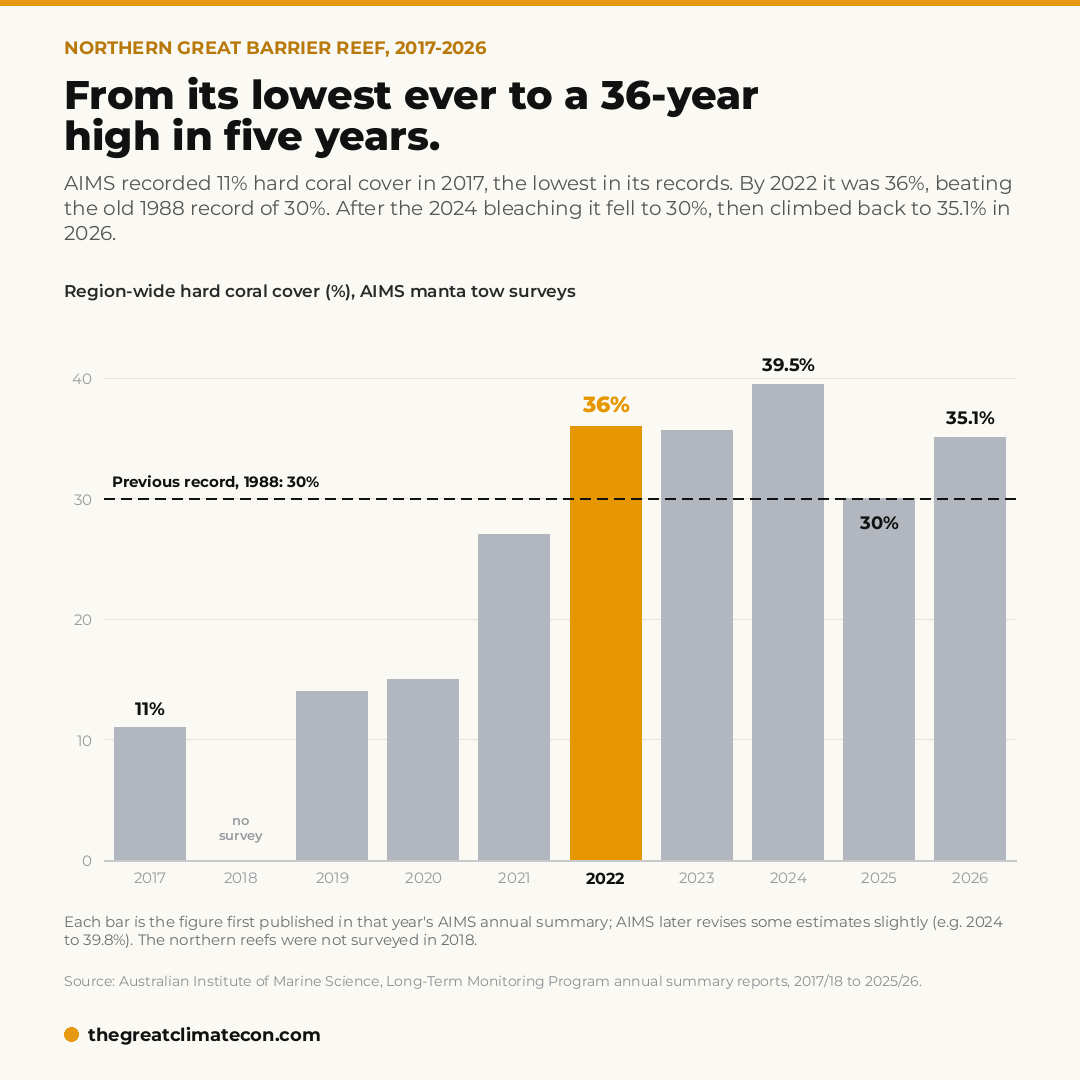
- 11% to 36%: northern reef, 2017 to 2022
- 12% to 33%: central reef, 2019 to 2022
- Old record: 30% on the northern reef in 1988, now beaten
Since then
Another record year, one big dip, and the climb back
2023 was a “pause in recent coral recovery”: northern 35.7%, central 30.8%, southern 33.8%, all close to 2022.
In 2024 the northern reef reached 39.5% and the central reef 34.0%, both “a regional high”. Most of those surveys were done before the March 2024 bleaching and two cyclones.
Those hit hard. In 2025 AIMS recorded the largest one-year falls on record on the northern reef (39.8% to 30.0%) and the southern reef (38.9% to 26.9%). The central reef fell from 33.2% to 28.6%. Even so, the northern and central reefs stayed above their long-term averages of 26.6% and 19.8%.
Then the reef did what it always does. AIMS’s latest report, published on 11 August 2026, is titled “Monsoon relief supports initial recovery from recent bleaching”. The northern reef is back up to 35.1% and the central reef to 31.6%. The southern reef was steady at 26.4%.
- 2026 northern: 35.1%, above its long-term average of 27.0%
- 2026 central: 31.6%, above its long-term average of 20.0%
- Only 3 of 121 reefs surveyed in 2026 had less than 10% coral cover
AIMS says the 2026 results show “the capacity of many reefs to withstand and recover from disturbance”, and that the reef’s coral cover “continues to be higher than on many coral reefs globally.”
The objection
“But the reef had a record fall in 2025”
It did, and we’ve shown you the numbers. A reef that loses coral to heat, cyclones and starfish and then grows it back is not a dying reef. That is the reef AIMS has described for decades: “hard coral cover on reefs of the GBR has decreased and increased in response to cycles of disturbance and recovery.”
Within ten years the northern reef has come back from its lowest level ever recorded and from its biggest one-year fall. Even that worst year left it with more coral than its long-term average, and nearly three times its 2017 low.
The obituary said it would never recover. The forecast said 5–10%. Every one of those predictions has had its date come and go, and the coral is still there.
The bottom line
The bottom line
- 2022: the most coral on the northern and central reef in 36 years of monitoring, and 2024 went higher still
- 2012 forecast: 5–10% on the central and southern reef by 2022; AIMS measured 33% and 34%
- 2016 obituary: a reef that “would never recover”; by 2022 the northern reef had beaten its 1988 record
- 2026: northern 35.1% and central 31.6%, both above their long-term averages
- The truth: the reef is alive, it bounces back, and the scare stories were wrong
For more on how well the reef is doing, read Good News: The Great Barrier Reef Is Doing Great.
Figures are AIMS region-wide averages of hard coral cover from manta tow surveys, as published in each annual summary. AIMS sometimes revises earlier years slightly in later reports.
Sources
Sources
- AIMS, Annual Summary Report of Coral Reef Condition 2021/22 (4 Aug 2022)
- AIMS news, “Highest coral cover in central, northern Reef in 36 years” (4 Aug 2022)
- AIMS, Annual Summary Report of Coral Reef Condition 2022/23 (9 Aug 2023)
- AIMS, Annual Summary Report of Coral Reef Condition 2023/24 (7 Aug 2024)
- AIMS, Annual Summary Report of Coral Reef Condition 2024/25 (6 Aug 2025)
- AIMS, Annual Summary Report of Coral Reef Condition 2025/26 (11 Aug 2026)
- AIMS, Annual Summary Report on coral reef condition 2017/18
- AIMS, Annual Summary Report on coral reef condition 2018/19
- AIMS press release, “The Great Barrier Reef has lost half of its coral in the last 27 years” (2 Oct 2012)
- De'ath, Fabricius, Sweatman and Puotinen, “The 27-year decline of coral cover on the Great Barrier Reef and its causes”, PNAS (2012)
- The Guardian, “Great Barrier Reef loses more than half its coral cover” (1 Oct 2012)
- Outside, “Obituary: Great Barrier Reef” (11 Oct 2016)
Want the reef argument, and the rest of the evidence, in one place? Unlock every lesson, book and course in The Climate Con Learning Centre. Join the membership or support the work.
Books, plus the free e-book Rich in Energy, Poor in Policy.
The Advanced Guide To The Climate Con

The Beginners Guide To The Climate Con
Continue Your Learning
36-Year High: They Said The Great Barrier Reef Was Dying. Then It Recorded The Most Coral Since Monitoring Began
In 2022 Australia’s official reef monitors recorded the most coral on the northern and central Great Barrier Reef in 36 years. Ten years earlier, the forecast was 5–10%.
75 Labour MPs Reportedly Want 300 Million Barrels Of British Oil Left In The Ground. So We Just Import It Instead?
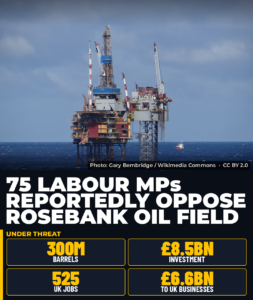
A reported 75 Labour MPs have signed a letter against Rosebank, around 300 million barrels of oil west of Shetland. Stop it and Britain loses £8.5bn of investment and 525 UK jobs, and still buys the oil, just from abroad.
Wind Farm Map UK
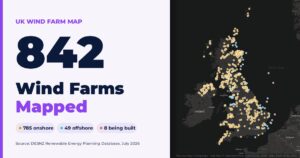
Every operational UK wind farm on one map: 834 sites and 31,519 MW (31.5 GW) from the government’s DESNZ Renewable Energy Planning Database, July 2026 extract.
Continue your learning at Thegreatclimatecon.com